A clear look at what random outcomes mean, how venue claims should be checked, and where the search for a pokie meets legal limits.
A pokie offers a particular kind of uncertainty: every spin is decided afresh, rather than carrying the memory of what happened before. A Random Number Generator (RNG) determines the outcome, and one spin does not make the next more or less likely to produce a win. A run of losses is not a debt the machine must repay. A recent win does not make another one overdue.
That independence is easy to forget in front of a screen. Repetition encourages the mind to invent a plot: the machine is warming up, the bonus is close, the previous player must have left just before a payout. These are familiar readings of random sequences, not evidence about the next result. The machine has no sense of fairness in the human meaning of the word. It does not notice patience, persistence or the size of the loss already accumulated.
A return percentage can still describe something useful, but it cannot settle what an individual session will bring. It is a theoretical measure of how much a game is designed to return across play over time, not a forecast for a single person or a particular visit. A percentage displayed or reported for a pokie should therefore not be read as a promise that a corresponding share of any one player’s spending will come back. Short stretches of play can look very different from the long-run model.
Choosing an online pokies option for South Australia in 2026 calls for a careful look at the information available about each operator. This list gives you a concise starting point for reviewing their stated licensing or payment details.
Roby Casino
Roby Casino is listed with a Curaçao eGaming licence held by Roby Games Ltd. That licensing detail is the key available point to consider.
DragonSlots Casino
DragonSlots Casino is listed with a Curaçao Gaming Authority licence held by Jumpman Gaming Ltd. The supplied information focuses on its licensing.
Thor Casino
Thor Casino is listed with a Curaçao licence from Antillephone N.V., with Versus Odds B.V. named as the operator. Its stated minimum deposit is EUR 20.
7Bit Casino
7Bit Casino is listed as operating under a Curaçao licence, with Dama N.V. named as the operator. The available details are limited to its licensing.
Golden Pokies
Golden Pokies is listed with a Curaçao licence. No further operator details are provided here.
Rollero Casino
Rollero Casino is listed with a Curaçao Gaming Control Board licence, OGL/2023/176/0095, held by Hollycorn N.V. Its licence details are the main supplied point of reference.
MrPacho
MrPacho lists crypto payouts at 30–120 minutes and fiat payouts at 24–72 hours. Its minimum deposit is A$30.
Kingmaker
Kingmaker lists crypto payouts at approximately 90 minutes and fiat payouts at 1–5 days. Its minimum deposit is A$30.
JustCasino
JustCasino is listed with a Curaçao Gaming Control Board licence. No other operator details are provided here.
WinSpirit Casino
WinSpirit Casino is listed with a Curaçao eGaming licence, OGL/2024/923/0383, from Antillephone N.V. Its minimum deposit is A$30.
There is another complication behind comparisons. A specialist review reports that some providers allow casinos to choose between more than one return setting for the same pokie. If a provider offers that choice, the version of a game installed at one venue may have a different return percentage from a version elsewhere. The familiar title and artwork would not, by themselves, establish that the underlying setting is identical.
That point matters to anyone looking for the best-paying pokies in South Australia. A game’s name alone cannot support a reliable ranking, and a state-wide label does not establish that every venue has the same version or configuration. Nor does a machine’s popularity reveal its return setting. Without clear information about the version in use, comparisons based on titles, themes or anecdotes are thin evidence dressed up as certainty.
Even where a return figure is available, it describes a model, not a near-term outcome. It cannot tell whether the next spin will pay, whether a bonus feature will appear during a session, or whether a player will leave ahead. The distinction is not a technical footnote. It is the difference between a statistical description and a personal promise, and machines make only the former.
The word “best” adds a human preference to a mathematical question. One player may favour a particular theme or pace; another may care about a game’s features. Those preferences can identify a favourite, but they do not prove that it pays more. A South Australian casino search, whether centred on the CBD or elsewhere, cannot turn preference into evidence about a machine’s settings. The same applies to claims built from a memorable win: an outcome is real, but it does not show that the next player faces better odds.
This is why a list of supposedly superior pokies can be more confident than its evidence. A title may be widely recognised, visually elaborate or associated with a striking story, yet none of those qualities establishes a higher return at a particular venue. If different settings are available to casinos, even a correct figure for one installation may not describe another. The details have to match the actual game configuration, not merely its name.
Randomness also resists the rituals people attach to it. Changing the stake, waiting between spins or choosing a machine that has been quiet does not alter the independence of the next outcome. Such habits may make play feel more orderly, but order in the ritual is not control over the generator. The difference can be emotionally inconvenient. It remains the difference.
For South Australia, then, the defensible answer is narrower than a league table. A pokie can be described by its mechanics and, where the relevant setting is known, by a theoretical return figure. It cannot promise a winning session, compensate for earlier losses, or certify that a similarly named game elsewhere operates with the same return setting. Random means random.
Attention: A return percentage is a theoretical long-run measure and not a promise of a payout for any single person or particular session.
A request for somewhere to play pokies now sounds like a simple question about the clock. In practice, it is a question about a particular venue: whether it is open at this moment, whether its gaming area is operating, and whether those arrangements apply on the day in question. South Australia does not have a single opening time that can answer all three.
That distinction matters most when the search is urgent. A venue’s ordinary hours may not settle whether its gaming facilities are available at the same time, and a general listing may not reflect a temporary change. Public holidays, maintenance, private functions or other local arrangements can alter what a visitor finds. The sensible unit of information is therefore the individual venue’s current notice, not a statewide rule inferred from a few familiar doors.
“Open” is an elastic word. A building may be open for meals or another service while its gaming area follows different hours; a listing may describe usual trading rather than what is happening today. Neither detail should be assumed without checking the venue’s own current information. Where that is unclear, direct confirmation is more useful than treating an old directory entry as a live report.
This is why searches for early openings in South Australia can produce a misleading sense of certainty. A request for pokies before the day has properly begun is not answered by the name of a suburb or by another venue’s schedule. Nor does an early opening elsewhere establish that a particular local gaming area will be operating. The same applies to late-night plans: the word “late” has no fixed statewide meaning unless attached to a specific venue and a specific day.
Opening hours also say nothing about a pokie’s payout percentage. The time a venue opens cannot establish a machine’s return setting, and an advertised schedule is not a measure of game performance. These are separate questions, even when they appear together in a single search. One concerns access to a place; the other concerns the rules and settings of a game. The clock is no statistic.
There is a social habit behind the demand for a statewide answer. A state is a convenient shape on a map, and search boxes encourage the impression that every practical question has an answer at that scale. But opening arrangements belong to businesses and their operating decisions. The state boundary does not turn separate schedules into one common timetable. That would be tidy. It would also be fiction.
A useful check is consequently narrow and time-specific: identify the venue, look for its own current hours, and distinguish the venue’s general trading information from any details about gaming. If information appears in a directory or an old listing, it may still help identify a place, but it should not be mistaken for confirmation that the doors or machines are operating now. A call or a current notice from the venue can resolve the distinction more directly.
There is no reliable shortcut from “South Australian pokies” to “open now.” A statewide phrase can describe the place being searched, but it cannot confirm a venue’s present status. Any answer that supplies a universal opening time would flatten local arrangements into a rule that may not exist. For someone planning a visit, the useful answer is less grand and more exact: the hours of the particular venue on the particular day.
That small change of scale is not bureaucratic fuss. It is the difference between a state-level label and information that can guide an actual trip. “Open in South Australia” may sound comprehensive; “open at this venue now” is the question that needs answering. The first belongs to geography. The second belongs to the door.
A request for pokies near an airport or in a central business district is first a question about geography. It is not evidence that a gaming venue is inside an airport, beside a terminal or within walking distance of a particular city centre. Those distinctions can disappear in a short search phrase, where a place name and a destination are pressed together without explaining what “near” means.
The word is elastic. For someone arriving by plane, it might mean a short trip from the terminal; for someone staying in the city, it might mean a venue reachable on foot. A map can make either distance look simple, but a pin alone says little about entrances, transport, access or whether a venue is actually open to the public. Proximity is not a property that can be inferred from a label.
South Australia adds another layer. Searches may combine the state with an airport, a central district, a northern area or a town name. Others may attach a neighbouring state to the same phrase. That mixture reflects the way people organise travel and memory: a state can be the broad destination, while a city, airport or familiar place is the point they actually have in mind. It does not establish that all the terms refer to one locality.
This is particularly true of searches that bring South Australia together with Victoria. The border is not a footnote to a journey; it separates different places and jurisdictions. A result that repeats both names may be responding to the wording rather than identifying a venue in the intended area. The same caution applies when a town name is appended to a state-level request. A shared search phrase is not a map.
The airport version is easy to misread. Airports are prominent landmarks, and they often serve as shorthand for a wider district, a meeting point or the first leg of a trip. But “near the airport” does not mean “at the airport”, and neither phrase establishes that pokies are available in the terminal or its surrounding precinct. A venue’s presence, address and relationship to an airport would need to be established separately, not supplied by the grammar of a search.
The CBD version works similarly. “Central” may refer to a city centre, a business district or simply the part of town someone regards as convenient. In South Australia, a state-wide phrase paired with “CBD” leaves an important place unstated. It cannot, on its own, identify which centre is meant or how far away a particular venue would be. The attraction of the phrase is its apparent precision. Its actual geography remains unfinished.
There is a small social history in this habit. People navigate through landmarks before they navigate through administrative boundaries: the airport, the centre, the north side, the place where a meeting or appointment is due. Search language compresses those practical routes into a few words. It is efficient, but compression can make an assumption look like a fact.
For a reliable location decision, a venue needs an identifiable address and a clear relationship to the intended destination. Without those, “near me” is only a request for local context, not a finding about what is nearby. The distinction matters more than the convenience of a confident-looking pin. Geography should not be invented to satisfy a phrase.
The phrase “online pokies in South Australia” can sound like a request for a local version of a familiar venue. Legally, however, the distinction is not between Adelaide and elsewhere in the state. It is between physical gaming and a real-money online service offered to someone in Australia.
The Interactive Gambling Act 2001 makes it illegal for companies to provide real-money online pokies to people in Australia without a domestic licence. No such licences have been issued, and there is no Australian-licensed online casino. The law is directed at operators, rather than making an individual player liable simply for playing on an offshore site. That distinction matters, but it does not turn an offshore service into a locally regulated one.
A website may present itself as available to South Australians, with offers framed around deposits, free spins or high stakes. Those claims do not establish that the operator has an Australian licence; none exists for online casinos. Nor does a South Australian label create a local venue or a local authority able to resolve a dispute. The language of a promotion can be more welcoming than the legal arrangement behind it.
If an offshore casino refuses to pay winnings, Australian players have no legal recourse in Australia to compel payment. A balance displayed on a screen is not the same thing as an enforceable local claim. That is the practical gap: the operator can invite participation from a distance, while the usual domestic protections and remedies for an Australian online casino are absent.
There is another complication. The Australian Communications and Media Authority (ACMA) enforces the Interactive Gambling Act and blocks access to illegal offshore gambling sites. Internet service providers must comply with its blocklist. A site appearing in a search or opening at a particular moment is therefore not evidence of lawful approval, stable access or dependable service. The route can be interrupted; the underlying legal position does not change with it.
Offers described as “no deposit” do not alter that position either. Whether a promotion asks for a payment, promises free play or sets a maximum stake, its wording cannot supply the domestic licence that the market does not have. A high limit is not a sign of stronger oversight. It is simply a condition presented by an offshore operator, with the same basic question left unanswered: what remedy exists in Australia if the operator does not honour its terms?
BetStop has limits in this context. It applies to Australian-licensed operators and does not bind offshore sites. Since there are no Australian-licensed online casinos, it should not be mistaken for a safeguard that controls offshore casino accounts.
This is a gap between an online offer and Australian accountability, not a South Australian exception. ACMA’s blocking role and the absence of local legal recourse are part of the same picture: access may be attempted, but an offshore casino does not become an Australian service by accepting Australian customers. The invitation is not the protection.
Legal Risk
Real-money online casinos without a domestic licence are illegal in Australia, and players have no local legal recourse if offshore operators refuse to pay winnings.
A venue’s character is not measured only by the machines on its floor. It is also shaped by the people expected to notice when gambling stops looking like recreation and begins to look like harm. That distinction matters when comparing places to play: a “best” venue is not a meaningful label if it says nothing about how a venue responds to risk.
A report published by regionriverina.com.au describes a requirement taking effect from 1 July: venues with more than 20 gaming machines must have a dedicated responsible gambling officer (RGO) on duty while those machines are operating. The requirement links staffing to the operation of the gaming floor, rather than treating oversight as a matter for occasional attention. The threshold is specific; it does not describe every venue.
The report also says venues will be required to keep a gambling incident register. It is intended to record occurrences, including situations in which a patron’s behaviour suggests they may be at risk of gambling harm or already affected by it. In this arrangement, an incident is not merely a disruption to be managed and forgotten. Recording it gives the venue a formal way to note what happened.
Paperwork is not care. But without a record, patterns can disappear into the ordinary noise of a busy room: one concern raised, one difficult evening, one moment no one quite claims to have seen. An officer on duty and a register cannot guarantee that harm will be recognised or resolved. They do make responsibility more visible, and less easily left to chance.
That is a more useful measure of a venue than a loose claim to be the best in South Australia. A list of machines, décor or popularity would not tell much about the practical safeguards operating around them. Nor does the presence of a named role prove that every interaction will be handled well. The point is narrower: when gaming machines are running, oversight has a human component, and the record of concerning incidents has an institutional one.
For people weighing up South Australian venues, the distinction is between atmosphere and accountability. The first is often described in glowing language; the second depends on roles and procedures that are less visible from the entrance. A responsible gambling officer is not a decoration for a gaming floor. The incident register is not a cure. Both are ways of making the venue answerable for what happens within it.
A venue’s safeguards deserve attention alongside its entertainment offer, not after it. That does not turn any location into a guarantee of safety, or make one venue objectively superior. It does shift the question from which room looks most inviting to whether responsibility has somewhere to sit—and whether concerns can leave a trace. A modest standard. A necessary one.
A request for pokies that operate around the clock is narrower than a search for a gaming venue in South Australia. It asks whether play is available at any hour, not simply whether a venue exists or has machines. Those are separate questions, and a broad state-level phrase cannot settle the hours of a particular place.
“Open now” adds another complication. It describes a moment, not a standing schedule: a venue’s doors may be open while its gaming area is not operating, or its hours may differ on a particular day. Without current, venue-specific information, a general statement that South Australian pokies are open all night would turn an unverified possibility into a promise.
That distinction matters because opening times are not properties of a game. A pokie does not set the timetable; the venue does. Any round-the-clock claim belongs to the establishment and to the conditions applying there, rather than to South Australia as a whole. “Twenty-four-hour pokies” can sound like a category. It is only a claim about hours, and it needs a place and a date attached to it.
The state’s regulation of gambling also makes venue oversight more than a matter of convenience. A report by regionriverina.com.au describes a requirement for venues with more than 20 gaming machines to have a dedicated responsible gambling officer on duty while those machines are operating. The report also notes a one-month grace period for venues to remove signage and introduce the officers. These measures concern the operation of gaming machines, not a guarantee that any venue runs them through the night.
The same report says venues will be required to keep a gambling incident register, recording occurrences that may indicate a patron is at risk of, or affected by, gambling harm. Such safeguards make the distinction between a building being open and its machines operating especially important: the relevant oversight is tied to the machines’ operation. A sign on a door, a listing with broad hours or an old mention of late-night access cannot establish what is happening now.
For South Australia, the careful answer is therefore not a statewide schedule. It is that hours must be confirmed for the specific venue and the specific time; a claim of continuous access should not be inferred from general information about pokies or gaming venues. If no current confirmation is available, the honest status is unknown—not open all night by default.
A narrow claim, properly checked.
A Crown-branded casino and South Australian pokies are not automatically part of the same story. A name entered beside a state can signal a wish to find a venue, identify a particular room, or compare machines. It does not, by itself, establish that the named brand has a venue in South Australia, or that any particular pokies are available there.
That distinction matters because search results can make proximity look like proof. A page may combine a brand name with a state, or repeat familiar wording without establishing where a venue is or what it offers. The careful reading separates the pieces: a South Australian location is one claim; a Crown connection is another; the presence of particular machines is a third. Each needs its own support.
The phrase “best pokies room” adds another layer. “Best” might mean a room’s atmosphere, the range of machines, practical access or some other preference. Without a clearly defined measure, it is not a comparison so much as a verdict in search of a standard. And even a well-defined comparison would need reliable details about the rooms being compared. A confident label cannot supply those details.
The same restraint applies to questions about maximum cash payouts. A maximum cannot responsibly be stated as a general South Australian figure merely because the question mentions pokies or Crown. Any answer would need to relate to the actual machine and the applicable venue terms; a state-and-brand phrase does not identify either. A number offered without that context would sound precise while answering a different question.
There is a social habit behind these combinations of words. Casino names become landmarks in the imagination, even for people who are not asking for a map. The name can stand for a kind of room, a style of gaming or an expectation built from publicity and repetition. But a familiar association is not evidence of local availability. Branding travels more easily than facts.
So the Crown-and-South-Australia question has to be kept narrow. The wording alone does not support a description of a South Australian Crown venue, a catalogue of its pokies, or a ranking of its gaming room. Nor does it settle what a particular machine might pay. Those are separate, concrete claims, not implications tucked inside a brand name.
A useful answer begins by identifying what is actually being compared: a place, a room, or the rules attached to a specific machine. Without that distinction, “best” and “maximum” do more theatrical work than informative work. The name may be memorable. The evidence still has to be local.
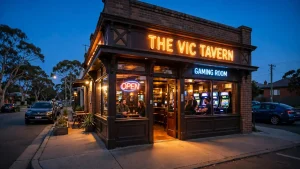
A club in a central business district can look, from the street, like an ordinary part of the city’s social machinery: a place for meals, events and familiar routines. The presence of pokies adds another layer. The useful question is not whether a particular club can be called the best, but what protections shape the environment in which its machines operate. No venue ranking follows from the word “CBD”.
Safeguards are visible in small details. Signage directing patrons towards gaming areas should not sit within sight of ATMs or EFTPOS terminals; signs pointing towards ATMs should not be visible from gaming machines. These separations matter because a venue’s design can either interrupt or smooth the path between gambling and access to more money. A sign is not merely decoration when it helps organise that path.
There is also a staffing question. A report published by regionriverina.com.au described a one-month grace period for venues to remove signage and introduce responsible gambling officers. That report should be read as an account of a particular regulatory change, not as proof that every South Australian club follows the same timetable or that a CBD venue is covered by identical arrangements. The distinction is less dramatic than a list of “best” clubs, but more useful.
For someone considering self-exclusion, the setting matters as much as the name on the door. A boundary is meaningful only if it applies where gambling takes place; a prominent reminder or a staff role cannot substitute for knowing which rules govern a venue and how exclusion is handled there. Nor does the word “club” itself tell anything reliable about the protections in force.
The same caution applies to searches for pokies in Adelaide’s CBD. A central address, a club’s social reputation or the presence of safeguards does not establish that its machines are fairer, nor that one venue is safer than another. Those are different claims, requiring different evidence.
Venue rules are often most legible at their edges: where a sign points, who is present while machines operate, and whether a patron’s distress can be noticed rather than ignored. That is not a ranking. It is the standard a ranking tends to obscure.
A cashless-payment search can mean several different things: a venue’s way of handling transactions, a machine interface, or an online deposit method. Those are not interchangeable. PayID, for instance, is a way to transfer money through Australia’s New Payments Platform using an email address, mobile number or ABN. It is an online payment mechanism, not evidence about how a physical pokie accepts funds.
Nor does a payment option establish that a machine is fair, that its return settings are disclosed, or that a venue has stronger safeguards. Payment technology describes the movement of money. It says little about what happens after the money reaches a game. A polished interface is not a certificate.
The distinction matters because searches for cashless pokies in South Australia can blend questions about venue practices with questions about online deposits. PayID’s connection to a bank account for online real-money play does not show that a South Australian venue uses PayID at its machines. It also cannot verify a machine’s location or its operating arrangements. Those claims need evidence specific to the venue, not an inference drawn from a payment brand.
A phrase combining Newcastle and South Australia carries a similar geographic ambiguity. It may reflect interest in either place, or confusion between them; it cannot identify a particular club or establish that a venue lies in South Australia. A payment method cannot resolve that uncertainty.
There is a wider social point. Cashless systems can make transactions less visible as transactions: a tap or transfer feels unlike handing over notes, though the financial consequence remains. That does not prove that cashless play is safer or more dangerous. It does make clear why convenience should not be mistaken for protection.
The useful distinction is modest: PayID concerns transfers, while a venue’s machine arrangements concern the venue. One does not certify the other.
A search for the best pokies in South Australia can suggest that the useful answer is a winning title or a favoured venue. Neither turns gambling into a dependable plan. What can be considered more practically is the boundary around play: how much money and time are set aside, and what happens when that boundary is reached.
Deposit limits can restrict the amount put into play. Loss limits set a ceiling on losses, while session time limits mark when a period of play ends. These tools do not change a game’s outcome or make a losing run less possible. Their purpose is narrower: to make decisions made in advance harder to quietly renegotiate in the moment.
That distinction matters. A limit is not a prediction, and a session timer is not a signal that a machine is due to pay. Safeguards work best as rules for stopping, not as instruments for managing luck. The machinery of gambling has long offered the feeling of control; a limit is useful partly because it refuses that invitation.
Self-exclusion is a stronger boundary, intended for someone who wants to prevent their own access to gambling. It belongs in the same family of tools, but it is not simply another setting to adjust during a session. Its value lies in creating distance when ordinary intentions have ceased to be enough.
Across South Australia, the phrase “best pokie” cannot responsibly stand in for a personal safeguard. A list of machines would say little about whether play remains within someone’s means or whether stopping is still possible. The more grounded comparison is between a casual intention and a limit that has been set before the atmosphere of the room takes over.
No tool can make gambling harmless. Still, limits and self-exclusion offer something more concrete than a promise about a game: a way to define when play ends. That is less glamorous. It is also the point.
Yes, Australians can legally play on offshore sites that accept them, but no Australian-licensed online casino exists. Offering real-money online pokies to Australians without a domestic licence is illegal for operators, and players have no legal recourse in Australia if an offshore casino withholds winnings.
You must be at least 18 years old to gamble online in Australia.
No strategy can make a particular spin more likely to win: each outcome is random and independent. Deposit limits, loss limits and session time limits can help you keep play within boundaries.