Learn why mobile play is not phone-bill payment, and how PayID, legal limits and withdrawal routes differ.
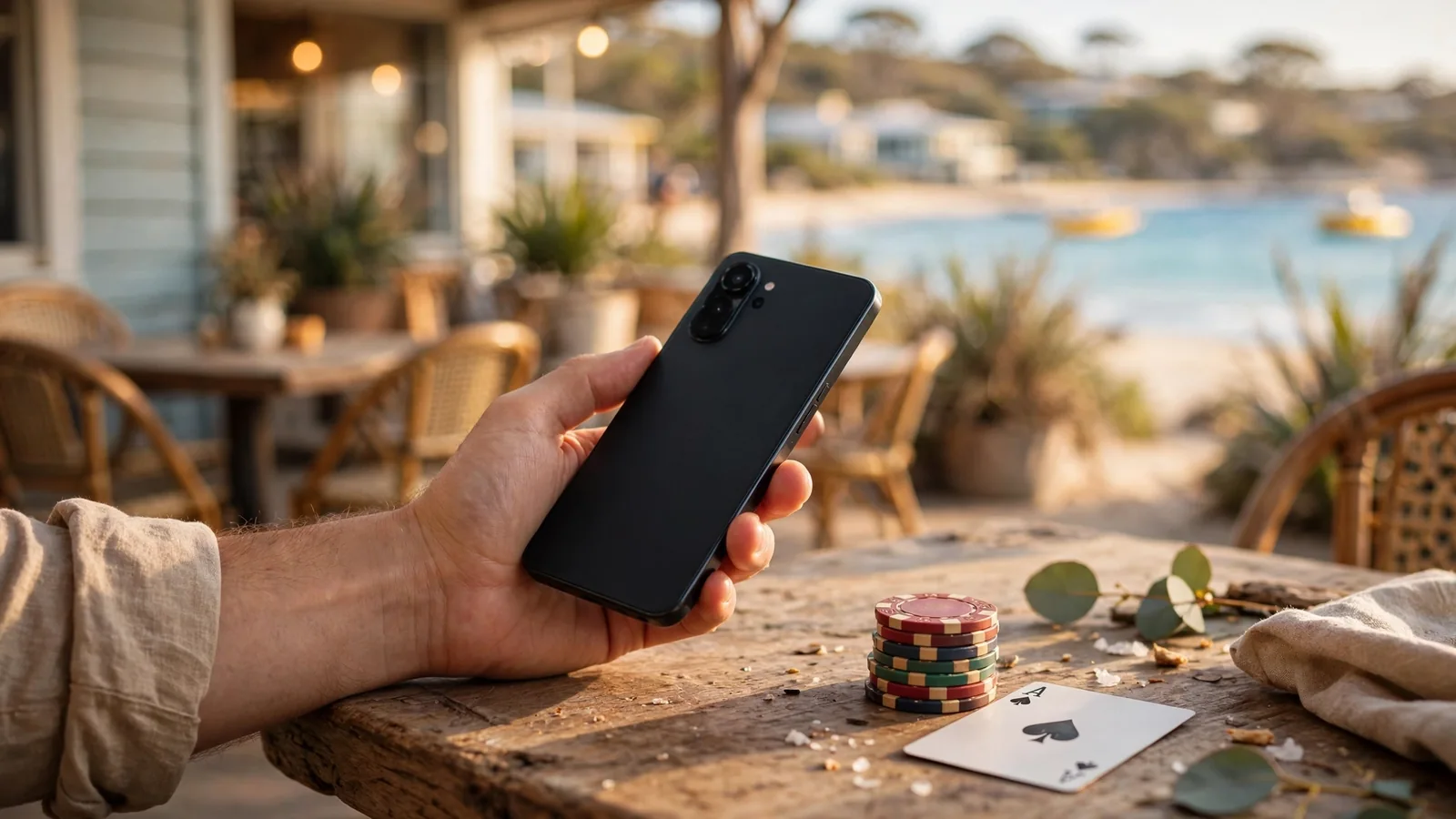
A phone can be the screen for a game without being the source of the money used to fund an account. Those ideas are often bundled together in the phrase “pay by phone”, but they describe different things: playing on a mobile device concerns access; charging a purchase to a mobile bill concerns payment. One does not establish the availability of the other.
In Australia, that distinction sits within a stricter legal setting. Under the Interactive Gambling Act 2001, operators may not provide real-money online casino games, including pokies and table games, to people physically located in Australia. The law also prohibits advertising those services to Australian audiences. A page discussing mobile access or payment terminology therefore cannot sensibly be read as an invitation to play. The distinction is useful precisely because the language around phones can make an unavailable or unlawful service sound like an ordinary feature.
The payment details relevant to the Australian context concern PayID, not a charge added to a phone account. PayID is offered through the New Payments Platform (NPP), where a payment can be sent or received using an identifier such as a mobile number or email address. The number identifies a destination for a bank payment; it does not mean that the amount is placed on the mobile carrier’s bill. The handset may still be involved, but in a different role: a banking app is used to confirm the transaction.
Paying by phone can make casino deposits more convenient, but the available payment options and terms vary by operator. Use these verdicts as a starting point when considering casinos for Australian players in 2026.
Roby Casino
Roby Casino is identified as operating under a Curacao eGaming licence held by Roby Games Ltd.
DragonSlots Casino
DragonSlots Casino is associated with the Curacao Gaming Authority and operated by Jumpman Gaming Ltd.
Thor Casino
Thor Casino is licensed in Curacao through Antillephone N.V. and operated by Versus Odds B.V. Its minimum deposit is EUR 20.
7Bit Casino
7Bit Casino is operated by Dama N.V. and holds a Curacao licence.
Golden Pokies
Golden Pokies is listed with a Curacao licence.
Rollero Casino
Rollero Casino holds a Curacao Gaming Control Board licence, OGL/2023/176/0095, and is operated by Hollycorn N.V.
MrPacho
MrPacho lists crypto payouts in 30–120 minutes and fiat payouts in 24–72 hours. Its minimum deposit is A$30.
Kingmaker
Kingmaker lists crypto payouts at around 90 minutes and fiat payouts in 1–5 days. Its minimum deposit is A$30.
JustCasino
JustCasino is listed as holding a Curacao Gaming Control Board licence.
WinSpirit Casino
WinSpirit Casino holds a Curacao eGaming licence, OGL/2024/923/0383, through Antillephone N.V. Its minimum deposit is A$30.
That difference is easy to miss because the same device can hold a messaging service, a banking app and a browser. A person might use a phone to open a page, enter payment details and authorise a transfer. None of that turns the transaction into carrier billing. The mobile device is the instrument on which actions happen; the payment method is the system that moves the money. A small distinction in wording, with rather larger consequences.
PayID’s use of a mobile number as an identifier can make the confusion more tempting. Yet an identifier is not an invoice. A PayID payment is initiated through a banking app, and the relevant confirmation takes place there. The existence of a phone number in the process says nothing about whether a purchase is charged to a monthly mobile account. It is simply one way for the payment system to direct a transfer.
That is the useful context behind searches for mobile casino games that can be paid for by phone bill. The phrase may suggest a single service—games on a handset, funded through the carrier—but the two parts need separate answers. Mobile access describes a device. A payment route describes how funds are authorised and transferred. PayID supplies information about a bank-based route; it does not confirm that phone-bill charging is offered, nor does it make real-money casino games lawful to provide in Australia.
The distinction also prevents a familiar kind of marketing blur. “Mobile” can describe a site’s layout or the device used to visit it, while “pay by phone” can be used loosely for several different acts. A label alone cannot establish what happens to the money, which organisation processes it, or whether the underlying service may legally be offered to someone in Australia. Clear payment language should identify the actual payment system rather than rely on the presence of a phone in the story.
There is no need to infer a particular set of pokies, an app, or a carrier-billing option from the fact that PayID works through a banking app. The payment fact is narrower: PayID uses the NPP and an identifier, and a bank app is where a payment is confirmed. That describes a banking action, not a catalogue of games or a promise about mobile casino access. The boundary matters more than the device.
Phones have become containers for nearly every routine transaction, so the language naturally makes the device seem like the payment source. But a phone can serve as a key, a screen or a place to approve a bank transfer without becoming the account that is charged. In Australian casino-related searches, that distinction also has to be read alongside the prohibition on operators providing real-money online casino games to people in the country. A payment method cannot alter that legal setting.
Legal Prohibition
Under the Interactive Gambling Act 2001, operators are prohibited from providing real-money online casino games to people physically located in Australia.
Thus, “mobile” and “pay by phone” should not be treated as synonyms. PayID’s mobile-number identifier belongs to a bank payment service, confirmed in a banking app. It does not establish carrier billing, and it does not establish lawful access to real-money casino games in Australia. The device is not the payment rail.
A PayID deposit is not a button that moves money by itself. The payment begins in a banking app: an amount is entered, the transfer is confirmed there, and the receiving account is identified through PayID. In a casino payment flow, the operator may first display its PayID details and ask for a player identifier to be included in the transfer reference. The bank handles the payment; the operator’s system has to recognise it and attach it to the right account.
That distinction matters. A transfer can reach its destination quickly while the balance on a casino account remains unchanged. The payment rail and the operator’s crediting process are separate parts of the chain.
There is an important legal boundary in Australia. Under the Interactive Gambling Act 2001, operators are prohibited from providing real-money online casino games to people in Australia. The mechanics described here explain what a PayID transfer involves; they are not an invitation or recommendation to deposit with an online casino.
Where a payment flow offers PayID, the sequence is generally straightforward in outline: the user selects PayID, enters the amount, and completes the transfer in their banking app. The app is where the payer authorises the movement of funds. The operator’s payment screen supplies the details needed to direct the transfer and may also specify what must appear in its reference field.
Before confirming, the recipient name should be checked against the details supplied for the transaction. A reference field deserves equal attention. Some operators rely on the player ID or username in that field to match the incoming payment automatically. If that identifier is absent, the money may arrive without the system knowing which account should receive the credit. The transfer can then remain pending until support staff process it manually.
A payment reference is not decoration. It is part of the bookkeeping.
This is why the final confirmation in a banking app is not necessarily the end of the process. There are two questions: whether the bank has sent the payment, and whether the receiving operator has correctly attributed it. A record of the transaction can help establish what was sent and when, but it does not by itself make an unmatched payment appear in an account balance. The critical detail is the reference requested for that particular payment.
PayID deposits are reported to reach casino accounts within seconds, commonly in a window of three to fifteen seconds. That describes a fast transfer, not an unconditional promise that every account will update at precisely the same moment. A missing or incorrect player reference can interrupt automatic crediting even when the payment itself has reached the recipient.
The distinction can be easy to miss because banking apps make transfers feel finished: confirmation appears, and the funds leave the payer’s view. Yet account crediting depends on the receiving side matching the transaction. If the reference is wrong, the next step may involve support rather than another transfer. Sending a second payment before the first is understood could leave two transactions to reconcile instead of one.
PayID Deposit Process
Select Payment
The user selects PayID as the deposit method on the payment screen.
Initiate Transfer
The user enters the amount and completes the transfer within their banking app.
Provide Reference
The user includes the required player ID or username in the transfer reference field to ensure automatic crediting.
The amount also has to fit the operator’s stated minimum. PayID casino deposits commonly begin at AUD 10–20, while some payment pages accept as little as AUD 5 by bank transfer. These are not universal terms: the minimum belongs to the specific payment option and account flow, not to PayID as a network-wide rule. A displayed minimum should therefore be read as a condition of that particular transaction, rather than as a fixed feature of the banking service.
The wording can be confusing when a page shows several ways to deposit. A lower minimum associated with bank transfer should not automatically be read as the PayID minimum. The payment option selected, its stated amount and its reference instructions all need to match. Otherwise, a transfer may satisfy the bank’s requirements while failing the operator’s own crediting rules.
The reference is where a fast payment can become a slow administrative matter. A player ID or username may be required so that an incoming payment is assigned automatically. Without it, the transaction may need manual handling. That is not a delay caused by the speed of the bank transfer; it is a matching problem after the transfer has been made.
For any transaction, the recipient details and reference should be checked before authorisation. If a deposit remains uncredited, the sensible distinction is between a payment still processing and one that has arrived but has not been matched. The confirmation record and the exact reference used are relevant to sorting that out; making another payment does not resolve the original mismatch.
The process is ordinary banking joined to an operator’s accounting system. The first part can be swift. The second depends on the identifying details being right.
“Pay by phone” can describe two different things. In one, a purchase is added to a mobile carrier account and appears on a phone bill or is deducted from prepaid credit. In the other, a phone is simply the place where a person opens a banking app to approve a payment. The device may be the same; the payment route is not.
PayID belongs to the second category. It is an Australian payment service built on the New Payments Platform (NPP), the banking infrastructure used to move money between accounts. Instead of relying only on account details, a sender can use an identifier such as a mobile number or email address. The identifier points to a bank account; it does not turn the transaction into a carrier-billed purchase. A phone number can be part of the address without the phone company becoming the cashier.
That distinction is easy to blur in a phrase such as “pay by phone casino.” It can sound like a charge passed through a mobile provider, even when the payment being discussed is a bank transfer confirmed in a banking app. PayID transactions settle through the NPP in real time. Their speed comes from the banking payment network, not from adding a cost to a mobile account.
PayID vs Carrier Billing
PayID is a bank-based payment service using the New Payments Platform (NPP), whereas carrier billing charges a purchase directly to a mobile provider account.
The difference matters because each route assigns the payment to a different institution. With a carrier-billed purchase, the mobile provider is involved in charging the customer. With PayID, the bank account is the source of funds and the NPP carries the payment. A handset may be used to access the bank, but it is not itself the payment method. Calling both arrangements “phone payments” is tidy marketing language; as a description of the money’s route, it is not tidy at all.
There is also a legal boundary that payment terminology cannot soften. Australian law prohibits operators from providing real-money online casino games to people physically in Australia. That prohibition covers casino-style services including pokies, poker and table games. The fact that a bank payment network exists, or that a mobile number can serve as a PayID identifier, does not establish that an online casino service is lawful to offer in Australia. A payment rail describes how money moves; it does not confer permission on the activity at either end.
This is why a reference to PayID should not be read as evidence of a phone-billing option. Nor does the presence of a mobile number in the process prove that a mobile carrier handles the charge. The useful distinction is institutional: PayID connects a payment to a bank account through the NPP, while carrier billing is a separate kind of arrangement involving a mobile provider. Similar screens and the same pocket-sized device do not make them interchangeable.
The language of convenience tends to compress these differences. “Pay by phone” is short, vivid and ambiguous; “bank payment initiated on a phone” is less elegant but more accurate when PayID is meant. That small correction changes the picture from a phone account being charged to a person authorising a bank payment. It also prevents a payment label from being mistaken for confirmation that a casino service may be offered to Australians.
One is the device. One is the rail.
A casino bonus is a set of conditions attached to a promotion, not a description of how a payment works. A deposit advertised as being made by phone does not, by itself, establish that a bonus exists, that it applies to a particular payment route, or that its terms are suitable. The same caution applies to claims about online pokies, named game studios or a “best” casino: promotional language is not proof of availability or eligibility.
In Australia, the legal setting matters before the offer’s arithmetic. The Interactive Gambling Act 2001 prohibits operators from supplying real-money online casino-style games, including pokies, to people located in Australia. Advertising those services to Australian audiences is also prohibited. A bonus headline does not alter that position. Nor does a foreign operator’s wording turn an offer into a lawful local service.
Where a promotion is being assessed in a general consumer-information context, its full terms matter more than the banner. The headline may state a benefit; the conditions determine when it applies, which games count and what can be done with any resulting balance. The distinction is old-fashioned but useful: a promise is written large, its limits small.
Several points deserve close attention in any published promotion:
These details should be read together, not as isolated footnotes. A generous-sounding headline can be narrowed by a low cash-out ceiling; a broad game catalogue can be narrowed by exclusions or weighting rules. If the terms are unclear, contradictory or unavailable, the claim is not made clearer by repeating it more confidently.
The phrase “pay by phone” also carries more than one possible meaning in ordinary language. It may suggest a mobile device, a phone-bill charge, or simply a payment made while using a phone. None of those meanings verifies a bonus. A payment method and a promotion are separate claims, and evidence for one cannot stand in for evidence for the other.
That is why rankings built around phone-payment bonuses can mislead when they treat a search-friendly label as a confirmed product feature. Names of studios or references to slots do not establish that a specific promotion covers those games. The exact terms, the payment route and the legal status are different questions.
Fine print is not fine merely because it is printed in small type. It is the part that decides what the headline means.
“No wagering” and “no deposit” describe different promotional ideas. The first suggests that a bonus does not carry a wagering requirement; the second suggests that an offer can be claimed without making an initial deposit. Neither phrase, on its own, establishes that an offer exists, who can receive it or what happens when someone tries to withdraw money associated with it.
A payment method answers a narrower question. PayID is initiated and confirmed through a banking app, using an identifier on the New Payments Platform. That describes how a payment moves. It does not establish that a promotion is available, that a player qualifies for one, or that promotional funds can be withdrawn. A smooth transfer and a generous-sounding offer are separate propositions, however often they are placed side by side.
The distinction matters especially in Australia. Under the Interactive Gambling Act 2001, it is illegal for operators to provide real-money online casino games, including slots, to people physically located in Australia. A claim about a no-deposit casino bonus or a no-wagering offer cannot change that legal position. Promotional language does not turn an unavailable service into a lawful one.
There is also a small linguistic trap in the phrase “no wagering”. It sounds like the absence of a condition, but it is not a complete description of an offer. The phrase alone says nothing about eligibility, expiry, withdrawal restrictions or whether the advertised benefit applies to Australian residents. Those details cannot be inferred from the wording, and a payment method supplies none of them.
Likewise, “no deposit” does not mean “no payment involved” in every sense. It describes the claimed entry condition for a promotion, not a transaction route. A phone number, a mobile device and a bank payment can all appear in the same discussion while referring to different things. Treating them as interchangeable makes a headline do work that only actual terms could do.
Attention: A PayID banking confirmation is evidence of a payment, not evidence that a no-deposit or no-wagering promotional claim is valid.
This is why a PayID reference cannot serve as proof of a bonus. PayID can move money from a bank account; it cannot verify promotional eligibility or define a promotion’s conditions. The banking confirmation is evidence of a payment, not evidence that the surrounding casino claim is valid.
The cleanest reading is also the least exciting: no-wagering and no-deposit are labels, not guarantees. In Australia, they must not be mistaken for confirmation that real-money online casino games may lawfully be offered to people in the country. A slogan can travel faster than its meaning. The distinction remains.
A phrase linking a casino to BetStop or Boku can sound like a useful distinction: one service supposedly absent, another supposedly involved. But those labels do not establish whether a particular operator is available, what payment methods it accepts, or what happens to a deposit. They are not substitutes for evidence about the transaction itself.
There is a further Australian context that promotional language tends to leave outside the frame. Under the Interactive Gambling Act 2001, providing real-money online casino games to people in Australia is illegal for operators. A claim that an offshore casino is “not on BetStop” does not alter that rule, nor does it establish the operator’s status. The wording may describe what a service claims about itself; it cannot make the underlying service lawful.
Boku-related wording needs the same restraint. A mention of Boku does not, by itself, confirm that phone-bill payment is available, that a casino accepts it, or that a payment has been processed. Nor does the absence of the name prove that another billing route exists. Payment claims need to be read as claims, not as a map of what can safely or legally be used.
The practical PayID issue is less dramatic and more specific. A casino may use the player’s ID or username in the transfer reference to match a deposit to the right account. If that identifying detail is omitted, automatic crediting may fail. The money can remain pending while support staff handle the match manually.
That is a small field with an outsized role. A transfer can be correctly sent and still not appear as an immediately credited casino balance if the reference does not identify its owner. The payment record and the account record are not the same thing; one has to be connected to the other.
Phone-bill language, meanwhile, should not be confused with PayID. PayID transfers are initiated through a banking app, and the reference attached to that payment can matter for crediting. A carrier-billed purchase would be a different kind of claim, and a search result using the word “casino” does not verify that such a purchase is offered or appropriate in Australia.
The sensible distinction is between a label and a confirmed process. BetStop wording cannot certify an operator; Boku wording cannot confirm a payment route; and a missing player reference can leave a PayID deposit awaiting manual attention. Small print, and smaller references.
If a player ID or username is omitted from the transfer reference, automatic crediting may fail, leaving the money pending until support staff process it manually.
A search for pokies or other casino games paid for by phone can blur three separate things: the game, the way money enters an account and the route by which a withdrawal might leave it. They are not interchangeable. A payment option shown beside a deposit button says little about how a payout would be handled.
There is also a legal boundary in Australia. Under the Interactive Gambling Act 2001, providing real-money online casino games—including slots, poker and table games—to people in Australia is illegal for operators. A description of payment processing should not be mistaken for confirmation that such a service is lawfully available.
Where payment methods are described, POLi belongs chiefly to the deposit side. It should not be treated as a cash-out route simply because it appears among ways to add funds. The distinction matters: a deposit method and a withdrawal method can be different, and a list of games cannot resolve that difference.
Visa and Mastercard are widely accepted for deposits, according to a specialist review, but card withdrawals may be slower or unavailable depending on the processor. That qualification is not a minor footnote. The same card logo on a payment page does not establish that money can return to that card. The processor’s arrangements determine what is possible.
The game itself does not settle the matter either. A title, a category of pokies or a promotional label says nothing reliable about the payment route. Nor does a casino bonus establish that a particular deposit method can later be used to withdraw funds. Payment rules sit apart from the entertainment being described.
The practical distinction is plain, if less glamorous than a game catalogue: deposits and withdrawals are separate processes, and a method shown for one should not be assumed to serve the other. Where real-money casino services are concerned, Australia’s law sets a further limit. A payment description cannot turn a prohibited operator service into a lawful one.
Games are one question. Money’s route is another.
An overseas casino may present a deposit option as though geography were a minor setting. For someone in Australia, the payment route can make it more consequential: a bank wire to an offshore account is not the same as a local PayID transfer, and the account currencies may differ. The language of convenience tends to travel more easily than the money.
A bank wire requires the receiving business’s details, including its name, account number and bank; international transfers may also call for SWIFT, BIC or IBAN codes. The wire can be arranged online, by phone or in person at a bank, but that flexibility does not make it immediate. A deposit may take as long as seven business days to appear in the casino account. Banks may also charge more for a wire than for other non-banking transactions.
Currency conversion adds another layer. If the bank account and the casino account use the same currency, foreign-exchange fees may be avoided or reduced. Where they do not match, the amount sent and the amount credited can differ after conversion and charges. The displayed deposit figure, in other words, is not necessarily the final accounting.
That friction is separate from the wording attached to phone payments. A casino described as international, or one associated with a foreign jurisdiction, does not thereby turn a carrier-billed phone purchase into a bank payment. Nor does a mobile screen determine whether a transaction is domestic or cross-border. Those are distinct matters: the device is where a payment may be arranged; the financial route is what determines how it travels.
Australia’s legal setting also cannot be inferred from the location or licence named by an overseas operator. The Interactive Gambling Act 2001 prohibits operators from providing real-money online casino games to people physically in Australia. An international label does not alter that rule.
The transfer can be slow. The geography is not a footnote.
“Phone credit” can mean airtime or a charge placed on a mobile account; credit-card payment is a different transaction. Visa and Mastercard are card networks, not mobile carriers. Their names can therefore appear in discussions of paying by phone without describing the same payment route.
A specialist review reports that Visa and Mastercard are widely accepted for deposits, while card withdrawals may be slower or unavailable, depending on the processor. Acceptance for one direction does not establish acceptance for the other. A deposit can be charged to a card, yet a later payout may need another route if the processor does not return funds to that card.
There may also be a method-matching rule. An operator may require a withdrawal to go back through the deposit method where that is possible. The qualification matters: card processing arrangements can prevent a direct return, so a card deposit does not guarantee a card cash-out. The payment method is not a promise of symmetry.
That distinction is easy to miss when “pay by phone” is used loosely. A phone can be the device used to access a banking app, a carrier account can be billed for a purchase, or a card can be used on a phone. These are separate arrangements, with different parties handling the payment. Calling them all phone payments does not make them interchangeable.
For Australian readers, there is a more fundamental boundary: the Interactive Gambling Act 2001 prohibits operators from providing real-money online casino games to people physically in Australia. A discussion of card mechanics should not be mistaken for an endorsement or an assurance that an online casino service is lawfully available to Australians.
Where card processing is relevant, the practical point is modest: deposit support and withdrawal support must be assessed separately, and any same-method condition can shape the route back. Card accepted. Cash-out uncertain.
Free spins belong to the language of promotions, not payments. They describe a possible offer attached to a game; they do not explain how money moves from a bank account or mobile carrier. A phrase linking phone payment and free spins therefore joins two separate ideas without proving that either feature is available.
PayID has a defined role: a payment is initiated in a banking app and confirmed there. It is not a charge added to a mobile phone bill, and it does not itself create a promotional entitlement. Likewise, “phone credit” can suggest carrier billing, prepaid balance or simply a search for a mobile-friendly offer. The wording alone settles none of those meanings.
There is a more consequential boundary in Australia. Under the Interactive Gambling Act 2001, operators may not provide real-money online casino games, including slots, to people physically located in the country. A free-spin label does not change the nature of the underlying service or turn a promotion into a payment method. Marketing language is not a legal exception.
That distinction matters because promotional phrasing can make a transaction sound simpler than it is. A claimed free-spin offer says nothing, by itself, about whether a payment method is supported, whether the offer’s conditions are met, or how a later withdrawal would be handled. Those are separate questions, not hidden features of the spins.
Free spins may sound like a gift; they remain a promotional claim. PayID remains a bank payment. Neither phrase should be mistaken for evidence that an online casino service is lawful to provide in Australia. The label does not alter the service.
Casino deposits commonly start at AUD 10–20, though some bank-transfer options accept as little as AUD 5. PayID transaction limits are set by your bank; most major Australian banks allow AUD 1,000–5,000 per transaction, with daily limits of AUD 10,000–20,000.
For verified accounts, withdrawal requests at top-rated PayID casinos are typically reviewed and approved within 2–6 hours. After approval, PayID withdrawals may arrive within minutes to hours; the operator’s review is often the main source of delay.
PayID is available through Australian banks that participate in the New Payments Platform, and most major Australian banks support PayID transactions.
Some operators offering PayID accept withdrawal requests through it, but Australia prohibits operators from providing real-money online casino games to people in the country.
PayID casino deposits commonly start at AUD 10–20; some bank-transfer options accept deposits as low as AUD 5.
PayID transfers typically reach the casino within 3–15 seconds. The casino may take longer to credit the balance if it needs to match the payment reference to your account.