The article distinguishes operator payment claims from Australian legality and explains what deposit and withdrawal evidence can—and cannot—show.
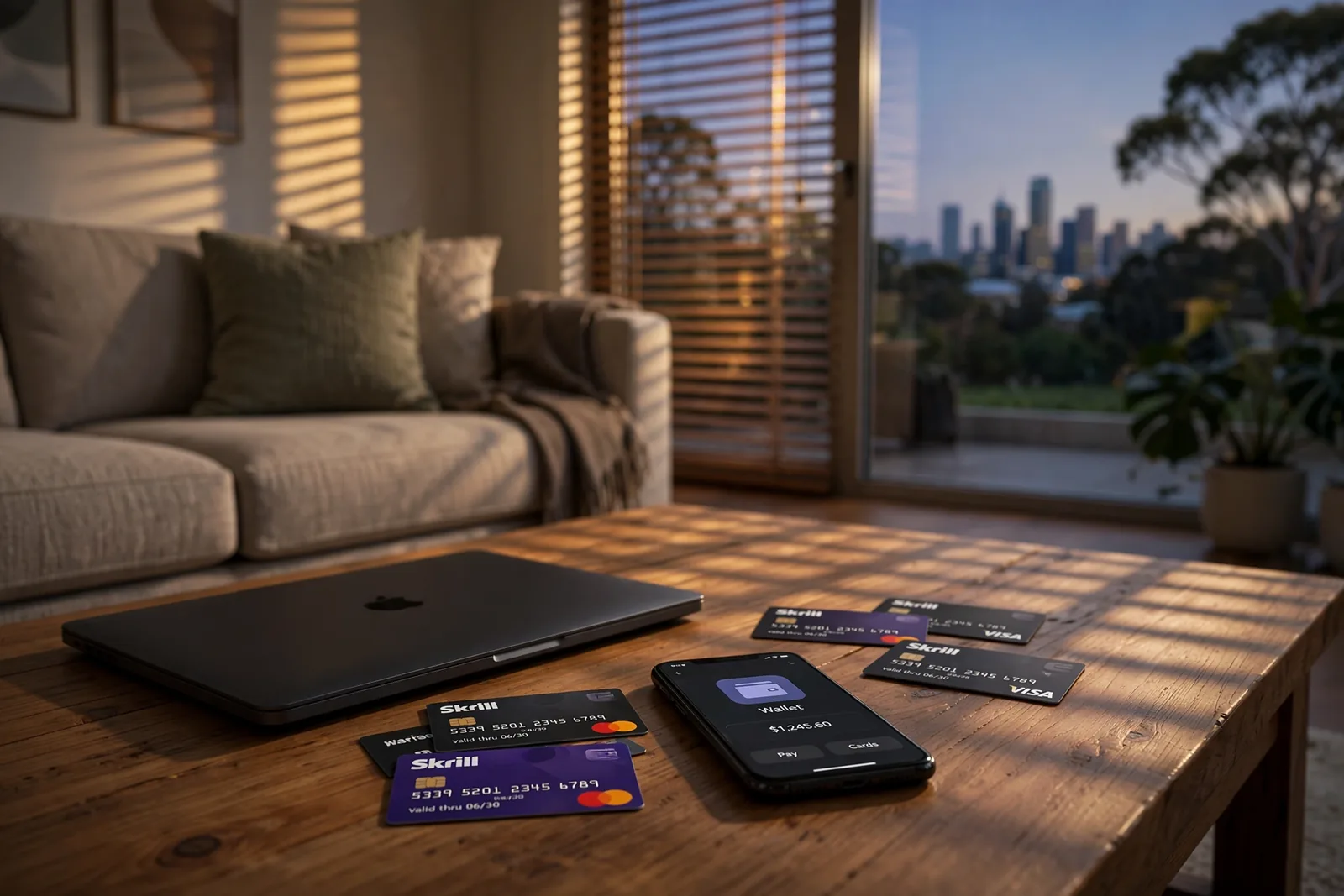
The phrase “pokies that accept Skrill” joins two separate questions: what payment methods a gambling operator might offer, and whether that operator may lawfully provide online casino games to people in Australia. The second question comes first. A cashier menu cannot change the legal status of the service behind it.
Under the Interactive Gambling Act 2001, operators must not provide real-money online casino games to people physically located in Australia. The prohibition covers pokies as well as online poker and table games. A website may describe itself as Australian-facing, display Australian currency or mention Skrill, but those details do not establish that its casino service is lawful in Australia. Payment branding is not a licence, and a familiar interface is not a change of jurisdiction.
The law draws its principal line around providers rather than treating players as the target of the prohibition. It does not explicitly criminalise an Australian resident for using an offshore casino. That distinction matters, but it is not an endorsement. The absence of player criminal liability does not make a prohibited service lawful, nor does it bring that service within Australia’s ordinary protections. Australian consumer law does not protect people who use offshore casinos.
When looking for a casino site that accepts Skrill in Australia, payment availability and the terms that matter to you are worth checking before you sign up. Use this list as a starting point and verify Skrill support directly with each operator.
Roby Casino
Roby Casino is listed with a Curaçao eGaming license held by Roby Games Ltd. The available information does not specify its Skrill payment options.
DragonSlots Casino
DragonSlots Casino is listed with a Curaçao Gaming Authority license held by Jumpman Gaming Ltd. Skrill availability is not specified in the available information.
Thor Casino
Thor Casino is listed with a Curaçao license from Antillephone N.V., with Versus Odds B.V. named as the operator. Its stated minimum deposit is EUR 20; Skrill support is not specified.
7Bit Casino
7Bit Casino is listed as operated by Dama N.V. under a Curaçao license. The available information does not state whether Skrill is accepted.
Golden Pokies
Golden Pokies is listed with a Curaçao license. No Skrill payment details are provided.
Rollero Casino
Rollero Casino is listed with a Curaçao Gaming Control Board license, OGL/2023/176/0095, held by Hollycorn N.V. Skrill availability is not specified.
MrPacho
MrPacho lists crypto payouts at 30–120 minutes and fiat payouts at 24–72 hours. Its stated minimum deposit is A$30; the available details do not confirm Skrill support.
Kingmaker
Kingmaker lists crypto payouts at around 90 minutes and fiat payouts at 1–5 days. Its stated minimum deposit is A$30, but Skrill availability is not specified.
JustCasino
JustCasino is listed with a Curaçao Gaming Control Board license. The available information does not specify its payment methods or Skrill support.
WinSpirit Casino
WinSpirit Casino is listed with a Curaçao eGaming license, OGL/2024/923/0383, from Antillephone N.V. Its stated minimum deposit is A$30; Skrill support is not specified.
The regulator responsible for enforcing the Interactive Gambling Act is the Australian Communications and Media Authority (ACMA). Offshore casino sites may be subject to blocking and other enforcement measures. Their continued appearance online, when it occurs, should not be mistaken for official approval. The internet has always been good at making availability look like legitimacy; the two are not synonyms.
This is the legal background to searches for an Australian online casino that accepts Skrill. The wording can sound as if a locally lawful category of online pokies exists and the remaining task is simply to identify which cashier supports a particular wallet. In Australia, that order is misleading. The legal position concerns the provision of the games themselves, not merely the payment rail used to move money.
Skrill is a payment service. Its name on a page, in a logo or in a payment-method list would say something about the operator’s claimed transaction options, not whether it is authorised to offer real-money casino games to Australians. Nor can a search result settle the question. Commercial descriptions often compress separate matters—location, payment support and legal status—into one confident label. Confidence is easy to print.
That distinction also explains why “Australian pokies” can be an ambiguous phrase. It may describe games or services marketed toward Australians, rather than games offered under a lawful Australian online-casino framework. The market’s familiar vocabulary does not alter the statutory boundary. A site’s use of local language, or its reference to Australian customers, does not transform an offshore casino into a locally regulated one.
 Payments and Crypto for Australian Online CasinosExplore Australian casino payment topics, including the listed card, bank, e-wallet, prepaid and cryptocurrency options.
 Casinos That Accept Neteller in AustraliaSee what a Neteller listing can—and cannot—confirm about Australian access, deposits and withdrawals, without relying on unsupported casino rankings.
The legal consequences stated in the Act apply to providers that breach it. The maximum daily penalty is $360,000 for an individual and $1.8 million for a body corporate. Those figures underline the seriousness of the operator-facing prohibition; they are not a statement that players face those penalties. The law’s structure is less symmetrical than the marketing language surrounding offshore sites might suggest.
Nothing about this framework confirms that a particular pokies operator accepts Skrill, and nothing about a claimed Skrill option answers whether a casino may legally serve Australians. Those claims require different kinds of evidence. Here, the relevant point is narrower: a payment method cannot make a prohibited online casino service lawful.
The phrase “best Australian pokies with Skrill” therefore carries a premise that deserves scrutiny. It can imply a straightforward local market of lawful real-money casino services competing on payment convenience. The statutory position does not support that picture. Australia prohibits operators from offering these games to people in the country, while a person’s lack of criminal liability does not amount to consumer protection or regulatory approval.
The boundary is plain, even when a website’s presentation is not. Skrill may appear in discussions of online payments; pokies remain within the class of casino games that operators are prohibited from providing to people in Australia. The wallet and the game occupy different parts of the story. Only one determines the legal character of the service.
Legal Prohibition
Under the Interactive Gambling Act 2001, operators are prohibited from providing real-money online casino games to people physically located in Australia.
A deposit claim is not one fact but several. A service may appear in a cashier without being available for every account, currency or kind of transaction. A minimum deposit is a separate condition, and fees are another. Treating all three as settled by the words “Skrill accepted” turns a narrow payment statement into a promise it cannot carry.
That distinction matters particularly for small-deposit searches. A request for a low entry point is really asking about the operator’s current minimum, not about Skrill in the abstract. Skrill does not, by its name alone, establish what amount a particular cashier will accept. Nor does a displayed minimum necessarily settle the full cost: a payment service, the operator, or a currency conversion may affect what is charged. Without the applicable terms, a small-deposit figure is only a figure in a claim.
The cashier is where a payment option would be presented, but its appearance is not a universal guarantee. Payment arrangements can be conditional on the account, location, currency or operator rules. A label on a general payment page may not describe the options actually offered during a transaction. The difference is prosaic, but important: a method can exist in principle without being available in every circumstance.
The phrase “Skrill deposit” also leaves open what happens to the amount entered. The cashier may state a minimum, display any charge, and show the amount before submission. Those details belong together. A headline that mentions only the payment method does not establish the minimum or the final amount debited. Nor does a reported minimum settle whether additional conditions apply to that particular payment.
 Casino Sites That Accept Trustly in Australia: What to KnowLearn why a Trustly listing does not confirm Australian access, what to check in a casino cashier, and why the available evidence…
 PayID and Australian Casinos: What Payment Menus ProveLearn why PayID availability cannot be confirmed from the evidence, and how Australia’s Interactive Gambling Act separates payment routes from casino legality.
This is why comparisons described as “best” can mislead when their basis is only payment acceptance. A ranking would need comparable, current details: whether the method is available, what the minimum is, whether charges apply, and under what conditions the information holds. A list that treats every mention of Skrill as equivalent collapses differences that matter most to someone deciding whether a small payment is possible. The adjective does little work.
There is also a difference between a deposit route and a deposit outcome. Entering payment details and submitting a transaction does not, by itself, establish that the operator has accepted it or that funds will be credited as expected. The cashier’s displayed instructions and the payment account’s own records are relevant to what occurred. A general description of a method cannot substitute for the terms attached to a particular transaction.
Currency deserves attention because an amount shown in one currency may not represent the amount ultimately taken from an account held in another. That possibility is not specific to Skrill, and it should not be converted into an assumed fee or rate. The operator’s displayed currency and the payment service’s applicable terms determine what can be understood about a transaction; the method’s name does not supply those details.
A careful description therefore separates the questions. Is Skrill offered for deposits in the relevant cashier? What minimum applies there? Is any charge disclosed, and does the displayed amount match the amount charged? Those are not interchangeable checks, and one answer cannot safely stand in for the others. If a page names Skrill but says nothing about the minimum or charges, it has answered only part of the deposit question.
In Australia, payment familiarity can make a method seem more settled than it is. A recognisable service name may look like a standard feature, yet acceptance remains an operator-level condition rather than a promise made by familiarity. Payment systems are built from agreements, restrictions and changing cashier settings. Their public image is smoother than their plumbing.
Small deposits are especially vulnerable to ambiguity because the headline amount attracts attention while conditions sit elsewhere. A stated minimum can be outdated, account-specific or subject to a separate charge; an advertised method can be unavailable when the transaction is actually attempted. None of those possibilities proves that a particular cashier behaves in one way. They show why an amount or acceptance claim needs to be tied to its terms, rather than repeated as a general rule.
So the meaningful claim is not simply that a casino accepts Skrill. It is that a particular cashier offers Skrill for a deposit under stated conditions, with a stated minimum and any applicable charges made clear. Anything less describes a possibility, not the complete cost or availability of a deposit. A payment label is not a receipt.
“Instant withdrawal” sounds like a single event, but a cash-out can involve several separate decisions. A request may be submitted, reviewed by an operator, released to a payment service and then reflected in an account. Those steps are not interchangeable. A payment method can move money quickly at one stage without making the whole process immediate.
 Casino Sites and Osko in Australia: What Is VerifiedLearn why references to bank transfers do not verify Osko availability, and what cashier details would be needed to support a casino…
 Casinos That Accept Mastercard in AustraliaUnderstand how Australian law applies to online casino services, what Mastercard acceptance can establish, and why withdrawal rules vary by payment method.
That distinction matters in searches for Skrill withdrawals from Australian-facing casino sites. A deposit and a withdrawal travel in opposite directions, under different conditions. The fact that a cashier accepts a payment method for incoming funds would not, by itself, establish that the same method is available for outgoing funds. Nor would it establish how long a withdrawal takes. “Instant” is a claim about an outcome, not a description of every step that precedes it.
The word is often made to carry more than it can bear. It may refer to the time taken for a site to approve a request, to the time after approval before a payment service processes it, or simply to a broad impression of speed. Without a clear definition, two services can use the same word while describing different points in the journey. The clock itself becomes part of the sales language.
A further distinction is between a payment being sent and money being usable. An operator might mark a request as processed once it has released funds; that status need not mean the recipient can already see or spend them. Conversely, an account display may update before every downstream record does. The useful question is therefore not merely whether a withdrawal is called instant, but what event the claim measures and what remains to happen afterwards.
Verification also has a place in this sequence. Online casinos typically require customers to complete a Know Your Customer assessment before financial transactions. That can make account checks part of the cash-out process, rather than a matter of payment speed alone. A payment method cannot settle an identity review, and a fast transfer cannot make an incomplete account check disappear.
Online casinos typically require customers to complete a Know Your Customer (KYC) assessment before financial transactions, which can affect withdrawal timing regardless of payment speed.
In Australia, the wider setting is not a minor footnote. The Interactive Gambling Act 2001 makes it illegal for operators to provide real-money online casino games to people physically located in Australia. The Australian Communications and Media Authority is responsible for enforcing the Act. The law does not explicitly criminalise players using offshore sites, but Australian consumer law does not protect people who use offshore casinos. A claim about speed sits inside that landscape, not outside it.
This is why the phrase “instant Skrill withdrawal casino” should be treated as a compound claim, not as proof. It implies that a site serves the relevant customer, supports Skrill for outgoing payments, and completes the full cash-out without meaningful delay. Each part needs its own evidence. A cashier icon or a general statement about fast payments cannot establish all three.
Nor does an advertised speed settle the question of what happens when a request is reviewed, held for account checks or returned for correction. These are different events from the payment service processing a released transfer. Without a stated definition and conditions, “instant” can be a label attached to only one link in a longer chain.
A sensible reading of speed claims is therefore exacting rather than hopeful. The relevant details are whether the method applies to withdrawals, which stage is timed, what checks can intervene, and whether the stated timing concerns approval or receipt. Those distinctions are not pedantry; they determine what a promise actually means.
The short version: instant is not a timetable.
 BPAY at Australian Casino Sites: What Is VerifiedLearn why BPAY claims need casino-specific confirmation, how card acceptance differs, and why deposits and withdrawals may follow different rules.
 Litecoin casinos in Australia: access and legal limitsUnderstand how Australia’s online casino rules apply to Litecoin, why the coin changes no legal boundary, and ACMA’s enforcement role.
The phrase “Skrill casinos in Australia” can sound like a straightforward description of a local market: a set of casinos, a payment method, and a country. But those elements do not fit together as neatly as the wording suggests. Skrill acceptance, even where an operator claims it, would not make an online casino lawful to offer in Australia or turn an offshore service into a locally regulated one.
The legal distinction begins with the operator. Under the Interactive Gambling Act 2001, operators are prohibited from providing real-money online casino games to people in Australia. That covers the kind of casino service people may have in mind when they look for places to play from home. The law does not explicitly make an individual player’s use of an offshore casino a criminal offence. Those are separate propositions, not a loophole that changes the status of the service.
The Australian Communications and Media Authority (ACMA) enforces the Act. Its role belongs to the public framework around prohibited interactive gambling services; it does not certify an offshore casino as suitable for Australian customers. A payment logo or a cashier option cannot do that work either. A method of moving money is not a licence, and the presence of a familiar financial brand does not settle the legal question.
This is where “best” becomes an especially slippery word. A ranking based on Skrill access, interface or advertised features might describe an operator’s claims, but it would not establish that the service can lawfully be offered in Australia. Nor does a foreign licence amount to local authorisation. For someone in Australia, the distinction is material: offshore casino use is not protected by Australian consumer law. If a dispute arises, the ordinary protections associated with a domestic consumer transaction cannot simply be assumed to apply.
Attention: Australian consumer law does not protect people who use offshore casinos, meaning players may lack local remedies in disputes.
That is less a technical footnote than a description of who stands behind the transaction. A polished website can make distance feel abstract; consumer law makes distance consequential. The operator may be beyond the reach of familiar local remedies, while the player is left to rely on terms set by a business outside Australia’s casino regulatory framework. A payment service does not bridge that gap.
The search for a casino that takes Skrill therefore has two different meanings, only one of which is about payment. It may ask whether an offshore operator advertises Skrill as an option. It may also imply that there is a recognised Australian category of Skrill casinos, comparable to locally authorised services in a market where such services are permitted. That implication is misleading. Payment acceptance, if claimed, cannot convert a prohibited offering into a lawful Australian casino service.
Careful wording matters. “Available to Australians” can describe a website’s own marketing or technical access, but it should not be mistaken for legal approval or consumer protection. Likewise, the fact that players are not explicitly criminalised does not mean the operator is allowed to provide the service. The law draws its line primarily around provision, not by granting offshore casinos a local standing.
So the phrase can safely mean only a question about an offshore operator’s stated payment arrangements, not a list of locally approved casinos. Skrill may be part of the wording. It is not an answer to the larger question of legality, oversight or recourse. The distinction is plain. The consequences are not.
A “best” label suggests that several options have been measured against the same standard. For a Skrill casino in Australia, that standard would need to begin with a basic question: does the operator actually accept Skrill for the transaction being discussed? Without confirmation, a ranking would turn an assumption into a verdict.
 Paysafecard at Australian casino sites: what is knownSee what evidence establishes about Paysafecard deposits and withdrawals, and why a payment option does not change the legal status of online…
 Casinos That Accept MiFinity in Australia: What’s KnownLearn why mentions of MiFinity, online pokies and Australia do not confirm that a casino accepts the payment method at checkout.
Even confirmed acceptance would not settle the comparison. A payment method may be available for deposits but not withdrawals; the cashier’s terms may also differ from the claims made elsewhere. A useful assessment would distinguish these details rather than compress them into a badge saying “best site”. Without reliable, current information about Skrill support, there is no sound basis for naming a best Skrill casino site or producing a Skrill casino list.
Bonuses complicate the picture. A headline casino bonus associated with Skrill is not evidence that the payment method qualifies, that the offer is available to a particular customer, or that its conditions are favourable. Those points depend on the operator’s terms. Where the details are unclear, a bonus label describes an invitation, not its practical value. The same caution applies to claims about Skrill casino bonuses generally: a broad category cannot establish what any individual offer permits.
Comparison pages can make unlike things appear commensurable. One may describe payment access, another a promotional offer, and another an operator’s own claims. Unless the underlying details are checked and compared on equal terms, “best Skrill casino websites” is more a publishing format than a dependable finding. A table does not make weak evidence stronger. It only gives it borders.
There is also a larger limit to any such recommendation in Australia. The Interactive Gambling Act 2001 prohibits operators from providing real-money online casino games to people physically in the country. Australian consumer law does not protect players who use offshore casinos. A ranking should not be mistaken for an endorsement, a sign of local approval, or a promise of recourse if something goes wrong.
For the same reason, searches for a Skrill casino website or a collection of Skrill slot sites cannot, by themselves, establish that a service is lawful, accessible, or suitable for Australians. Nor does the word “best” resolve the question of what is being compared: payment access, terms, or something else. Each claim needs evidence specific to that claim.
A careful comparison would therefore require current operator terms and clear confirmation of the payment functions being described. Where those are absent, withholding a ranking is more informative than inventing one. The gap is real.
A game catalogue and a cashier answer different questions. The catalogue describes what an operator makes available; the cashier describes which payment methods it accepts. Seeing a game listed does not establish that it can be funded through Skrill, just as seeing Skrill named as a payment option would not establish which games, if any, are available.
That distinction matters because payment labels can make a service look more settled than it is. A familiar e-wallet may suggest a straightforward bridge between an account and a game, but the label alone says nothing about the operator’s rules, the scope of the service, or whether a particular transaction is supported. “Skrill casino games” is therefore not a single verifiable category. It combines two separate claims, each of which would need its own evidence.
There is also a more fundamental boundary in Australia. The Interactive Gambling Act 2001 prohibits operators from providing real-money online casino games to people physically in the country. That includes casino-style games such as poker, blackjack, roulette and pokies. A payment method does not alter the status of the service: Skrill cannot make a prohibited offering permissible, nor does its presence in a cashier establish that an operator may lawfully provide games to Australians.
This is a distinction between machinery and permission. Payment systems move money; they do not grant authority to offer a product. The Australian Communications and Media Authority is responsible for enforcing the Act, while Australian consumer law does not protect people who use offshore casinos. A polished interface can blur these lines. It cannot remove them.
For that reason, claims linking Skrill to a particular game or game category should not be inferred from general payment information. A game may appear in a catalogue, and Skrill may appear elsewhere on a site, without evidence that the two are connected in a usable or lawful way for someone in Australia. The wording “games using Skrill” can imply a direct link that a payment logo alone cannot prove.
The neatness of the label is misleading. A payment option is not a game feature, and neither one answers the legal question. In Australia, that boundary comes first.
Australia’s everyday payment culture is built around several familiar routes rather than one dominant habit. Contactless credit and debit cards are accepted almost everywhere, and mobile wallets such as Google Pay and Apple Pay have a similarly broad presence. Bank-linked services, including PayPal, sit alongside them. Switching between these options is ordinary consumer behaviour, not a declaration of loyalty to one system.
That familiarity can shape how a payment method is judged. A card or phone wallet feels legible because it already belongs to daily shopping; a digital wallet such as Skrill may require a separate check of how a particular service treats it. But national comfort with mobile payments does not establish that a casino cashier offers Skrill. Nor does the fact that people commonly use bank-linked services make every such service interchangeable. Payment habits describe the public, not the options available at an individual operator.
The distinction matters when “Skrill” appears beside “Australian casino” in a phrase. It can sound as though a local convention has already settled the question. It has not. Australia’s broad acceptance of contactless payments and phone wallets says something about the infrastructure and habits surrounding ordinary transactions. It says nothing conclusive about a casino’s payment menu, and still less about whether that service is lawful for people in Australia.
There is a more consequential difference between familiar and protected. Australian consumer law does not protect players who use offshore casinos. A payment option recognised in everyday commerce does not carry those protections with it when attached to an offshore gambling service. The familiar interface can make the unfamiliar arrangement look routine. It is not the same thing.
Payment culture changes by accumulation: cards become tap-and-go, phones become wallets, and bank-linked services become another everyday choice. Skrill belongs to a separate question of acceptance at a specific service, not to a general Australian habit that can answer on its behalf. Familiarity is not evidence.
A payment method appearing in a cashier does not settle how winnings can be paid out. A casino might accept Skrill for a deposit yet offer a different set of withdrawal options, or impose conditions on returning funds. The two directions of a transaction are separate arrangements, not a single promise running both ways.
That distinction matters in searches for Skrill withdrawals at online casinos and pokies sites in Australia. A logo beside a deposit option, or a general statement that Skrill is supported, cannot by itself establish that Skrill is available for withdrawals. Nor does it explain whether the method is available to every customer, in every account situation, or only under particular payment rules.
The cashier’s withdrawal terms are where those distinctions belong: supported payout methods, account requirements, and any conditions attached to a chosen route. Operators also typically require customers to complete a Know Your Customer assessment before financial transactions. That requirement can affect the handling of a withdrawal, but it does not establish that Skrill is an available destination.
There is a further difference between a payment method’s technical ability to receive money and the legal position of the service using it. Under the Interactive Gambling Act 2001, operators may not provide real-money online casino games, including pokies, to people physically in Australia. The Act does not make players liable simply for using an offshore site, but that does not turn the service into a protected one. Australian consumer law does not protect people using offshore casinos.
A careful reading of withdrawal language therefore asks a narrow question: does the operator explicitly describe Skrill as a payout method, and under what conditions? Deposit support alone is not an answer. Neither is a broad label such as “e-wallets,” which may conceal differences between individual services.
Operators typically require a completed Know Your Customer assessment before processing financial transactions. Additionally, a site may accept Skrill for deposits but offer different options or impose separate conditions for returning funds.
The distinction is mundane, but consequential. Money entering an account and money leaving it travel under different rules. In Australia, that practical uncertainty sits alongside a legal boundary that leaves offshore casino customers without Australian consumer-law protection. A payment button can look like a small detail. It is not.
Payment comparisons can look more settled than they are. A specialist review has reported that some online casinos do not accept Amex; a separate specialist review has suggested Visa may be accepted more broadly than Amex at Australian online casinos. Neither observation is a permanent rule. Cashier options can differ between operators and may change, so a comparison involving two card brands says nothing reliable about a third payment method.
That distinction matters when Skrill is part of the question. A casino’s support for Visa or Amex cannot establish that it accepts Skrill, and the reverse is equally true. Payment methods are separate arrangements, each subject to the operator’s cashier and its own terms. A label such as “e-wallets accepted” would also need to identify Skrill specifically before it could answer whether Skrill is available.
Even a method displayed in a cashier does not settle every practical detail. Deposits and withdrawals can be treated differently, while fees, currency handling and account checks may also vary. A broad comparison of brands cannot substitute for the specific conditions attached to the relevant payment route. The small print has a habit of becoming the main text.
The Australian legal setting makes the distinction more consequential than a mere question of convenience. The Interactive Gambling Act 2001 prohibits operators from providing real-money online casino games to people in Australia. The Australian Communications and Media Authority enforces the Act, and Australian consumer law does not protect people who use offshore casinos. A payment comparison is not an endorsement or a route around those limits.
So the comparison with Amex and Visa has a narrow use: it shows that acceptance can vary by method, not that Skrill works at any particular casino. Claims about a Skrill casino payment method need to be specific to Skrill and to the relevant cashier conditions. Card acceptance is not a proxy.
A payment method does not identify which games a casino offers. Skrill, where listed as a payment option, describes a way an operator may handle transactions; it does not establish that any particular online slot is available, or that a slot can be funded through that method. The distinction is easy to lose in a phrase such as “Skrill slots”, which makes a connection sound more direct than it is.
Game access and payment arrangements are separate decisions made by an operator. A casino might present a catalogue of games alongside a cashier, but their proximity on a website is not proof that Skrill applies to every game in that catalogue. Nor does a game’s presence establish that the operator can lawfully provide it to someone in Australia.
That last point is not a technicality. Under the Interactive Gambling Act 2001, operators may not provide real-money online casino games, including slots, to people physically located in Australia. The Australian Communications and Media Authority enforces the Act. Australian consumer law does not protect people who use offshore casinos.
The language of “online slots that accept Skrill” also gives a payment method an agency it does not have. A game does not accept a payment: an operator handles payments, while a game is part of its offering. Treating those as one feature can obscure both the legal boundary and the uncertainty of any specific claim.
So a reference to Skrill cannot, by itself, establish a Skrill-linked slot catalogue for Australian players. It says nothing reliable about which games are offered, whether a payment route applies to them, or whether access is lawful. The label may be tidy. The underlying questions are not.
Limits are set by each casino and can vary. Check the casino’s cashier and payment terms for the limits that apply to your account.
Examples include Jackpot City Casino, Spin Palace, Ruby Fortune, Ignition Casino, Joe Fortune and PlayAmo. Availability can vary, and the cashier may not offer Amex for every account.
Yes, some casinos accept Amex deposits, but Australian banks may block gambling transactions and not every casino offers the method. The Interactive Gambling Act prohibits operators from offering online casino games to people in Australia.
Amex deposits are typically free, but a casino may add a 1.5% surcharge, and currency conversion can incur a 3% fee. Withdrawal fees may also apply.
Amex deposits are processed instantly. Withdrawals can take up to five days to clear.
Australian consumer law does not protect people using offshore casinos, and the fact that a site accepts Amex does not make its service lawful. The Interactive Gambling Act prohibits operators from offering online casino games to people in Australia.
Amex acceptance does not establish that an offshore casino is safe or authorised. Australian consumer law does not protect people using offshore casinos, and operators are prohibited from offering online casino games to people in Australia.
Deposits are typically fee-free, but a casino may charge a 1.5% surcharge, currency conversion can cost 3%, and withdrawal fees may apply.