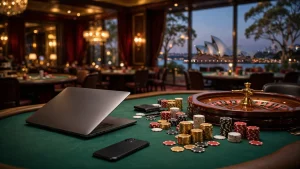
A Curaçao licence reflects an offshore regulatory claim; Australian law separately restricts offering real-money online casino games locally.
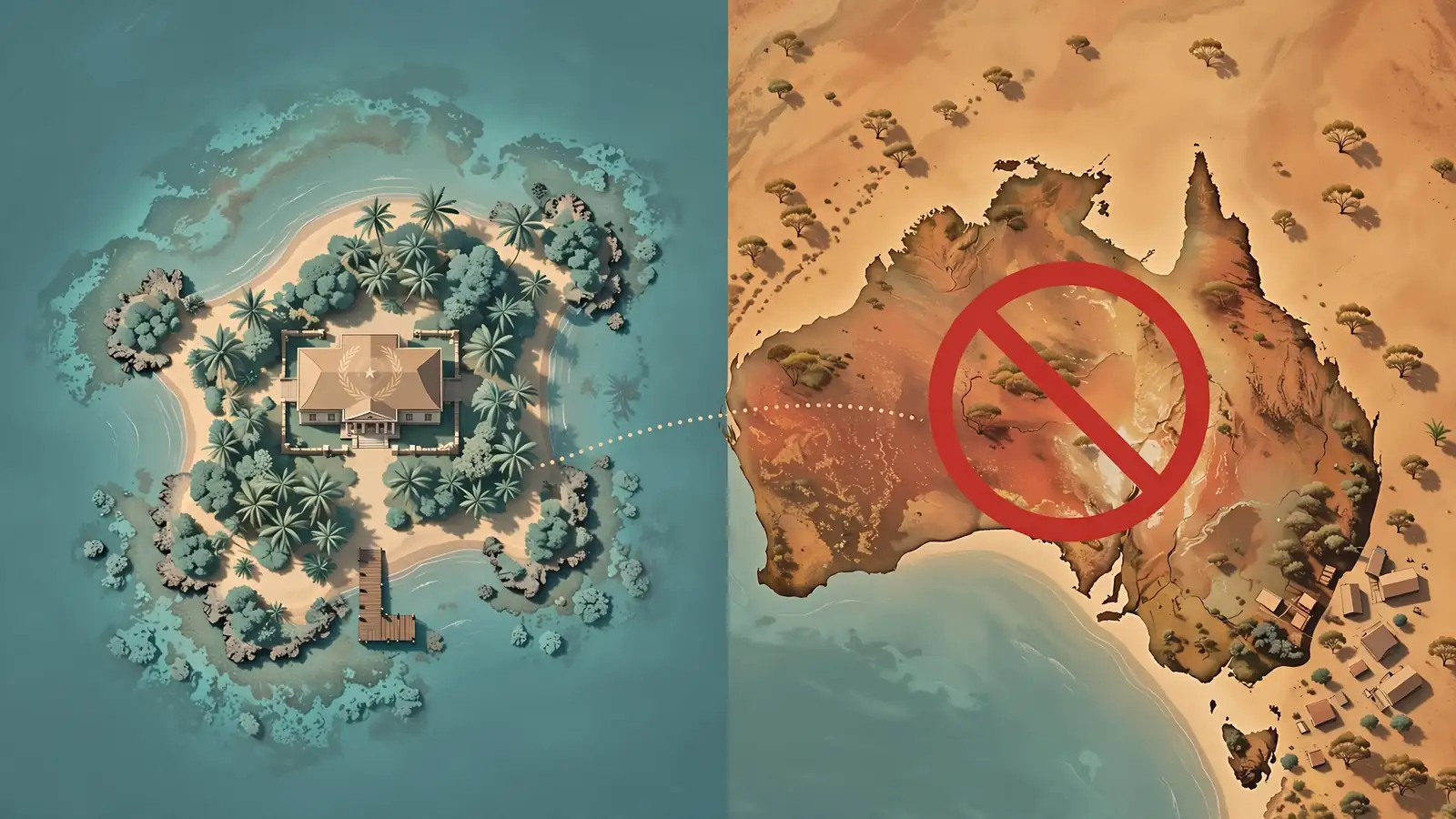
A Curaçao licence and permission to offer online casino games in Australia are different things. An offshore licence may describe the regulatory status claimed by a provider elsewhere; it does not convert that status into Australian authorisation. Under the Interactive Gambling Act 2001, offering real-money online casino games to people in Australia is prohibited. The legal question is therefore not settled by the place named on a licence.
That distinction matters because the law addresses the operator’s conduct, not simply the paperwork attached to a site. A company cannot rely on an offshore licence as a substitute for permission under Australian law to provide casino games to people here. Slots and table games sit within the online casino category at issue. The border on a website’s terms page does not move the border in the law.
The individual player’s position is different. The Act does not explicitly make a person criminally liable merely for using an offshore casino site. That is not the same as saying the service is lawful to provide in Australia, or that an offshore licence gives its users local protections. Operator and customer are not treated as interchangeable parties.
For Australian players considering casinos with a Curacao licence in 2026, the licence details and any published practical terms can help clarify what is known about each option. Use this list as a reference point and check the current terms before signing up.
Roby Casino
Roby Casino is listed with a Curacao eGaming licence held by Roby Games Ltd.
DragonSlots Casino
DragonSlots Casino is listed under the Curacao Gaming Authority, with Jumpman Gaming Ltd named as the licensee.
Thor Casino
Thor Casino is associated with a Curacao licence from Antillephone N.V. for Versus Odds B.V. Its stated minimum deposit is EUR 20.
7Bit Casino
7Bit Casino is listed as operating under a Curacao licence, with Dama N.V. as its operator.
Golden Pokies
Golden Pokies is listed with a Curacao licence.
Rollero Casino
Rollero Casino is listed with a Curacao Gaming Control Board licence, OGL/2023/176/0095, held by Hollycorn N.V.
MrPacho
MrPacho lists crypto payouts of 30–120 minutes and fiat payouts of 24–72 hours. Its minimum deposit is A$30.
Kingmaker
Kingmaker lists crypto payouts at approximately 90 minutes and fiat payouts at 1–5 days. Its minimum deposit is A$30.
JustCasino
JustCasino is listed with a Curacao Gaming Control Board licence.
WinSpirit Casino
WinSpirit Casino is listed with a Curacao eGaming licence, OGL/2024/923/0383, from Antillephone N.V. Its minimum deposit is A$30.
This separation can be easy to miss in a phrase such as “Curaçao casino for Australian players”. It joins a licensing claim to an audience, as though the first automatically settles the second. It does not. A licence issued offshore and the Australian rule governing online casino services answer separate questions.
The distinction is narrow, but consequential: the prohibition concerns the provision of the service to people in Australia, while the Act does not explicitly criminalise the individual for playing. No local authorisation follows from an offshore document. The address on the licence is not the rule.
A licence claim has a narrower meaning than its presentation may suggest. At most, a genuine offshore licence indicates that a named business has been authorised under the rules of the jurisdiction that issued it, and only for the activities covered by that authorisation. It does not, by itself, establish that the business may offer online casino games to people in Australia.
That distinction can disappear in the language of casino websites. “Curaçao-licensed” may appear beside a logo, in a footer or in promotional copy, where it can look like a general seal of approval. Yet the claim concerns an offshore authority, not Australian permission. The jurisdiction named in the claim matters; so does the business it names and the activity it covers. A badge without those particulars is not much of a credential.
 Online Craps in Australia: Formats, Rules and PlayCompare electronic craps with live tables, and learn how bets, odds, bonuses and real-money play shape the experience of online craps.
 Pocket Pokies Casino in Australia: Safety and OffersLearn how to assess Pocket Pokies reviews, safety claims, free-spin wagering terms and verification before withdrawal in Australia's complex online casino context.
The Australian question is separate. The Interactive Gambling Act 2001 sets the local boundary for operators offering online casino games to people in Australia. An offshore licence does not move that boundary or convert an online casino service into one licensed in Australia. The distinction is not a technicality reserved for legal paperwork. It is the difference between a company being authorised somewhere and being permitted to serve this market.
If the underlying authorisation is genuine and applies to the operator in question, it may support a limited statement: that the relevant business holds an offshore licence for the activities specified by that licence. That is not the same as establishing how the business handles a particular account, whether a particular game is covered, or what practical remedy a customer would have in a dispute. Those are separate questions, and a licence label alone does not answer them.
The name on a website may also be a trading name rather than the legal entity named in licensing material. That makes the connection between a visible brand and a claimed authorisation important. A claim is not verified merely because it is repeated across pages, or because a graphic looks official. The useful question is whether the claimed authorisation belongs to the entity actually providing the service and covers the activity being offered. Even a well-supported answer to that question remains an offshore answer.
A foreign licence describes an operator's status abroad but does not provide authorisation to offer online casino games to people in Australia.
This is why “Curaçao casino” and “casino licensed in Australia” should not be treated as interchangeable descriptions. One refers to an offshore licensing claim; the other would mean local authorisation. The first cannot be used as shorthand for the second. An online service may present a foreign licence as evidence of its status abroad, but that presentation cannot settle its status under Australian law.
There is a further difference between a licence and a promise. A licence is a regulatory status within a particular jurisdiction; claims about safety, fairness, fast payments or attentive customer service are not made true merely by placing that status nearby. Such matters require their own evidence. The word “licensed” can carry a great deal of visual weight. It does not carry every other claim on the page with it.
ACMA is Australia’s primary regulator for online gambling. Its website and the national register are the relevant public starting points for identifying legal gambling products in the Australian market. ACMA has urged people to use these resources to understand which products are legal, and Australians are encouraged to consult its public register to check whether a wagering service holds a valid Australian licence.
That register has a specific purpose: checking local licensing status. It should not be read as a catalogue of every offshore gambling business, nor should an offshore certificate be treated as a substitute entry in it. A foreign licence and a valid Australian licence answer different questions. The register helps with the Australian one.
 Pragmatic Play Online Casinos in Australia: Slots & TermsLearn how demo play differs from cash wagering, why a provider name does not confirm casino availability, and what bonus terms mean…
 Uptown Pokies Casino Australia: Legal ContextUnderstand how Australian law treats offshore online casinos: the Interactive Gambling Act 2001 restricts providers, not individual players. The guide also weighs
There is also a category distinction worth keeping intact. The public register is described in terms of wagering services and Australian licences. Its existence does not imply that an online casino can qualify for Australian authorisation simply by appearing in a foreign licensing system. Nor does the presence of an offshore licence settle whether a casino service is permitted here. Local status must be assessed against the local framework, not inferred from a document issued elsewhere.
The practical reading is therefore restrained: a Curaçao licence claim, if authentic, may describe an operator’s position in Curaçao. It does not establish permission to offer online casino games in Australia, and it should not be mistaken for Australian licensing. ACMA’s public information and register are the proper reference for the local position. Two jurisdictions, two questions.
An offshore casino site can appear accessible one day and fail to load later. That change may have little to do with the site’s own decisions. In Australia, ACMA can act against online gambling services that breach the Interactive Gambling Act 2001, including by asking internet service providers to block access to websites offering prohibited interactive gambling services to Australian customers. It can also seek blocks against services that are unlicensed for adults in Australia.
The distinction matters because a block is aimed at access from within the Australian market. It does not necessarily mean that a website has vanished everywhere, or that its name and pages have ceased to exist. A site may remain visible from elsewhere while an Australian connection cannot reach it. For someone encountering an online casino associated with Curaçao, the practical point is that offshore hosting or a foreign-facing website does not make access in Australia fixed or dependable.
VPN Risks
Using a VPN to access a casino may lead to winnings being voided, accounts being closed, or deposits being lost.
ACMA’s powers also extend beyond requests to internet providers. It can impose fines on operators that breach the Act, as well as block websites. These are different forms of enforcement: one can affect whether a service is reachable from Australia; the other can impose a financial consequence on the operator. Neither requires a site to announce that anything has changed. The result may simply be an error page, a failed connection, or a site that no longer opens through a particular provider.
The mechanism is easy to mistake for a verdict about every detail of a site. A website being reachable does not establish that its service is permitted in Australia; nor does a sudden failure to load, on its own, explain the reason. Availability is a technical fact about a connection at a particular time. The legal status of the service is a separate matter.
That separation is especially useful when an offshore casino is described as a Curaçao casino or as an online casino operating from the island. Such labels can make a distant business sound settled and geographically straightforward. ACMA’s blocking powers, however, concern the service offered to people in Australia and the rules governing that offer. The route by which a page reaches a screen does not settle the regulatory issue.
A block can also interrupt the ordinary routines around an account. A saved address may stop opening; a link from a discussion or directory may lead nowhere; the same site name may appear in several places even as access through an Australian provider changes. These observations do not prove that a service has been approved, rejected, or restored. They describe the uncertainty created when access is subject to enforcement.
This is not an invitation to find another route around a block. Using a VPN to reach a casino may lead to winnings being voided, an account being closed, or a deposit being lost. A technical workaround cannot convert a prohibited service into an authorised one; it can instead add a dispute about how the account was accessed.
ACMA’s record shows that website blocking is not merely a theoretical power. Since the regulator made its first blocking request in November 2019, it has restricted access to 1,369 illegal gambling and affiliate websites. The total includes affiliate sites as well as gambling services, a reminder that the field around offshore casinos is broader than the casino page itself. Referral material can also sit within the enforcement picture.
That figure should not be read as a live catalogue of sites currently blocked, or as a count of every service that has ever been unavailable to every Australian. It records restricted access over time. A changing total is part of the point: enforcement acts on services and associated sites as they arise, while the visible landscape can shift for people trying to reach them.
The scale also gives the quiet failure of a webpage a larger context. A site that does not open may be part of a wider regulatory response, not simply a temporary inconvenience or a defect in a device. Yet the number alone cannot identify the status of any particular address. That requires checking ACMA’s public information rather than treating accessibility as evidence.
For offshore operators, the possibility of a block makes the Australian market uncertain in a concrete way: a service may not remain reachable through local internet providers. For the public, it marks a regulatory boundary enforced through access as well as rules. The internet can make a casino seem only a click away. ACMA can make that click stop working.
“Curaçao casino” looks like a geographical description, but online it can do several kinds of work. It may point to a licence claim, suggest a connection between a business and an island, or simply act as a label attached to an online gambling site. Those meanings are not interchangeable. A phrase on a website does not, by itself, establish where a company is based, where its games are supplied from, or what rules apply to customers in Australia.
Geography is particularly slippery on the internet. A service can be encountered on an Australian screen while its business claims a connection to somewhere else. The place named in that claim does not move the person playing, or change the laws that apply where that person is physically located. For Australian residents, the relevant boundary is not redrawn by a site’s name, its imagery, or the jurisdiction it invokes.
That distinction matters because online casino games are not permitted for customers in Australia. Slots and table games such as blackjack fall on the prohibited side of that line. Calling a service a Curaçao casino does not create an Australian exception. The description may tell something about how the operator presents itself; it does not turn online casino play into an authorised Australian product.
A licence reference can also be mistaken for a map. It may sound as though the service itself is a place, or as though the player is somehow entering the rules of the place named. Neither follows from the wording. A website is not territory. Its label cannot establish that a player has crossed into a different legal environment simply by opening a page.
The distinction is easy to lose because the language compresses several questions into one short phrase. “Casino in Curaçao” could be read as a physical venue, a business connected with the island, an online service that mentions a Curaçao licence, or a search label that groups such sites together. A label alone does not settle which meaning is intended. Nor does it tell whether the same business has any connection to a building where people gather to gamble.
This phrase can be a geographical description, a licence claim, a label for an online site, or a search term. None of these meanings establish a legal exception for providing online casino games to customers in Australia.
This is why the phrase “Curaçao casinos” should not be treated as a straightforward category of places. In an online context, it often functions as shorthand for a kind of service or a claim made about that service. Shorthand is efficient, but it hides the distinction between a physical casino and an internet offering. The first is a question about premises and local activity; the second is a question about a service reaching customers across borders. One cannot answer the other.
The reverse confusion is just as common. A physical casino’s existence, if established, would not demonstrate that an online casino using the same geographical label is authorised to serve Australians. A building on an island and a website visible in Australia are different objects, subject to different questions. The geographical word can make them feel like parts of one story. It does not make them so.
There is a broader habit behind this confusion. Online services often borrow the authority of place: a country name, a flag, a familiar map outline, or a reference to a regulator. Such details can make a distant business feel legible. They offer a point of orientation in a system where the operator, the customer and the computer infrastructure may not share a location. But orientation is not proof. The presence of a place-name on a site cannot establish the legal status of the service for Australians.
The phrase “casino licence in Curaçao” therefore answers, at most, a question about what the site says it holds or where it claims a regulatory connection. It does not answer whether the service may offer real-money casino games to people in Australia. That question is settled by Australia’s own rules, not by importing a foreign place into the sentence. A licence reference and Australian permission are separate ideas; geography does not fuse them.
This can be obscured by the small grammar of the phrase. “Curaçao casino” puts the place before the activity, making the location seem like the defining feature. “Casino in Curaçao” sounds more concrete, as though the venue itself were on the island. “Curaçao-licensed casino” shifts the emphasis from place to authority. Each construction suggests something slightly different, yet none alone establishes what matters to an Australian customer: whether the online games may lawfully be supplied here. The answer remains no.
There is also a difference between asking whether Curaçao has casinos and asking what an online site means when it calls itself one. The former concerns physical establishments on the island. The latter concerns the wording and operation of a digital service. An online description cannot confirm whether land-based casinos exist there, how they operate, or what rules govern them. Those matters require evidence about the island’s physical venues, not inference from a website’s label.
That is not a technicality. Search language routinely makes distant businesses feel local and local law feel distant. A person in Australia may see the island’s name on a screen and imagine that the relevant rules have travelled with it. They have not. Australia’s restriction concerns the supply of online casino games to people here. A change of branding, a foreign licence claim, or a geographical adjective cannot alter that boundary.
Attention A foreign licence claim or geographical branding cannot alter the Australian legal boundary regarding the supply of online casino games.
So “casino Curaçao” can be a useful description of a claim or an online-market category, but it is a poor substitute for asking what kind of service is involved and where it is being offered. The same words can evoke a resort, a licence, a corporate address or a website. They do not prove that these are the same thing.
Place names carry weight. On a screen, they can carry more than they should.
A game’s return-to-player figure, or RTP, can look like a neat answer to an untidy question: what happens to money put into a game over time? It is a stated game characteristic, not a promise about the result of a particular session. A high-looking figure cannot tell anyone what will happen on the next spin, and a short run of play cannot confirm whether the figure is being applied as expected.
For a pokie, the RTP may be available in the game’s information or help screen. The control is often marked with an “i” or tucked into a menu. That is a more useful place to begin than a promotional description, because it is where the game itself may disclose its return information. The wording and layout can differ between games, so the detail may take a little finding.
There is a further complication: the name and appearance of a game do not necessarily identify its RTP version. Some providers make the same game available in several versions with different RTP settings. The operator selects which version to run. Two screens that look alike can therefore refer to different underlying configurations.
That distinction matters when a claim about “the game’s RTP” is presented as though there were only one possible figure. A game title alone may not settle the matter. The information screen is relevant not merely because it displays a number, but because it can help identify the version in use. If the displayed details are unclear, the claim remains difficult to assess.
This is where fairness language tends to outrun what the available detail can show. RTP says something about the game’s stated return characteristic; it does not, by itself, establish that every session will behave predictably or that every version has the same setting. Nor does a familiar title erase the operator’s choice of version. Small distinctions, large consequences.
The phrase “Curaçao gaming casino” may describe the setting in which a person encounters a game, but it says little about the game’s selected RTP version. The relevant evidence is narrower and more practical: the game’s own information, the version being offered, and whether the displayed details match claims made about it. Fairness is not a mood created by polished graphics or confident wording. It depends, at least in this limited respect, on what the game discloses and which version is actually running.
Game RTP is a stated characteristic. Because operators can select different RTP versions of the same game, the internal information screen is the most reliable source of current return details.
A claim that an offshore casino is “safe” can bundle together several different things: secure data transmission, identity checks, fair treatment of accounts and a route to resolve a dispute. Evidence for one does not establish the others. A lock icon or polished security statement is not a substitute for knowing what happens when a withdrawal is questioned.
SSL encryption is used to protect transactions and sensitive information as it moves between a user’s device and a casino site. That is a technical safeguard, not a promise that the operator will pay winnings, handle a complaint fairly or provide consumer protections. Security at the connection level and accountability at the business level are separate matters.
Identity checks are another concrete part of account handling. Casinos conduct know-your-customer procedures and require identity verification before withdrawals. These checks may involve photo identification, proof of address and evidence that the payment method belongs to the account holder. A request for documents is not, by itself, proof of misconduct; nor does completing verification establish that the service is licensed in Australia or that a later dispute will be resolved in the player’s favour.
The more consequential gap is legal protection. Unlicensed gambling services lack consumer protections, and Australian laws may not assist if an offshore operator withholds winnings. A site can appear orderly until a disagreement arises; the appearance of an orderly account is not the same as an effective remedy. That is where broad assurances become thin.
Using a VPN to reach a casino may lead to winnings being voided, an account being closed or a deposit being lost. It does not change the service’s status under Australian rules, and it can add another complication to an already difficult account dispute. A concealment tool is not a consumer safeguard.
Support information offers a more human measure of responsibility, though not a complete one. Reputable platforms provide information about gambling-related harm and direct people to professional support services across Australia. The presence of such links does not settle questions about licensing or withdrawals, but their absence leaves a site with little to say about the people affected by its product.
The question of whether a Curaçao-branded casino is safe cannot be answered by geography in a label, encryption alone or a verification checklist. Each speaks to a limited part of the arrangement. The protection that matters most may be the one that is missing when something goes wrong.
A polished website can make a licensing claim look like a settled answer. It is only one claim, and the important question for an Australian audience is whether the service is licensed in Australia to offer the product being advertised. An offshore licence does not answer that question.
The distinction matters when a site presents itself as one of the leading Curaçao casinos, or publishes a directory of services said to hold a Curaçao licence. A list can organise claims; it cannot turn them into Australian authorisation. Nor does a familiar logo, a formal-looking certificate or a confident statement in an advertisement establish that online casino games may lawfully be offered to people in Australia.
ACMA directs Australians to its website and the national register for information about gambling products that are legal in the local market. Its public register can also be consulted to check whether a wagering service holds a valid Australian licence. That is a more relevant test of local status than a foreign licence displayed on a casino page.
The scope of the check still matters. A service appearing in a register as a licensed wagering service is not thereby authorised to offer every kind of gambling product. The register is useful for checking the service and licence it records; it should not be read as a general approval of a site’s casino games, branding or offshore credentials. Labels are easy to stretch. Regulatory categories are less elastic.
A careful assessment therefore separates three things that promotional material often places in one frame: the operator’s claimed offshore licence, any Australian licence recorded for the service, and the particular product being offered. The local register addresses the Australian licensing question. A Curaçao certificate addresses a different claim. Neither should be mistaken for the other.
A list of casino sites associated with Curaçao may be presented as a consumer guide, but its inclusion criteria can be unclear. Does it confirm a licence, describe a licence claim made by the operator, or simply collect sites using similar language? Without knowing what is being checked, the word “best” is a judgement, not evidence of local authority.
The same restraint applies to claims that a service is “approved,” “regulated” or “safe.” Those words do not identify which regulator has authorised which activity in which market. A reference to an offshore regulator may be relevant to the operator’s own licensing claim, but it does not establish that the service holds a valid Australian licence. The Australian register is the place to check the local position, not a decorative extra to an offshore certificate.
There is also a practical limit to what any list can establish. A directory can become outdated, while a site’s own pages may describe its status in terms that are difficult to compare. A current entry in ACMA’s register is a concrete point to verify; a ranking assembled elsewhere is not a substitute for it. Nor does a site’s continued availability establish that its offer is permitted.
VPN use does not change the licensing position. Accessing a casino through a VPN may lead to winnings being voided, an account being closed and deposits being lost. That is a poor foundation for treating an offshore claim as local permission. The useful question is not which site has the most persuasive presentation, but what the Australian regulatory record actually says.
A crypto payment label can make an offshore casino seem like a different kind of service. It is not. The legal question in Australia remains what the operator offers, not whether a deposit is described in dollars, tokens or another digital form. The Interactive Gambling Act 2001 bars operators from providing online casino games to people in Australia. A crypto casino is not exempt from that boundary.
The use of cryptocurrency as a payment method does not create a separate gambling category or exempt a service from the Interactive Gambling Act 2001.
Searches for Curaçao casinos that accept cryptocurrency often combine two ideas: an offshore licence and a payment method. Neither, by itself, establishes permission to offer online casino games in Australia. A payment method does not change the nature of the service, and the word “crypto” does not create a separate Australian gambling category. The label is modern; the underlying question is not.
Transaction security is a separate matter. Casinos may use SSL encryption to protect information sent through a website, including sensitive transaction details. That describes a security measure for data in transit. It does not establish that the operator is licensed in Australia, that a gambling service is lawful here, or that a crypto transaction has particular protections. A secure connection is not a regulatory credential.
The distinction can be easy to miss because payment pages and licence badges sit close together on a site, as though they answered the same question. They do not. One concerns how information is transmitted; the other concerns whether the service may be offered to Australians. A polished interface cannot settle that.
Nor does a VPN change the legal position. Using one to reach an offshore casino may lead to winnings being voided, an account being closed or a deposit being lost. Concealing a connection does not turn an unauthorised service into an authorised one.
Where an unlicensed service withholds winnings, Australian law may not provide the player with a practical remedy, and such services lack the consumer protections associated with regulated services. That risk is not removed by choosing a digital asset instead of a conventional payment method. The same caution applies to claims of security: encryption can protect a connection while leaving the larger question of accountability unanswered.
Crypto may alter the mechanics of a payment, but it cannot redraw Australia’s boundary for online casino games. A different token, a different interface, the same legal line.
A newly appearing casino site can look like evidence of a new opening in the market. It may be newly launched, newly visible, or simply newly noticed; the label alone settles none of those possibilities. Nor does freshness establish that the service may offer online casino games to people in Australia.
ACMA’s record gives the changing landscape a more concrete measure. Since its first blocking request in November 2019, access has been blocked to about 1,011 illegal gambling and affiliate websites. That figure describes a market in which names and pages can disappear from ordinary access, while others may become visible. It does not make every recently noticed site illegal, or every site still accessible lawful.
This is where the word “new” does too much work. It suggests discovery and opportunity, though in a market subject to blocking it can just as easily signal uncertainty. A site’s age, branding or presence in a list cannot establish its standing in Australia. The practical question is not whether it looks recent, but whether its claims accord with the Australian regulatory position.
Using a VPN to get around a block is not a reliable answer: doing so may lead to winnings being voided, an account being closed, or a deposit being lost. A workaround does not turn a service into one licensed in Australia.
The distinction matters because a site can be difficult to reach without being newly created, and a fresh-looking address does not show that a service has passed any Australian check. ACMA’s blocking history is a reminder that access is not a permanent endorsement. Newness is a poor credential.
The Interactive Gambling Act 2001 does not explicitly criminalise individuals for using offshore casino sites. However, an offshore licence does not authorise a casino to offer online casino games to people in Australia.
Casinos commonly ask for photo ID, proof of address and proof that you own the payment method used. Identity checks may be required before a withdrawal.
After approval, PayID transfers and some e-wallet withdrawals can be quick, while bank transfers and card withdrawals can take several business days. Card withdrawals may also be slower or unavailable depending on the processor.