The amount shown by a casino is only one part of the transaction; the payment method may set a higher practical minimum.
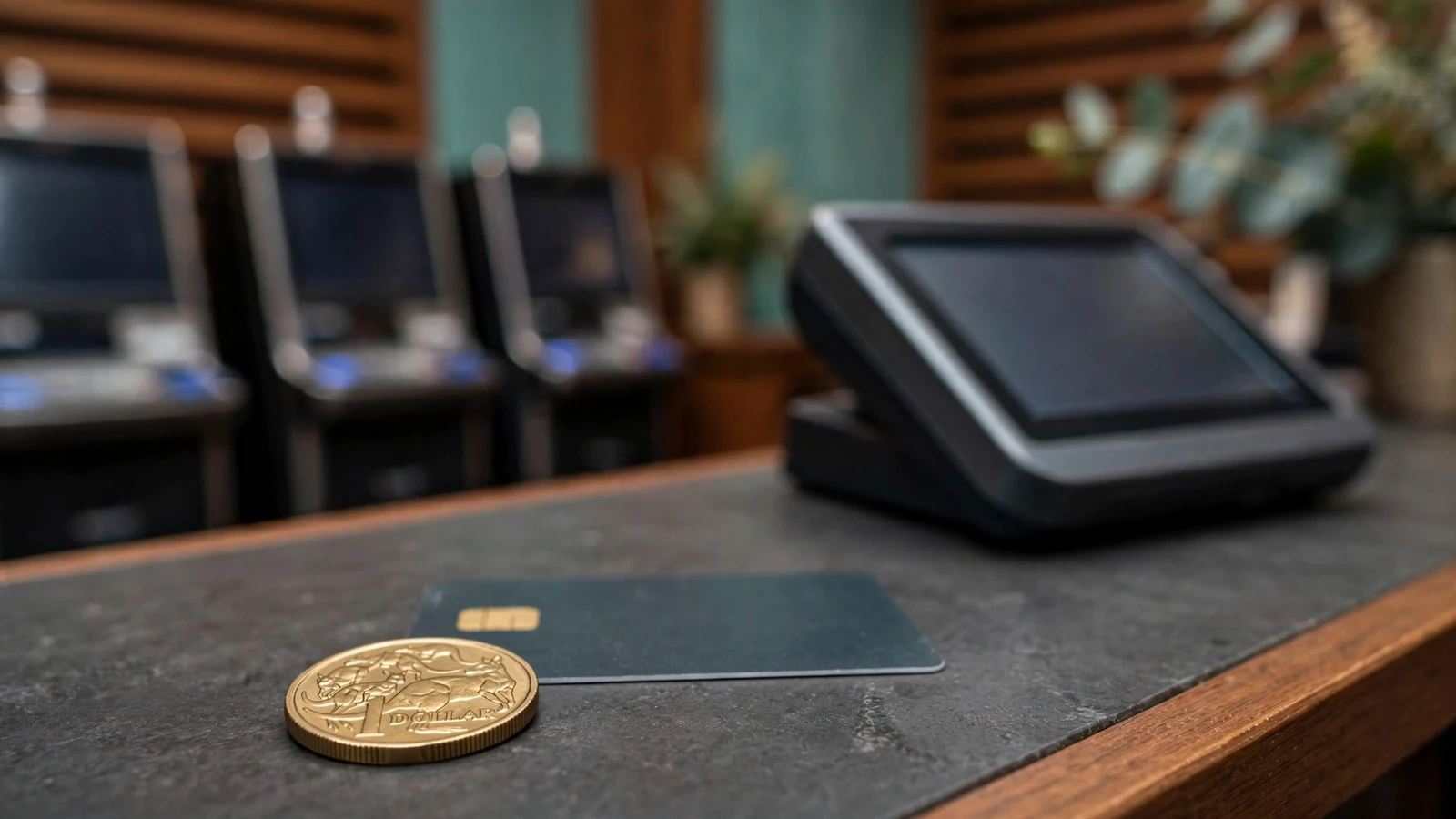
A casino’s advertised minimum and the amount that can actually be sent are not necessarily the same figure. The first may be a setting on the operator’s account system; the second depends on whether the payment route will process that amount. A page can therefore display a $1 minimum without establishing that a $1 transaction is available to someone in Australia.
That distinction matters because a deposit passes through more than one set of rules. The operator may specify the lowest amount its cashier will accept, while a payment provider applies its own threshold. The transaction can also be affected by the way a particular method handles transfers. A nominal minimum describes only one part of that arrangement.
This is the practical meaning behind claims about a $1 deposit for online pokies: the amount may be permitted in the casino cashier, yet fail at the point where the payment is made. The wording can be technically accurate and still leave the central question unanswered. What matters is not simply whether the account screen displays one dollar, but whether the selected route accepts it and credits the account.
A low minimum deposit can make it easier to try pokies without committing much upfront, but the amount required varies by casino. Use this list to check which operators have a stated minimum deposit and what other verified details are available.
Roby Casino
Roby Casino is listed with a Curacao eGaming licence held by Roby Games Ltd.
DragonSlots Casino
DragonSlots Casino is listed with a Curacao Gaming Authority licence held by Jumpman Gaming Ltd.
Thor Casino
Thor Casino lists a minimum deposit of EUR 20. Its stated licence is Curacao – Antillephone N.V., with Versus Odds B.V. as operator.
7Bit Casino
7Bit Casino is listed as operating under a Curacao licence, with Dama N.V. as its operator.
Golden Pokies
Golden Pokies is listed with a Curacao licence.
Rollero Casino
Rollero Casino is listed with Curacao Gaming Control Board licence OGL/2023/176/0095, held by Hollycorn N.V.
MrPacho
MrPacho lists a minimum deposit of A$30. Stated payout speeds are 30–120 minutes for crypto and 24–72 hours for fiat.
Kingmaker
Kingmaker lists a minimum deposit of A$30. Stated payout speeds are around 90 minutes for crypto and 1–5 days for fiat.
JustCasino
JustCasino is listed with a Curacao Gaming Control Board licence.
WinSpirit Casino
WinSpirit Casino lists a minimum deposit of A$30. Its stated Curacao eGaming licence is OGL/2024/923/0383, held by Antillephone N.V.
An Australian specialist review places the effective minimum for a usable deposit between $10 and $20 AUD. That is a reported assessment, not a fixed market-wide rule: payment arrangements change, and an individual service may set a different threshold. It nevertheless illustrates why a stated one-dollar floor should not be treated as a reliable description of what can be deposited.
The difference is not unusual in financial services. A business may have little reason to reject a small amount at its own end, while the systems that move the money impose conditions of their own. The operator’s number can look like the whole story because it is the number shown most prominently. It is not.
Nor does the phrase “$1 minimum” tell much about the character of the service offering it. It says something, at most, about a cashier setting. It does not establish that the route is available in Australia, that the transaction will clear, or that the service is lawful to provide here. A small figure can be precise and still be incomplete.
There is a more basic limit in the Australian setting. Real-money online casino games, including pokies, are prohibited services when provided to people in Australia under the federal framework. The question of whether a payment can be made is therefore not the same as whether the underlying service may lawfully be offered to Australian residents. A deposit threshold cannot settle that question.
 200 Free Spins No Deposit in Australia: Offer TermsLearn how sign-up, game restrictions and withdrawal rules shape no-deposit spin offers, and how Australia’s Interactive Gambling Act 2001 affects their context.
 $5 PayID Casino No-Deposit Bonus in AustraliaSee how a $5 no-deposit offer differs from a first-deposit bonus, and how wagering, cashout caps, game limits and expiry affect withdrawals.
The Australian Communications and Media Authority can ask internet service providers to block websites offering prohibited interactive gambling services, or advertising them locally. The regulator reports that more than 1,455 illegal gambling and affiliate websites have been blocked since November 2019. It also reports that more than 210 illegal services have left the Australian market since enforcement began in 2017; other reporting gives a lower figure of more than 190. The counts differ. The broader point is that access is subject to active enforcement, not merely to the terms shown on a payment screen.
This makes “online pokies with a $1 deposit” an especially narrow description. It combines an operator’s stated threshold with an assumption about payment access and, often, an assumption about availability in Australia. Those are separate matters. A one-dollar label cannot make them equivalent.
The same applies when the wording refers to mobile play. A mobile page may present the same cashier and the same advertised threshold as a desktop page, but the screen size does not remove payment-provider conditions or change the legal position. The amount displayed remains only the operator’s side of the transaction.
For a reader trying to understand what a $1 deposit means in practice, the useful distinction is therefore between a displayed minimum and a completed, usable deposit. The first is a claim about a setting. The second depends on payment acceptance and the wider conditions in which the service operates. One dollar may appear on the page; that alone does not make it a practical or lawful option in Australia.
A small number is not the whole transaction.
Legal Warning
Real-money online casino games, including pokies, are prohibited services when provided to people in Australia under the federal framework.
A small qualifying deposit can make a promotion look modest and manageable. The wagering requirement may tell a different story. It determines how much eligible betting must take place before bonus-related winnings become available, so the size of the deposit alone says little about the effort involved. A low entry point is not a shortcut through the terms.
A specialist review reports wagering requirements of 35x to 50x the bonus amount for some low-deposit bonuses. That range is not a universal rule: the applicable multiplier depends on the promotion’s terms. The important detail is what the multiplier applies to. A requirement calculated on the bonus amount is different from one calculated on the deposit plus bonus, and the wording should make clear which balance is used.
The arithmetic can become substantial even when the offer is presented as a small extra. A stated multiplier measures required turnover, not a guaranteed loss or a promise that the bonus will be cleared. Each eligible stake contributes toward the total, but the result of play remains uncertain. More turnover means more opportunities for a balance to rise or fall before the requirement is met. The bonus has a price in play, even when no separate fee appears.
That distinction is easy to miss because promotional language tends to foreground what is added to an account, while the wagering clause sits further down. Yet the multiplier is often the more useful measure of the offer. A bonus that looks generous in headline form may require a long sequence of eligible bets; a smaller offer with less restrictive terms may be easier to understand, though not necessarily more valuable. The label does not settle the question.
Game weighting adds another layer. Pokies may count fully toward a wagering requirement, while blackjack and roulette may contribute only 10% or 20%. In practical terms, a bet on a game with reduced weighting advances the requirement more slowly than an equivalent eligible bet on pokies. A player who assumes that every game counts equally could spend time and funds without making the progress expected.
Full contribution does not mean a game is safer or that the requirement is certain to be completed. It only describes how much of eligible play is credited under the promotion’s rules. Likewise, a reduced contribution does not mean table games are excluded altogether; their smaller share can simply make them an inefficient route for clearing a requirement. The distinction is administrative, not a prediction about outcomes.
The terms may also define which games qualify, when the wagering period begins, and what happens if conditions are not met. Those details belong to the offer itself and can vary. A promotion’s banner is not a substitute for its rules: the rule text determines whether a particular game counts and how progress is recorded. If the wording is unclear, the apparent simplicity of a small deposit does not resolve it.
Before accepting a promotion, the key checks are the minimum deposit required to activate it, the wagering multiplier, and the weighting assigned to pokies compared with table games. These are related but separate conditions. A deposit can meet the threshold while the bonus remains subject to a demanding turnover requirement; a game can be available while contributing only part of each eligible stake. Checking one clause does not answer the others.
There is a social history in this arrangement. The deposit is visible and immediate, while the obligation attached to the bonus is expressed as future play. That imbalance is useful to promotion design: a small entry figure feels concrete, whereas a multiplier requires calculation. The terms then turn an apparently simple offer into a contract about how play will be counted.
For anyone comparing a one-dollar entry point with a bonus, the amount required to qualify should not be confused with the amount of play required afterwards. Nor does a low minimum establish that a promotion is suitable. The only reliable comparison is between the offer’s activation threshold, its multiplier, and its game-weighting rules, read together rather than as separate pieces of fine print.
The bonus may be small. The obligation need not be.
A one-dollar minimum describes an entry condition, not a promise that one dollar will go far. The distinction matters because a deposit passes through several separate thresholds: the amount a casino says it will accept, the amount that arrives after payment costs, and the balance needed to place a bet. Only the last of these determines whether the money can be used for pokies.
A specialist review has reported cryptocurrency deposits with a casino-set minimum as low as the equivalent of A$1. That is a narrow claim about a stated threshold, not evidence that every payment route will accept that amount or that a player can make practical use of it. The figure may be visible on a deposit screen while the real conditions sit elsewhere: in the transfer process, the exchange between currencies, or the game’s minimum stake.
This is how a small number acquires a larger meaning than it deserves. A casino can define the smallest amount its system is prepared to credit. A payment provider can have its own rules, and transaction costs can make a tiny transfer poor value or reduce what reaches the account. The displayed minimum and the usable balance are therefore not interchangeable. A deposit may technically succeed and still leave too little to place even a permitted bet.
Pokies make that difference especially plain. Each game sets the terms on which a spin can be made, including a minimum stake. If the account balance falls below that floor, the money is present but cannot be put into play on that game. If it sits only slightly above the floor, the balance may allow very little room to continue. The point is not that every game has the same minimum; it is that the deposit amount alone cannot establish how many bets a balance can support.
There is a small but important shift in the language here. “Minimum deposit” sounds like a useful measure because it is easy to compare: one amount against another. Yet it measures the doorway, not the room beyond it. A low threshold can make a platform look accessible while saying nothing about the cost of moving funds, the stake required by a chosen game, or how much play a balance permits. The number is precise; its practical meaning is not.
A deposited amount only becomes a playable balance if it meets the specific minimum stake required by the chosen pokies game.
For someone looking for a $1 deposit on pokies in Australia, the relevant question is therefore not merely whether a casino lists a one-dollar minimum. It is whether the chosen route can transfer that amount, whether costs leave a meaningful balance, and whether that balance meets the game’s minimum bet. These conditions can differ, so a headline figure cannot settle the matter by itself. A one-dollar deposit may be possible in a nominal sense without being a workable starting balance.
That distinction also helps explain why a tiny advertised minimum should be read cautiously rather than treated as a measure of affordability. Affordability concerns the full amount that leaves an account and the amount that can actually be used; a minimum deposit is only one part of that picture. If the transfer costs are disproportionate or the remaining balance cannot meet a game’s stake floor, the smallest permitted deposit is effectively a label without much practical value.
The attraction is understandable. A low threshold makes an unfamiliar service appear less demanding, and the neatness of a single dollar has an obvious appeal. But money does not become useful merely because a system accepts it. The meaningful minimum is the one that survives the transaction and can be used under the game’s rules. That is a less tidy figure.
A one-dollar figure attached to a cryptocurrency deposit can sound unusually precise. In practice, it describes a nominal threshold, not necessarily the amount that reaches a game balance in a useful form. The casino may set a low minimum in a digital currency, while the Australian-dollar equivalent shifts with the coin’s value. The number displayed at one point can therefore represent a different amount later.
That distinction matters especially when the advertised threshold is presented as an Australian-dollar amount. A specialist review has described some casino-set crypto minimums as low as the equivalent of A$1. That is a report about a possible nominal limit, not evidence of a stable market-wide offer. Another specialist review has reported deposits as low as A$5 through cryptocurrency at some offshore operators. Neither figure establishes what a particular service currently accepts, or what the deposited amount can practically do.
The gap between a minimum and a usable balance comes from the transaction itself. A deposit may incur costs, and the value transferred can be affected by the conversion between Australian dollars and the cryptocurrency used. Where the starting amount is tiny, even a cost that seems modest in isolation can take a substantial share of it. A deposit credited in crypto also remains exposed to changes in its Australian-dollar value; the stated equivalent is not a promise that the balance will retain that value.
Then there is the game’s own scale. Pokies have minimum bets, so a balance that technically clears a deposit screen may still leave little room to play. A one-dollar equivalent can meet a payment threshold without becoming a meaningful playing balance. The distinction is almost architectural: one figure belongs to the cashier, another to the game.
Attention: A nominal cryptocurrency minimum may be reduced by transaction costs or affected by shifts in the coin's value relative to the Australian dollar.
Bitcoin is often the coin named in searches for a one-dollar deposit, but the label alone does not settle the practical question. The relevant terms are the casino’s minimum, the coin accepted, the conversion used to show an Australian-dollar value, and any transaction costs. Those details can vary between services and over time. A low number on a promotional page should not be read as proof that the same amount will arrive intact or support a usable session.
There is also a legal boundary that the smallness of the amount does not alter. Under Australia’s Interactive Gambling Act 2001, operators may not provide real-money casino games, including pokies, to people located in Australia. A low crypto threshold does not change the nature of the service or create an exception. Describing figures reported about offshore sites is not an endorsement of using them.
The appeal of going small is understandable: a low entry figure appears to place a neat ceiling on the cost. Cryptocurrency makes that appearance more complicated, because the displayed Australian-dollar value, the amount credited, and the balance available for play are not necessarily the same thing. A nominal minimum answers only one narrow question. It does not tell the whole financial story.
Small on screen. Not necessarily in effect.
PayID can make a payment feel almost immediate: it uses Australia’s existing bank-payment infrastructure rather than asking someone to buy a separate voucher or arrange a conventional transfer. That convenience, however, does not set the amount a gambling site will accept. The casino’s payment rules and the bank’s own processes remain separate parts of the transaction.
A specialist review places the reported minimum for PayID or instant bank transfers at AU$10–AU$20. That range is not a fixed rule for every service, and payment conditions can change. It does show why a search for a $1 PayID deposit may run into a practical barrier before any funds reach a gaming account. A page can display a low headline minimum while the PayID option at checkout requires more. The relevant figure is the one shown for that method at the point of payment, not a general claim about the site.
There is a small institutional irony here. PayID’s appeal comes from making ordinary bank payments simpler; the minimum is still governed by the arrangements attached to the receiving service. A one-dollar amount may be easy to type, but that does not mean the payment rail or the operator’s cashier will accept it.
PayID is also described as a fast route for cashing out. A specialist review reports that payments may arrive the same day, though that is not a promise applying to every account or transaction. Account verification and the service’s own processing steps can affect timing. The speed of a payout should therefore be treated as a separate question from the minimum required to deposit: a payment method can be quick at one end and unsuitable for a very small amount at the other.
For anyone comparing a $1 PayID deposit with a larger bank payment, the distinction is not merely technical. The advertised minimum may refer to the site as a whole, while the method-specific floor determines what can actually be sent. PayID’s convenience does not erase that floor, and a same-day cash-out description does not establish that a one-dollar deposit can be made.
In Australia, the numbers attached to PayID should be read as reported conditions, not permanent standards. The cited specialist review gives a range for deposits and describes same-day payouts as possible; neither detail guarantees what a particular service will permit. The method is best understood as a fast bank-linked option with its own minimum, not as a shortcut around minimum-deposit rules. A small figure on a page is not yet a completed payment.
A one-dollar starting balance can make the possible loss look neatly contained. The sum is small; the uncertainty is not. In real-money pokies, each stake puts part of that balance at risk, and a low deposit does not change the game’s underlying chance of losing. It changes only how much money is present at the outset.
Cash out introduces a separate measure: the minimum amount an account must reach before a payment can be requested. A specialist review has cited minimum cash-out thresholds of $20 to $50 AUD, but that is a report from one review, not a settled rule across the market. The relevant terms can differ between services, and a small balance may sit below the stated threshold.
That gap can make a modest win feel less like money in hand than money behind a gate. If the balance is below the minimum, it may not be eligible for cash out yet. Reaching the threshold would require the balance to grow, but further play also exposes it to loss. There is no dependable path from a small deposit to a cashable amount.
The distinction matters because a deposit limit measures what goes in, while a cash-out threshold governs when money may come out. They are not matching ends of a simple transaction. A player can lose the deposit before any threshold becomes relevant; a remaining balance can also be too small to request as a payout. Either way, the screen’s balance and spendable money are not necessarily the same thing.
This is one reason the phrase “small risk” misleads. A low starting sum limits the amount initially put at stake, but it cannot promise a return, make a loss recoverable or remove conditions attached to cash out. The possibility of losing the entire deposit remains. And a threshold can make the final step harder, not easier.
The arithmetic is plain. The feeling is not.
The word “Australian” on an online casino’s page can describe its intended audience, its currency display or its branding. It does not mean that the service is authorised to provide real-money casino games in Australia. That distinction is central to the country’s offshore market: the audience may be local while the operator and its licence sit elsewhere.
The federal framework is the Interactive Gambling Act 2001. It makes supplying online casino-style games, including pokies and table games, to people in Australia unlawful for operators. The prohibition concerns the service being provided, not merely the way a site describes itself. A foreign licence does not turn a service prohibited under Australian law into a locally authorised one.
This federal framework makes it unlawful for operators to supply online casino-style games, including pokies and table games, to people located in Australia, regardless of where the operator is licensed.
Responsibility for applying the federal rules rests with the Australian Communications and Media Authority (ACMA). The authority monitors compliance and can ask internet service providers to block websites that supply prohibited interactive gambling services or advertise them in Australia. Blocking is one instrument of enforcement, rather than a declaration that every offshore site has disappeared from view. The boundary is policed, even if it is not always visible on a screen.
That leaves an important distinction between the operator’s position and the individual’s. The law restricts operators from providing the prohibited service to people in Australia, but it does not make a person’s act of placing a bet with an offshore operator a criminal offence. This is not the same as government approval, consumer protection or a local licence. It is a difference in where the law places the prohibition.
For anyone considering real-cash play, the phrase “Australian pokies” therefore needs careful interpretation. It may signal a market the operator seeks to reach, not a service regulated as an Australian casino. Some sites operate from offshore jurisdictions; their foreign licensing arrangements do not displace the federal ban on supplying online casino games to people physically in Australia.
A small advertised deposit does not alter that legal boundary. Nor does a site’s Australian-facing presentation. The deposit language belongs to the commercial surface; the statute addresses the underlying service. Two different maps.
A payment screen can show a low deposit threshold while the route chosen to fund it imposes a higher one. That gap matters more than the casino’s displayed figure: the payment method may determine whether a small amount can be sent at all.
Neosurf illustrates the point. A voucher purchase is typically set at A$10, which effectively makes that the minimum deposit through this route. A nominal $1 minimum on the receiving end cannot make a smaller voucher purchase possible. The threshold belongs not to the game balance but to the way money enters it.
E-wallets can create a similar barrier. A specialist review has reported that Skrill and Neteller deposits to gambling sites often have a A$10 minimum transaction, and that fees may apply. Both details can vary by service and transaction, so the relevant terms are those shown for the specific transfer. A fee also changes the arithmetic: a small payment may lose some of its value before it reaches the account. Small amounts, meet fixed costs.
Bank transfers present a different problem. Their obstacle is less a stated minimum than the time and possible expense involved. A transfer may take several business days to process, while the sending bank may charge a fee. For a low deposit, waiting and paying for the movement of funds can make the route disproportionate to the amount being sent.
These methods show why “minimum deposit” is not always a single figure. A voucher’s purchase denomination, an e-wallet’s transaction floor and a bank’s processing conditions all shape what can actually be deposited. The smallest amount displayed by a gambling site may therefore be irrelevant to someone whose chosen payment route will not handle it.
For anyone comparing a stated $1 minimum with the amount a payment method accepts, the distinction is practical rather than semantic. A low figure on a deposit page does not override the rules of the service carrying the money.
Voucher purchases are typically set at A$10, which effectively becomes the minimum deposit for this route.
Services like Skrill and Neteller often have a A$10 minimum transaction and may apply additional fees.
These routes may involve processing times of several business days and potential fees from the sending bank.
A first-deposit promotion can make a small opening payment look more substantial, but the displayed bonus is not automatically money available to cash out. Once accepted, its terms may govern how winnings are treated, how much can be staked during play and what amount can ultimately be paid.
The wagering requirement can make the distance between a bonus and a cashout considerable. A specialist review gives the illustration of a $1,000 bonus carrying a 35× wagering requirement: the required betting total would be $35,000 before bonus winnings could be withdrawn. That example describes one set of terms, not a standard that applies to every promotion. The multiplier and the amount it applies to determine the actual requirement.
The permitted stake during wagering matters as well. If the terms set a maximum stake per spin, exceeding it can void winnings. A permitted bet is therefore not simply a matter of choosing a comfortable amount; it can determine whether the promotion remains valid. The cap may apply while the wagering requirement is being completed, rather than only when a cashout is requested.
Game weighting also affects how quickly eligible play contributes. Pokies generally count in full toward wagering, while blackjack and roulette may count for much less. A balance can be active without every game contributing equally to the required total.
Finally, a maximum cashout cap can limit what is payable even after the wagering requirement has been met. These are separate restrictions: one governs the betting needed to qualify, another may restrict the stake, and another can limit the resulting payout. The headline offer alone reveals none of that.
For Australian audiences, real-money online casino games are prohibited services under the Interactive Gambling Act 2001. Promotion terms can be described as conditions, not as an invitation to use such services. Where a first-deposit offer is presented, its minimum qualifying deposit, wagering requirement, game weighting, maximum stake and cashout cap are the terms that define its limits. The small print does the accounting.
A one-dollar deposit is most plausible through cryptocurrency, where a casino may set its own minimum far below the amount accepted by a bank or voucher service. A specialist review has reported crypto minimums as low as the equivalent of A$1. That is a report about a particular offering, not a dependable Australian-market standard: payment rules can differ between services and change over time.
The figure on a deposit screen also describes only the casino’s threshold. A crypto transfer has to travel through a payment network, and its costs can make a very small transfer poor value. Even if the deposit is credited, the balance may not stretch to the minimum stake on a game. The nominal entry point and a playable amount are separate things.
That distinction matters more than the headline. A search for pokies that accept a one-dollar minimum can turn up a payment threshold that is technically possible but awkward in practice. “Accepted” may mean only that a deposit passes the casino’s stated minimum; it does not establish that the funds can be transferred economically or used for a meaningful session. Tiny figures look precise. Their usefulness is another matter.
Cryptocurrency is therefore the route most often associated with a nominal A$1 threshold in specialist coverage, but that does not make a dollar a reliable first deposit for online pokies in Australia. The result depends on the casino’s current deposit rule, the coin and network selected, and the game’s minimum bet. A low number in one part of the transaction cannot settle the others.
There is no sound basis for treating every crypto-enabled site as able to accept one dollar, or for assuming that a deposit accepted at that level will be usable. The narrow answer is that some crypto deposit settings may reach that nominal floor; whether the transfer can be completed and played is a separate question.
The casino may set no minimum, but payment methods commonly require AU$10–AU$20. Some offshore operators accept cryptocurrency deposits from as little as AU$5.
The Interactive Gambling Act 2001 prohibits the provision of certain online gambling services to Australian residents. It does not criminalise an individual for placing a bet with an offshore operator.
A usable deposit in Australia commonly requires AU$10–AU$20, while some low-deposit bonuses have wagering requirements of 35x to 50x the bonus amount. Check whether the multiplier applies to the bonus alone or to the deposit and bonus together.
Yes, but casinos often set a minimum withdrawal of AU$20–AU$50. Bonus wagering terms may also need to be met before bonus-related winnings can be withdrawn.
Yes. Some low-deposit bonuses require wagering of 35x to 50x the bonus amount, and the promotion’s terms determine which bets count.