A guide to distinguishing venue hours from gaming hours and interpreting searches for Tasmanian pokies.
“Open” sounds like a simple condition: doors unlocked, lights on, people coming and going. For pokies, it can describe something narrower. A venue may be operating while its gaming machines are not available, so a venue’s opening hours and the hours of play should not be treated as interchangeable.
That distinction matters to anyone trying to establish whether pokies are available at a particular time in Tasmania. A listing that says a hotel, club or other venue is open does not, by itself, settle whether its gaming area is operating. The two schedules answer different questions: when the premises welcome customers, and when the machines can be played.
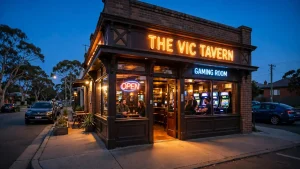
The wording on a sign or listing can blur the difference. “Open” may refer to the venue as a whole, while a separate schedule or direct confirmation may be needed for its gaming facilities. A late-night kitchen, bar or accommodation desk can have its own rhythm; the presence of activity in one part of a building says little about another. A lit window is not a timetable.
“Open now” is a claim about the present, not a durable description of a venue. Even a schedule that was accurate when last checked can become stale if hours change or a service is temporarily unavailable. Online listings are useful starting points, but they do not necessarily update at the same moment as a venue’s own operations.
For that reason, a current status needs confirmation from the venue itself. The useful question is not merely whether the building is open, but whether pokies are operating at the time in question. Asking that directly avoids the small but consequential ambiguity built into a general opening label.
This is especially relevant when the intended visit is early or late. A search for pokies available at dawn or after dark is really asking about machine access at a particular hour, not simply whether some part of a business is open. The distinction should remain clear even when the wording on a listing is brief.
No universal Tasmanian timetable can be inferred from the phrase “open now”. A schedule that applies to one venue does not establish the hours of another, and an opening time for a business should not be silently converted into a machine operating time. Specificity belongs to the individual venue.
A venue can be understood as running on more than one clock. Its public-facing services may have one pattern; its gaming machines may have another. These arrangements can be presented separately, and the difference is easy to overlook when hours are condensed into a single line.
The distinction also changes what “open early” or “open late” means. For a café or bar, those phrases point to service availability. For pokies, they point to whether machines are accessible for play during that period. The words may look interchangeable in a hurried listing, but they describe separate facts.
A sound check therefore needs to be specific and current. The venue’s own published information may help, while direct contact can clarify whether the machine area is operating at that moment. If the answer is simply that the venue is open, the question about pokies remains unanswered.
Hours shape the character of gambling as much as the physical setting does. A place that is open for one kind of service may not offer every activity throughout that period. Treating all opening information as a single promise makes the venue seem more uniform than it is.
There is also a human dimension to the clock. A late visit or an early one can sit within a longer stretch of activity, and the passage of time may become less visible in a room designed for continued play. Deposit limits, loss limits and session time limits are among the standard tools used to place boundaries around gambling; self-exclusion is another. They do not establish when a particular venue’s machines are available, but they reflect a recognition that time and spending can be difficult to track while play continues.
The practical distinction remains modest and important: venue hours describe access to the premises; machine hours describe access to pokies. Neither should be presumed from the other. For a current answer, the venue’s confirmation matters more than a general label, particularly when the intended time falls outside an ordinary daytime visit.
“Open now” is only the beginning of the answer.
Choosing pokies for play in Tasmania means checking the details that matter to you before signing up. This list offers a concise reference to the information available for each operator.
Roby Casino
Roby Casino is listed with a Curacao eGaming licence held by Roby Games Ltd.
DragonSlots Casino
DragonSlots Casino is listed with a Curacao Gaming Authority licence held by Jumpman Gaming Ltd.
Thor Casino
Thor Casino is listed with a Curacao licence from Antillephone N.V., with Versus Odds B.V. named as the operator. Its minimum deposit is EUR 20.
7Bit Casino
7Bit Casino is listed as operating under a Curacao licence, with Dama N.V. named as its operator.
Golden Pokies
Golden Pokies is listed with a Curacao licence.
Rollero Casino
Rollero Casino is listed with a Curacao Gaming Control Board licence, number OGL/2023/176/0095, and Hollycorn N.V. is named as the operator.
MrPacho
MrPacho lists crypto payouts at 30–120 minutes and fiat payouts at 24–72 hours. Its minimum deposit is A$30.
Kingmaker
Kingmaker lists crypto payouts at approximately 90 minutes and fiat payouts at 1–5 days. Its minimum deposit is A$30.
JustCasino
JustCasino is listed with a Curacao Gaming Control Board licence.
WinSpirit Casino
WinSpirit Casino is listed with a Curacao eGaming licence, number OGL/2024/923/0383, from Antillephone N.V. Its minimum deposit is A$30.
The word “best” sounds like a verdict, but a return figure is not a promise about what a particular machine will pay during a visit. It describes a setting associated with the game, not a personal forecast. That distinction matters wherever people compare pokies in Tasmania, whether the question concerns a casino floor, a club or another venue. A number can look wonderfully decisive while saying very little about the next spin.
RTP, or return to player, is commonly used to describe the proportion of stakes a game is designed to return over a very large volume of play. It is a long-run measure, not a schedule of repayments. A figure displayed in promotional material cannot tell anyone when a win will occur, how large it will be, or whether a particular session will end ahead. “Best paying” may therefore be an appealing label, but it can encourage an expectation the measure was never built to provide.
There is another complication: the title of a game does not necessarily identify one unchanging return setting. A specialist review reports that some game providers give casinos a choice of RTP settings for the same pokie. If that arrangement applies, two versions bearing the same game name can have different stated return percentages at different casinos. A comparison based on the title alone may miss the detail that matters.
That is a narrow claim, not a licence to assume every venue changes settings or that every game comes in several versions. It means that an RTP claim needs context: which setting is being discussed, and whether it applies to the version in question. If that detail is not clear, a confident ranking of “best pokies in Tasmania” rests on a shaky foundation. The game name may be familiar; the setting may not be.
Nor does a higher stated return make the machine a reliable source of income. The arithmetic behind RTP concerns repeated play across a very large number of outcomes. It cannot be converted into a promise that an individual will receive a particular share back, or that losses will be corrected later. A machine does not keep a social account of who has waited patiently.
Each spin is generated through a Random Number Generator, with the outcome of one play separate from the next. A previous loss does not make a win due, and a recent win does not make another one more likely. Patterns can seem persuasive in the moment: a machine has been quiet, a bonus has appeared, or several outcomes have clustered together. But a sequence that feels like a story to a person is not evidence that the next result has been scheduled.
This is why advertised return figures and the experience of a short session can appear to disagree. A player may see a run of outcomes that bears little resemblance to the published long-run measure. That does not, by itself, show that the machine has broken its pattern or that a payout is imminent. It shows the difference between a statistical description across extensive play and the small, uneven stretch that any one person encounters.
Each spin is generated through a Random Number Generator, meaning the outcome of one play is separate from the next and previous losses do not make a win due.
The same caution applies to lists that rank pokies by apparent generosity. Without a comparable, clearly identified setting for each game, a ranking may place unlike versions side by side. Even when figures are directly comparable, they do not settle questions about how a session will unfold. Return is one property of a game; it is not a forecast of an individual result, and it cannot turn chance into a dependable plan.
So a return percentage can help describe a game, provided its setting is known and its meaning is kept in proportion. It cannot establish which pokie will pay during a visit, and it cannot make a “best” label universal across Tasmania’s venues. The promise suggested by that word belongs to advertising. The outcome belongs to chance.
A request for pokies near a Tasmanian airport sounds as though it should have a simple answer: find the airport, find a venue, measure the gap. But the phrase alone does not identify a particular gaming venue or establish how far one is from an airport. A location-shaped question is not yet a location-based answer.
The difficulty begins with the word *near*. It can mean a short drive, a walk, or simply somewhere in the same broad area. Those are different measures, and none can be inferred from a general reference to Tasmania. Nor does the word *airport* settle the matter. Without a specified airport and a verified destination, a distance would be guesswork dressed up as directions.
That distinction matters for travellers, whose idea of a convenient stop is often shaped by luggage, transport and the time available between arriving and leaving. A venue that appears close on a map may not be easy to reach in practice; a venue in the same region may still be a substantial journey. Yet no particular route, travel time or nearby venue can be responsibly attached to the broad search for pokies near Tasmania’s airport.
The same caution applies to searches that mention north Tasmania. A regional label may narrow the intended area, but it does not identify a venue, confirm that it has pokies, or establish its position relative to an airport. “Near me” is more precise only when the location behind *me* is known. Without that reference point, it is a request for proximity with the most important coordinate withheld.
The wording that combines Tasmania and Victoria adds another kind of uncertainty. A place name can be mistyped, misremembered or used without a clear sense of which side of a state boundary is intended. It cannot, by itself, support a claim about where a venue is or how far away it lies. A confident answer built from an unclear place label would create certainty where there is none.
Online maps and directory entries can help with orientation, but a pin is not proof of current venue details, machine availability or a reliable route. Those are separate questions. A distance calculated between two points is meaningful only if both points have first been identified correctly; otherwise, the arithmetic merely gives an exact answer to the wrong question.
This is a narrower issue than finding pokies in Hobart’s central area. Airport access concerns a starting point and a journey; a CBD search concerns a defined part of a city. The two should not be folded into one list, as though a central-city result automatically answered a traveller’s question about airport proximity.
For anyone comparing locations, the useful distinction is between a general regional search and a confirmed venue address. Until both the airport and the destination are clear, there is no sound basis for calling a venue nearby or assigning it a distance. A neat number would not make the answer more useful. It would only make the uncertainty harder to see.
A venue’s responsibility for gambling harm is not measured only by what happens at the machines. It also depends on whether staff are present to notice when play appears to be affecting someone, and whether the venue has a way to record and respond to those concerns. A report by regionriverina.com.au describes new duties for venues operating more than 20 gaming machines. That threshold matters: the reported requirements concern larger machine floors, not every place where pokies may be found.
Under the reported change, a dedicated Responsible gambling officer (RGO) must be on duty while the machines are operating. The role is not merely a name on a roster. Its significance lies in having a designated person available during gaming hours, rather than leaving responsibility diffuse among staff occupied with other tasks. The report says the requirement begins from 1 July; it should be understood as a reported regulatory change, not as evidence that every Tasmanian venue has the same arrangements.
There is also a transition period. The report describes a one-month grace period for venues to introduce RGOs and remove signage covered by the change. That allowance recognises the practical work of changing staffing and the environment around gaming. It is not a permanent exemption. Nor does a grace period tell a visitor whether a particular venue has completed the changes; it describes time given to venues, not a public certification of compliance.
Records form another part of the approach. Venues are to keep a gambling incident register, recording occurrences that may indicate a patron is at risk of harm or already affected by it. Such a register turns an observation into something that can be reviewed: a moment of concern need not disappear when a shift ends. The point is not to label patrons, but to give the venue a record of incidents and a basis for follow-up.
This paperwork has a social meaning. Gambling harm can become visible first as a change in behaviour, while the person experiencing it may not ask for assistance. Assigning an officer and recording incidents places some responsibility on the institution that hosts the play, rather than treating every consequence as a private failure of self-control. It is a modest redistribution of attention.
For anyone comparing Tasmanian pokies venues, these duties are more useful as questions of practice than as a ranking. A venue’s machine count or reputation alone cannot show how staff respond to distress, whether concerns are documented, or how the transition has been handled. The reported rules set out a framework; they do not certify individual venues or identify a “best” one. Compliance, where applicable, is the baseline. Not a prize.
A search about pokies aboard the Spirit of Tasmania and a search for online pokies point to different questions. One concerns a named ship; the other concerns gambling services accessed over the internet. Putting “pokies” beside the ship’s name does not, by itself, establish that machines are available on board. A vessel’s identity and its role in travel are not evidence of a particular onboard amenity.
That distinction matters because the same word can make unrelated things appear to belong together. A person looking for entertainment during a crossing may have a different purpose from someone seeking a Tasmanian venue, and neither purpose is answered merely by attaching a game category to a place-name. The name of the ship should not be treated as a promise of onboard play.
The same caution applies to references to a Crown casino in Tasmania. A casino name joined to a state does not establish that a venue by that description operates there, or that it offers any particular pokie. Names can travel easily through headlines, old discussions and copied listings; their repetition is not confirmation. The label is not the venue.
Online searches that mention Tasmanian pokies, real money or a no-deposit bonus belong to another category again. They describe a hoped-for online offer, not a land-based machine or an onboard facility. The phrase “no deposit” may sound like a way to try a game without paying, but it does not change the legal status of the service being advertised. In Australia, the Interactive Gambling Act 2001 prohibits companies from supplying real-money online casino games to people in the country without a domestic licence, and no such licences have been issued.
The law’s focus is on the operator rather than the individual player. That does not make offshore gambling a protected transaction: if an offshore casino withholds winnings, Australian players have no local legal route to compel payment. Nor does BetStop solve that problem. Its exclusions apply to Australian-licensed operators, not offshore sites, so an offshore service is not bound by a person’s BetStop registration.
These distinctions are less exciting than a bonus banner. They are more useful. A ship name does not establish onboard machines; a casino label does not establish a Tasmanian venue; and an online offer does not become safe or lawful simply because it mentions Tasmania. Each belongs to a different question, and none should be used as proof of the others.
The phrase “24-hour pokies” sounds like a description of a service: machines available at every hour, somewhere in Tasmania, perhaps across a network of venues. But a phrase is not a timetable. It does not establish that any particular venue operates pokies around the clock, or identify a statewide group that does.
The distinction matters because a venue and its machines are not interchangeable ideas. A building may trade late, or open early, without that alone proving when its pokies can be used. Conversely, a general claim about all-night availability cannot be inferred from a venue’s name, its category or a broad description of its business. The wording needs a specific place and a specific operating arrangement behind it.
A search for Tasmanian pokies opening hours can therefore produce the impression of a directory without supplying the substance of one. The words point towards information people want—where machines are available and when—but do not themselves verify either. “Open all night” is a claim, not a map. The small difference is the whole matter.
This is especially easy to miss when a phrase is compressed into a headline or listing. “Open 24 hours” may refer to a venue’s doors, a service within it, or an assumption repeated from elsewhere. Without a clearly identified venue and an explicit statement about machine availability, those meanings blur together. A statewide conclusion built from them would be tidier than the evidence warrants.
Tasmania, in this sense, is not made into a round-the-clock pokies destination by the existence of a round-the-clock phrase. Nor does a general reference to opening hours tell whether a particular machine floor is available through the night. A venue schedule would need to connect the place, the hours and the gaming operation; otherwise, the claim remains too broad to guide anyone.
There is also a quiet social habit inside these searches. “Twenty-four hours” is shorthand for a world expected to be permanently accessible: food, transport, entertainment, even gambling. Yet a search term records a desire or an assumption, not proof that local businesses have organised themselves around it. The language of constant availability travels more easily than the arrangements it suggests.
That is why the idea of 24-hour pokies in Tasmania should be treated as a claim requiring a named venue and a clear schedule, not as a ready-made directory. A general phrase cannot establish how many places fit it, where they are, or whether the machines themselves are available throughout the stated period. Without those particulars, certainty would be decoration.
Tasmania’s pokies sit within a national gambling landscape, even when interest is intensely local. People may be thinking about a game, a venue or a particular feature such as a maximum bet or cash payout. Those are different concerns, but none changes the national age threshold: gambling in Australia, including playing online pokies, is for people aged 18 and over.
That rule makes age a boundary rather than a matter of local custom. A small community and a state capital may have different relationships with gambling, but the minimum age applies across Australia. It is one of the clearest points of common ground in a system where the practical experience of gambling can vary from place to place.
The other national reference point is the Australian Communications and Media Authority, or ACMA. It is the primary domestic regulator and enforces the Interactive Gambling Act 2001. Its presence connects local interest in Tasmanian pokies to a wider framework: gambling is not only a question of what people want to play, but also of which rules govern the services involved and who is responsible for enforcing them.
That distinction matters because an individual’s search for a particular feature does not, by itself, explain the regulatory setting. “Best” might mean something different to each person; questions about maximum bets or cash payouts point to specific practical concerns. But a phrase typed into a search box is not evidence that a particular machine, setting or payment arrangement is available in Tasmania. Nor does local curiosity make the national rules disappear.
There is a social history in that gap. Gambling is often described through personal choice, yet the rules around it are made collectively, with public institutions assigned the task of drawing and enforcing boundaries. The minimum age identifies who may take part; ACMA’s role identifies one of the bodies charged with enforcing the law around interactive gambling. Neither turns a local preference into a verified description of a particular pokie.
The national frame is therefore useful precisely because it is not a venue guide. It does not establish what a Tasmanian venue offers, or settle a question about a specific machine’s limits. It gives the broader context in which those questions arise: a nationwide age rule and a regulator responsible for enforcing a national law. Local interest, national rules.
A request for online pokies in Tasmania meets a national legal boundary, not a local catalogue. Under the Interactive Gambling Act 2001, companies may not provide real-money online pokies to people in Australia without a domestic licence. No such licences have been issued, and there is no Australian-licensed online casino. The prohibition concerns the service being offered, rather than a Tasmanian distinction between one kind of online game and another.
The law is directed at operators, not individual players. Australians are not subject to a player penalty simply for using an offshore site that accepts them. That distinction can sound reassuring; it is not the same as having the protection of an Australian-licensed service. If an offshore casino withholds winnings, an Australian player has no legal recourse in Australia to compel payment. A site’s willingness to accept a deposit does not supply the protections that the domestic licensing system does not provide.
Access is also less straightforward than a working page might suggest. The Australian Communications and Media Authority (ACMA) acts against illegal offshore gambling services by ordering access restrictions. Internet providers must follow the authority’s blocklist, so a site that is reachable at one point may later be blocked. The boundary is enforced in the ordinary machinery of internet access, not just in the wording of a statute.
BetStop has a narrower reach than its name might imply. It applies to Australian-licensed operators; it does not bind offshore sites. Since no Australian licences for online casinos have been issued, registering with BetStop cannot be treated as a way to exclude a person from offshore pokie services. That is a limitation worth understanding, not a reason to seek those services elsewhere.
Terms such as “best paying” or “high limit” do not alter the legal position. They are claims attached to offers, not evidence of Australian authorisation or a guarantee that winnings will be paid. For someone looking for a Tasmanian online casino, the important distinction is therefore not between a site with a larger-sounding promise and one with a smaller one. It is between a prohibited service offered from offshore and a domestic online-casino market that does not have licensed operators.
The law draws a line around companies offering the games; the practical risks fall more broadly. Offshore access can be interrupted, and a payment dispute may have no Australian remedy. A small distinction on paper. A large one in practice.
Legal Risk
Under the Interactive Gambling Act 2001, providing real-money online pokies without a domestic licence is prohibited, and players using offshore sites have no local legal recourse to compel payment of winnings.
A search for pokies in Hobart’s central business district can sound like a request for a simple directory: clubs, addresses and machines. But the wording alone establishes none of those details. It does not show which clubs have pokies, whether a particular venue has gaming machines, or how many machines are on site. A list assembled without confirmation would turn a location-based phrase into a claim about real businesses.
“Best” adds another layer of uncertainty. It might refer to atmosphere, convenience, the range of machines or a player’s own idea of a good night. Without stated criteria and reliable information about particular venues, it cannot support a meaningful CBD ranking. The word is not a measure; it is an expectation.
Clubs are no more self-explanatory. The category does not establish that every club offers gaming, or that a club with gaming machines is in the CBD. Nor does it tell how a venue operates. A club’s name or status cannot stand in for current, venue-specific information.
There is a wider distinction between the place and the activity. A central address does not tell whether machines are available at a particular time, and a venue’s existence does not answer questions about its policies. Those are separate matters, requiring direct confirmation rather than inference from a map label or a club listing.
Self-exclusion is a more personal concern, but the general availability of self-exclusion as a responsible-gambling tool does not establish the arrangements at any particular Hobart venue. It should not be treated as a uniform local process on the strength of a broad phrase. Deposit, loss and session-time limits are also recognised tools, but their existence as options in responsible gambling does not reveal what a specific venue provides or how it administers them.
That gap matters because a directory can look authoritative while quietly joining unrelated facts: a club, a CBD address and an assumption about pokies. The result is not local knowledge but a plausible-looking shortcut. Central-city searches can identify the subject and the area of interest; they cannot, by themselves, verify a venue’s machines, policies or suitability.
The honest boundary is modest. Venue details need confirmation from the venue, and no ranking follows from the location alone. A search phrase is a starting point, not a register of what Hobart’s clubs offer.
A venue described as offering cashless play would need to be identified through information about that venue and its payment arrangements. The phrase alone does not establish which Tasmanian venues, if any, provide that option. Nor does the presence of a payment method elsewhere show that it is accepted at a land-based gaming room.
PayID belongs to a different context: it is a transfer service built on Australia’s New Payments Platform, allowing payments through an email address, mobile number or ABN. That description says nothing about whether a pub, club or other Tasmanian venue allows cashless play on its pokies. An online payment facility and a venue’s arrangements for machine play are not interchangeable evidence.
The place wording is just as uncertain. A reference to Newcastle alongside Tasmania does not, by itself, identify a particular Tasmanian town, club or gaming venue. It also cannot establish that a place with that label has pokies, let alone which machines might be available there. The familiar name may prompt an assumption, but an assumption is not a directory entry.
That distinction matters because local phrases can sound more precise than the information behind them. “Cashless” suggests a particular way of paying; “Newcastle” suggests a definite place. Neither phrase supplies the missing venue-level detail. Without an identifiable establishment and reliable information about its services, naming a location or describing its payment options would turn uncertainty into false guidance.
The sensible boundary is narrow: cashless play in Tasmania cannot be attributed to a venue without confirmation about that venue, and the Newcastle wording does not establish a local pokies listing. Online payment terminology cannot fill either gap. A label is not a location.
Yes, Australians can play on offshore sites that accept them, but no Australian-licensed online casino exists and operators cannot legally offer real-money online pokies to Australian residents without a domestic licence. Players have no legal recourse in Australia if an offshore casino refuses to pay winnings.
You must be 18 or older to gamble online in Australia.
Yes, PayID is treated like any other qualifying deposit method at the recommended sites. You need to link PayID to a bank account first, and some banks may block transfers to known gambling merchants.
Compare the wagering requirement with the bonus and any withdrawal cap. For example, a $500 bonus with 40x wagering requires $20,000 in bets; if wagering applies to a $500 deposit plus a $500 bonus at 35x, it requires $35,000 in bets. Free-spin winnings may also be capped.