CashtoCode availability cannot be verified from search wording alone, and a payment option would not establish that an Australian casino service is lawful.
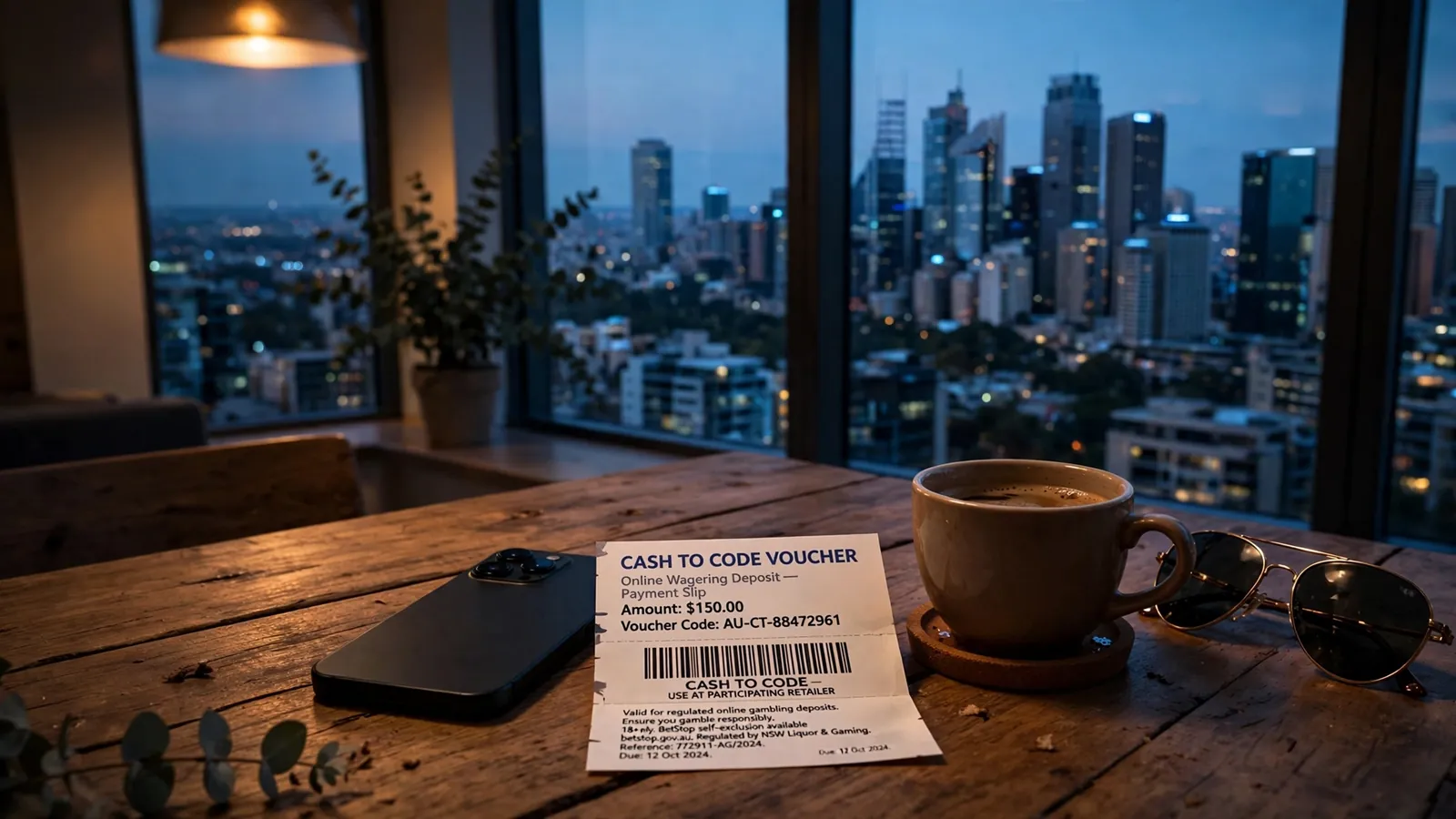
A payment method can answer a narrow practical question: whether a transaction might be accepted. It cannot answer the prior one: whether an operator may lawfully offer online casino games to people in Australia. Those questions are often folded together in searches for pokies and CashtoCode, but they belong to different parts of the picture. A cashier option, even if present, would not change the legal status of the service around it.
The governing framework is the *Interactive Gambling Act 2001*. It prohibits operators from providing online casino games to people in Australia. The prohibition covers casino-style play such as pokies, poker and table games when offered for real money. The law therefore addresses the service being supplied, not the label attached to its payment process. Describing a site as Australian-facing, mobile-friendly or compatible with a particular payment product does not turn that service into a lawful local casino.
That distinction matters because online transactions can look ordinary. A deposit screen may resemble the checkout pages used for shopping; a game may be available through a phone browser; an account may be described in the language of customer service. Familiar interfaces do not settle the question of whether the underlying activity is permitted. A payment rail carries money. It does not issue permission to operate.
CashtoCode availability can depend on a casino’s cashier and your location, so check the payment options before signing up. The details below provide a concise reference to the information available for each operator.
Roby Casino
Roby Casino is listed with a Curacao eGaming license held by Roby Games Ltd. The supplied details do not confirm whether CashtoCode is available.
DragonSlots Casino
DragonSlots Casino is listed with a Curacao Gaming Authority license held by Jumpman Gaming Ltd. The supplied details do not confirm whether CashtoCode is available.
Thor Casino
Thor Casino is listed with a Curacao – Antillephone N.V. license through Versus Odds B.V., and has a minimum deposit of EUR 20. The supplied details do not confirm whether CashtoCode is available.
7Bit Casino
7Bit Casino is listed as operated by Dama N.V. in Curacao. The supplied details do not confirm whether CashtoCode is available.
Golden Pokies
Golden Pokies is listed with a Curacao license. The supplied details do not confirm whether CashtoCode is available.
Rollero Casino
Rollero Casino is listed with a Curacao Gaming Control Board license, OGL/2023/176/0095, held by Hollycorn N.V. The supplied details do not confirm whether CashtoCode is available.
MrPacho
MrPacho lists crypto payouts in 30–120 minutes and fiat payouts in 24–72 hours, with a minimum deposit of A$30. The supplied details do not confirm whether CashtoCode is available.
Kingmaker
Kingmaker lists crypto payouts at approximately 90 minutes and fiat payouts in 1–5 days, with a minimum deposit of A$30. The supplied details do not confirm whether CashtoCode is available.
JustCasino
JustCasino is listed with a Curacao Gaming Control Board license. The supplied details do not confirm whether CashtoCode is available.
WinSpirit Casino
WinSpirit Casino is listed with a Curacao eGaming license, OGL/2024/923/0383, held by Antillephone N.V., and has a minimum deposit of A$30. The supplied details do not confirm whether CashtoCode is available.
Enforcement sits with the Australian Communications and Media Authority, or ACMA. The regulator is responsible for enforcing the Act, and offshore casino services are subject to blocking and enforcement measures. Their presence in search results or their apparent availability from a device should not be mistaken for a sign that Australian law recognises them as local services. The internet gives a service a visible address. It does not supply a local licence by implication.
There is also an important difference between the operator’s position and the player’s. The Act prohibits operators from offering these games to people in Australia, but it does not explicitly make an individual player’s use of an offshore site a criminal offence. That distinction is not an endorsement, a consumer guarantee or a declaration that the activity is protected. It describes where the law places the prohibition. The absence of an explicit player offence is not the same thing as the presence of a lawful, regulated market.
Nor does the law’s focus on operators create the ordinary protections associated with a domestic consumer transaction. Australian consumer law does not protect players who use offshore casinos. If a dispute arises over access to an account, a balance or the handling of a transaction, the fact that a company can be reached online does not make it answerable as an Australian casino operator. A polished interface is not a substitute for local recourse.
 Casinos That Accept Ethereum in AustraliaThe article separates Ethereum as a payment method from game availability and explains why claims of instant transfers or low fees are…
 Casinos That Accept Neteller in AustraliaSee what a Neteller listing can—and cannot—confirm about Australian access, deposits and withdrawals, without relying on unsupported casino rankings.
This is where payment-led searches can give a misleading impression. Asking whether an Australian online casino accepts CashtoCode assumes that the central question is a cashier feature. Yet the phrase “Australian casino” can mean different things: a casino operating lawfully under Australian rules, a foreign business that accepts Australian customers, or simply a site that appears in an Australian search. Those descriptions are not interchangeable. In this legal setting, a payment method cannot bridge the difference between them.
The same applies to references to “pokies” in a casino’s catalogue. A game’s name or format does not create a separate legal category that escapes the Act. Casino-style games provided for real-money play to people in Australia remain within the prohibition, whether they are called pokies, slots or something more discreet in a menu. Changing the interface changes the wording, not the nature of the service.
This does not mean that every phrase involving CashtoCode establishes a particular operator’s position. It means the payment question must not be allowed to stand in for a legality question. A method’s appearance in a cashier, if it appears at all, would say something about payment acceptance; it would say nothing on its own about permission under Australian law, consumer protection or the practical consequences of using an offshore service.
Legal Status
Under the Interactive Gambling Act 2001, it is illegal for operators to provide real-money online casino games to people in Australia.
The distinction is less exciting than a list of convenient options. It is also the necessary one. In Australia, the legal framework puts the responsibility for offering online casino games on operators, while the player’s lack of an explicit criminal offence does not confer consumer protection or make offshore play a lawful domestic product. Payment compatibility cannot rewrite that arrangement.
A deposit question sounds small: whether a payment method appears in a cashier and can be used to add funds. But that apparent simplicity hides several separate claims. A service might be mentioned on a payment page without being available to Australian customers; a deposit route might exist without applying to every account; and a method’s name alone says nothing about the amount accepted or how quickly a transaction is processed.
For CashtoCode, those distinctions matter. It is the boundary of what can responsibly be said.
That boundary also applies to searches for a small, specific amount.
The cashier is where a payment choice, when genuinely offered, would ordinarily be presented. Yet a method’s name on a general information page would not by itself settle whether it is available to a particular customer, whether the account is eligible, or what conditions attach to the transaction. Those are operator-specific matters.
There is a further reason to treat “deposit accepted” as a narrow claim. A deposit is not simply a transfer of money; it takes place within an account relationship. Online casinos commonly ask customers to complete identity checks before allowing financial activity. Such checks are generally described as Know Your Customer, or KYC, assessments. The existence of that account condition does not confirm that any particular payment method is supported, and it does not make a payment route lawful.
 PayID and Australian Casinos: What Payment Menus ProveLearn why PayID availability cannot be confirmed from the evidence, and how Australia’s Interactive Gambling Act separates payment routes from casino legality.
 Amex casino sites in Australia: acceptance explainedSome online casinos accept Amex and others do not; cashier availability is not a guarantee that a deposit will complete, and arrangements…
The legal setting in Australia is decisive, not decorative. The Interactive Gambling Act 2001 makes it illegal for operators to provide real-money online casino games to people located in Australia. A payment method’s availability cannot change that rule. Nor does a cashier label amount to permission to use a prohibited service. The law places the prohibition on operators; it does not make an Australian player criminally liable merely for using an offshore casino. Still, that distinction should not be mistaken for consumer protection.
Australian consumer law does not protect people using offshore casinos. That leaves a practical asymmetry: a payment interface may look orderly, while the player’s position in a dispute remains exposed. A displayed deposit option, if encountered, cannot be treated as evidence that Australian protections apply or that the service is permitted to offer casino gambling here. A tidy cashier is not a legal framework.
The question “which casino accepts CashtoCode deposits?” therefore cannot be answered by turning an unverified payment claim into a recommendation.
It is useful to separate three kinds of information that are often blurred together: a payment brand’s general existence, an operator’s claim that it accepts that brand, and the actual terms of a particular transaction. Only the last would settle details such as the permitted deposit amount or processing behaviour; the first two do not supply them automatically.
KYC Requirements
Online casinos commonly require Know Your Customer (KYC) identity checks before allowing financial activity, regardless of the payment method used.
The broader habit of looking for a payment route before considering the service itself also reverses the order of importance. A payment method answers, at most, how funds might move. It does not establish that an operator may offer online casino games in Australia, that a customer has recourse under Australian law, or that a transaction will be accepted. Those are different questions, and a brand name in a cashier cannot answer them all.
In this market, the payment detail is not the first uncertainty. The legality of the service comes before the cashier.
A list of casino sites is not merely a set of names. In this case, it would suggest that each named operator both accepts CashtoCode and is an appropriate place for an Australian resident to play. Those are separate claims, and neither follows from a payment label or a polished ranking.
The legal position makes the distinction consequential. Under the Interactive Gambling Act 2001, operators may not provide real-money online casino games, including pokies, poker and table games, to people in Australia. The Australian Communications and Media Authority enforces the Act. A site’s willingness to display a payment option would not change that rule or make the service lawful for Australian customers.
Nor does the absence of player liability turn offshore gambling into a protected activity. Australian consumer law does not protect people who use offshore casinos. The rules place the prohibition on operators, but a person using an offshore service may still find that the ordinary safeguards of Australian consumer law do not apply. A neat list can conceal that imbalance. Names look practical; the legal and consumer position behind them is less tidy.
 Litecoin casinos in Australia: access and legal limitsUnderstand how Australia’s online casino rules apply to Litecoin, why the coin changes no legal boundary, and ACMA’s enforcement role.
 Casino Sites and Osko in Australia: What Is VerifiedLearn why references to bank transfers do not verify Osko availability, and what cashier details would be needed to support a casino…
A recommendation also implies that the facts have been checked against the particular site, not inferred from a general description of a payment method. A casino might describe one payment route while its cashier presents another, or distinguish between depositing and receiving money. A site’s name alone settles none of those questions. This is not a reason to treat every online claim as false; it is a reason not to turn an unsubstantiated label into advice.
The word “best” adds another layer. It can mean a method is accepted, that transactions work smoothly, that fees are favourable, or that the operator offers a suitable service. Those meanings are not interchangeable. A site could satisfy one and fail another; a claim about payment acceptance cannot establish the broader promise hidden in a ranking. “Best” is doing a lot of unpaid work.
The same caution applies to descriptions of a CashtoCode casino website or pokies site. A payment method is not a licence, a consumer guarantee or a seal of approval. Searchable names and promotional descriptions may make the category appear settled, but their existence does not establish that an operator can lawfully offer online casino games to Australians. The commercial language of a payment page cannot overrule an Australian law.
This is why a responsible account cannot present a shortlist as though it were a neutral directory. Naming operators in a recommendation would risk advertising real-money online casino services to an Australian audience, which is prohibited. Recasting the names as “options to investigate” would not cure the problem: it would still direct attention towards offshore casino services, while leaving the central legal distinction blurred.
Consumer Protection
Australian consumer law does not protect players who use offshore casinos, leaving them exposed in the event of a dispute.
The issue is not whether a particular site has a recognisable brand, a cashier or a CashtoCode logo. It is that those details do not establish a lawful Australian service, and a list cannot supply the protection that Australian consumer law does not extend to offshore casinos. In this market, a payment claim and a recommendation carry more weight than their compact wording suggests. A shortlist would make that weight look lighter than it is.
“Instant” sounds like a clock reading. In payment language, it is more often a promise about one part of a process, while the money’s full journey can involve several separate decisions. A request may be submitted, reviewed, approved and then passed through a payment network before it appears in an account. Treating those events as one moment makes a neat headline, not a reliable measure.
That distinction matters when CashtoCode is placed beside claims about instant casino withdrawals. A payment method’s name does not establish how a particular operator handles a payout, whether the method is available for withdrawals, or how long any stage takes. Nor does an “instant” label settle whether a transaction has cleared in the sense that funds can actually be used. The label needs a defined start point and finish point; without them, it is elastic.
There is a particular looseness in the phrase “instant withdrawal.” It can refer to an operator approving a request quickly, even if a separate institution still has work to do. It can also refer to the money appearing promptly after approval. Those are different claims. A time statement that does not say which event it measures leaves the most important part to interpretation.
 Casinos That Accept Mastercard in AustraliaUnderstand how Australian law applies to online casino services, what Mastercard acceptance can establish, and why withdrawal rules vary by payment method.
 Casinos That Accept Neosurf in Australia: What’s KnownThe article separates payment claims from proof: no Australian operator is confirmed to accept Neosurf, and withdrawals and bonus terms remain unverified.
A sensible reading of any speed claim therefore asks what the clock measures: the time from submitting a request to the operator’s decision, or from that decision to funds becoming available? It also matters whether the statement applies to every transaction or only to a specified route and set of conditions. “Instant” without this context is not a timetable. It is a mood.
The word carries a little social history, too. Digital payments have trained people to expect money to behave like a message: sent, received, done. Yet money still passes through systems built for identification, risk checks and settlement, each with its own rules. The interface may reduce the wait to a clean animation. The underlying process remains less theatrical.
For Australian casino searches, speed cannot be separated from the legal setting. The Interactive Gambling Act 2001 makes it illegal for operators to provide real-money online casino games to people in Australia, and the Australian Communications and Media Authority enforces that law. A claimed withdrawal feature does not make such a service lawful. Australian consumer law also does not protect people who use offshore casinos. Fast is not the same as safe or legally sanctioned.
This is not a claim that every offshore transaction fails, nor a prediction about a particular payment. It is a boundary around what speed language can prove. A payment may be described as quick without establishing the route, the conditions, the availability of a payout option or the point at which funds are usable. Those details are not interchangeable.
An "instant" label can refer to either the operator approving a request quickly or the money appearing promptly after approval; it does not necessarily mean the funds are immediately usable.
The phrase “instant CashtoCode withdrawal” consequently joins two ideas that need separate evidence: acceptance of a payment method and the timing of a payout. Neither follows automatically from the other. A deposit option, where one exists, would not by itself demonstrate that winnings can be returned by the same means. And a general statement about rapid processing would not identify CashtoCode as the route.
The appeal is obvious. Waiting feels like a technical defect in a world that has made nearly everything else appear immediate. But speed claims are useful only when they describe a measurable event, and legal status cannot be compressed into a stopwatch. The word may be instant. The questions are not.
A request for casinos accepting CashtoCode in Australia in 2026 combines two questions that cannot be answered by the payment name alone: whether an operator currently accepts that method, and whether it may lawfully offer casino games to people in Australia. A page, cashier icon or search result mentioning CashtoCode would not settle either question. Nor does a year attached to a phrase turn it into confirmation of present-day terms.
 Bitcoin Cash Casinos in Australia: Legal and Payment GuideLearn how Australian rules treat offshore crypto casinos, what BCH transfers involve, and why the Interactive Gambling Act 2001 focuses on operators.
 Casinos That Accept Tether (USDT) in AustraliaLearn how to check whether an online casino accepts Tether, what the TRC20 question means, and how offshore play differs in consumer…
The legal distinction is unusually important here. Under the Interactive Gambling Act 2001, operators may not provide real-money online casino games to people physically in Australia. That prohibition covers casino-style services; a payment option does not create an exception. The Act does not explicitly make a player’s use of an offshore site a criminal offence, but that is not an endorsement or a guarantee of safety.
There is a difference between a person not being criminalised for a particular act and the surrounding service being lawful, reliable or protected. Australian consumer law does not protect players who use offshore casinos. The regulatory arrangement places the prohibition on operators, while leaving people who encounter offshore offers with no equivalent local consumer protection. A payment method cannot bridge that gap.
The date in the phrase also carries little weight. Payment arrangements can change, and a description written for another market or an earlier period does not establish what is available to Australians now. Even a claim that a site “takes” CashtoCode would need to be distinguished from evidence that the payment option works for Australian customers. Those are not interchangeable statements.
That distinction matters because payment language can make an offer appear ordinary. Cards, bank-linked services and prepaid methods belong to familiar consumer life; a casino cashier borrows that familiarity. But the familiarity of the transaction does not alter the legal status of the service behind it. A polished checkout is still a checkout.
The phrase “best casino” adds another unsupported leap. A ranking might suggest that a lawful Australian choice exists, when the governing rule is that real-money online casinos cannot be offered to people in Australia. Presenting an operator as a recommendation would blur the boundary between describing a search and promoting a prohibited service. No shortlist can fix that contradiction.
The more careful reading is therefore narrow: the wording expresses interest in CashtoCode and casino payments, but proves neither current acceptance nor legal availability. The year is a timestamp in the request, not a certification. And offshore access, where encountered, should not be mistaken for local approval or consumer protection. The distinction is not technical. It is the point.
A payment method and the service receiving it belong to different parts of the same transaction, but they do not answer the same question. CashtoCode appearing in a cashier, if it does, would describe a payment option. It would not establish that the underlying online casino service may lawfully be offered to people in Australia.
The distinction matters because the Interactive Gambling Act 2001 places the prohibition on operators: offering real-money online casino games to people physically in Australia is illegal. The law does not explicitly criminalise players for using offshore sites. That difference in responsibility is not an endorsement of those services, nor does it make them lawful. The Australian Communications and Media Authority enforces the Act, and offshore casino services are subject to blocking and enforcement.
Payment wording can blur these lines. A page may pair CashtoCode with casino games, or describe a cashier as supporting a particular payment method, but neither phrase establishes that the service is available to Australians, that the payment will work, or that the offer complies with Australian law. A method’s general existence says nothing about the legal status of the activity it might be used to fund.
That is why searches joining CashtoCode and casino games cannot be answered simply by matching a payment name to a game category. They combine two separate questions: whether a payment route is accepted by a particular operator, and whether that operator may provide the gambling service in Australia. The first cannot settle the second.
The regulatory approach is revealing. Australian law draws a line around the provider’s conduct rather than making the player’s use of an offshore service an explicit criminal offence. Yet the absence of a stated player offence does not remove practical risks. Australian consumer law does not protect people who use offshore casinos, and enforcement measures can make those services inaccessible. Legal exposure and consumer protection are not the same thing.
Nor does a payment label change the character of the service. Calling a transaction a CashtoCode payment, a voucher transaction or a cashier deposit cannot turn prohibited online casino gambling into something else. The label belongs to the movement of money; the law looks at what service is being supplied.
No shortcut, then. Game and payment are separate matters, and neither should be treated as proof of the other. A CashtoCode reference cannot establish that a casino game is legally offered in Australia, while a game listing cannot establish that CashtoCode is accepted. The decisive issue remains the Australian prohibition on operators providing real-money online casino games to people in the country.
A payment method shown for adding funds does not, by itself, establish that the same method can receive a withdrawal. Deposits and payouts are separate transactions, and a cashier’s stated rules matter more than the method’s name appearing somewhere on a casino page.
Identity checks add another layer. Online casinos commonly ask customers to complete a Know Your Customer assessment before carrying out financial transactions. That means a payout is not simply the reverse of a deposit: an operator may require identity information to be reviewed before money can move. The existence of a payment option does not tell anyone what documents are required, how a review is handled, or whether the method is permitted for withdrawals. Those details cannot be inferred from a deposit screen.
Other routes have their own trade-offs. A specialist gambling review has reported that bank transfers can take longer and carry higher fees, but that is a source-specific observation, not a rule for every operator or transaction. It also says nothing about CashtoCode. A comparison between payment methods only becomes useful when it concerns the actual route, the operator’s terms and the conditions attached to the account.
There is a larger boundary around these practical details. Under the Interactive Gambling Act 2001, providing real-money online casino games to people in Australia is illegal for operators. The Australian Communications and Media Authority enforces the Act. Australian consumer law does not protect people who use offshore casinos, so a dispute over a payment or withdrawal may leave them without the protections they might expect from a lawful domestic service.
That is the distinction worth keeping in view: verification concerns who is requesting a transaction; a withdrawal route concerns how funds would be returned. Neither can make an unlawful service lawful, and neither turns a CashtoCode deposit label into proof of a CashtoCode payout option. The route remains a separate matter.
In ordinary Australian commerce, payment has become less a choice between cash and card than a small choreography of taps and screens. Contactless credit and debit cards are accepted almost everywhere, as are mobile wallets such as Google Pay and Apple Pay. Consumers are also comfortable moving between cards, phone wallets and services connected to bank accounts, including PayPal. That familiarity describes daily transactions, not the rules of online gambling.
The distinction matters because a payment method’s visibility in shops, apps or bank-linked services does not establish that an online casino accepts it. Familiarity is not compatibility. A service may be well known to Australians and still have no place in a particular cashier; the name CashtoCode, likewise, cannot be inferred from the country’s broader habits of switching between payment tools.
There is another boundary here. Australia’s Interactive Gambling Act 2001 makes it unlawful for operators to provide real-money online casino games to people in Australia. The Australian Communications and Media Authority enforces that law. A payment route does not change the legal character of the service it might be used to fund, nor does a site’s apparent accessibility amount to approval. Australian consumer law does not protect people using offshore casinos.
That leaves a rather ordinary-looking payment landscape beside an unusually firm legal line. Cards and mobile wallets may be ubiquitous in everyday life; bank-linked services may feel familiar; none of that turns an offshore casino into a lawful local merchant. Nor does it establish that a particular Australian casino accepts CashtoCode. The method-specific question has to be kept separate from the country’s general payment culture.
The habit is flexibility. The evidence of acceptance is another matter.
CashtoCode can appear in the same sentence as a casino, a cashier or a payment method, but those words do not establish that a particular operator accepts it. Nor do they explain what a transaction would involve. Acceptance, where it exists, is an operator-specific condition—not something that can be inferred from the name of a payment service.
That distinction matters in Australia. The Interactive Gambling Act 2001 makes it illegal for operators to provide real-money online casino games to people physically in the country. A payment option cannot change the legal character of the service it would fund. The Australian Communications and Media Authority enforces the Act; an offshore brand’s payment arrangements do not turn prohibited provision into lawful local casino gambling.
A further complication is the separation between a payment label and the actual route of funds. A cashier might name a method, but that alone would not establish whether it is available to Australian customers, what account or voucher is involved, or whether the same route applies across the operator’s services. Those are separate terms, not details contained in the word “CashtoCode”.
The broader payment landscape offers little basis for filling in those blanks. Australians commonly move among cards, mobile wallets and bank-linked services, but familiar habits say nothing about a specific casino’s acceptance of CashtoCode. A method’s presence in a payment conversation is not proof of its availability at a cashier.
There is also a distinction between access and protection. Australian consumer law does not protect players who use offshore casinos. That remains true regardless of the payment brand or the form a transaction might take. A payment choice cannot supply the safeguards that the legal setting does not provide.
So “paying with CashtoCode” describes an intended connection between a service and a casino account, not a confirmed arrangement. The name alone settles neither acceptance nor legality. A label is not a licence.
A bonus linked to CashtoCode may sound like a small condition attached to a payment method. It is, instead, a claim about a gambling promotion: that an operator offers an incentive, that the offer applies to a particular payment route, and that it is available to people in Australia. None of those details follows from the wording of a bonus page or its appearance in a search result.
The legal setting matters more than the sales language. Under the Interactive Gambling Act 2001, operators may not provide real-money online casino games to people physically in Australia. The Australian Communications and Media Authority enforces the Act. Advertising real-money interactive gambling services, including online casinos, to Australian audiences is also prohibited; inducements and promotions are subject to further restrictions, particularly between 5:00 AM and 8:30 PM. A payment-linked bonus does not sit outside those rules simply because it is framed as a reward for using a particular method.
That distinction is easily blurred by promotional copy. A headline can present an offer as current, while its terms, audience or payment conditions remain unclear. A claimed CashtoCode casino bonus is not proof that a lawful offer exists for Australians, nor does it establish that CashtoCode is accepted by an operator. The language of a promotion is not a licence.
There is a human cost to that blur: offshore offers can look familiar while leaving players outside the protections of Australian consumer law. Australian consumer law does not protect people who use offshore casinos. The bargain may be advertised; the safeguards are another matter.
Limits are set by each casino and can vary. Jackpot City Casino, Spin Palace and Ruby Fortune are among the Australian gambling sites listed as accepting Amex; check each casino’s cashier for its current limits.
Jackpot City Casino, Spin Palace, Ruby Fortune, Ignition Casino, Joe Fortune and PlayAmo are listed as supporting Amex deposits for Australian players. Availability may depend on the casino and account.
Yes. Each casino sets its own Amex deposit and withdrawal limits, so check the limits shown in that casino’s cashier.
Amex or your Australian bank may block gambling transactions to a particular website. Acceptance also varies between casinos, and some do not take American Express.
Yes, at casinos that accept American Express, but gift cards can be used for deposits only.
Casinos typically require customers to complete a Know Your Customer assessment before making financial transactions.
Amex deposits are typically free, but a casino may add a 1.5% surcharge, and a 3% currency conversion fee may apply. Withdrawal fees can also apply, depending on the casino.
Some casinos allow Amex withdrawals, but not all do, and you generally need to have deposited with Amex first. Withdrawals may take up to five days to clear and may incur a fee.