The distinction turns on how gambling is supplied: venue machines and free-play formats differ from prohibited online casino services.

A name can travel farther than the thing it names. Lightning Link may be associated with casino-style play, but the important legal question in Australia is not what a game is called. It is whether a prohibited interactive gambling service is being provided online to people in the country. The federal framework draws its boundary around the service and its delivery, not around a search term or a familiar game title.
The Interactive Gambling Act 2001 prohibits operators from providing certain online gambling services to Australian residents. The covered services include online poker and casino-style games. That category includes digital versions of games such as slots, blackjack and roulette when supplied as interactive gambling. A service does not fall outside the rule merely because its presentation resembles a game found elsewhere or because the operator is based beyond Australia’s borders.
This is a rule directed at provision. The Act is chiefly concerned with the businesses making prohibited services available, rather than treating the person who encounters a website as the central enforcement target. That distinction matters in public discussion, where the language of “legal” and “illegal” can flatten different roles into one. The operator’s conduct and the player’s position are not the same thing.
If you’re looking for Lightning Link online pokies in Australia in 2026, checking each operator’s listed details can help you decide what to investigate further. Use this shortlist as a starting point and verify the terms that matter to you before playing.
Roby Casino
Roby Casino is listed with a Curacao eGaming licence held by Roby Games Ltd.
DragonSlots Casino
DragonSlots Casino is listed with a Curacao Gaming Authority licence held by Jumpman Gaming Ltd.
Thor Casino
Thor Casino is listed under a Curacao licence from Antillephone N.V. for Versus Odds B.V. Its minimum deposit is EUR 20.
7Bit Casino
7Bit Casino is listed as operated by Dama N.V. in Curacao.
Golden Pokies
Golden Pokies is listed with a Curacao licence.
Rollero Casino
Rollero Casino is listed with Curacao Gaming Control Board licence OGL/2023/176/0095, held by Hollycorn N.V.
MrPacho
MrPacho lists crypto payouts at 30–120 minutes and fiat payouts at 24–72 hours. Its minimum deposit is A$30.
Kingmaker
Kingmaker lists crypto payouts at approximately 90 minutes and fiat payouts at 1–5 days. Its minimum deposit is A$30.
JustCasino
JustCasino is listed with a Curacao Gaming Control Board licence.
WinSpirit Casino
WinSpirit Casino is listed with Curacao eGaming licence OGL/2024/923/0383, held by Antillephone N.V. Its minimum deposit is A$30.
Nor does the existence of a familiar title settle the legal question. A game name is not a licence, a regulatory category or a guarantee that every format is lawful. In the phrase “Lightning Link online casino”, the decisive part is not the product name but the online casino service being offered to people in Australia. Federal law addresses that provision. It does not turn on whether the screen looks polished, whether the site uses Australian currency, or whether its marketing borrows the atmosphere of a physical venue.
The distinction also explains why venue-based play and online casino-style services should not be casually treated as interchangeable. The Interactive Gambling Act described here concerns the provision of prohibited services over the internet. A physical venue belongs to a different setting; its operation is not made equivalent to an online service simply because both involve gambling. The boundary is about how a service reaches its customers. A screen is not a venue.
The Australian Communications and Media Authority, generally known as ACMA, is the federal body responsible for enforcing the Act and monitoring compliance with interactive gambling laws. Its role gives the statutory boundary practical force. A prohibition without any mechanism for monitoring or enforcement would be a declaration on paper; ACMA’s work makes it part of the country’s active regulatory landscape.
Where a website provides prohibited interactive gambling services, or advertises them in Australia, ACMA can ask internet service providers to block access. The request is a measure aimed at access to the website, not a statement that every person who has seen or visited it has committed an offence. Blocking also does not erase the wider market: it is one enforcement tool used against services regarded as unlawful under the federal framework.
The scale of that work is substantial, though public totals are not presented consistently. ACMA reports having blocked more than 1,455 illegal gambling and affiliate websites following enforcement actions since November 2019. Figures for illegal services that have left the Australian market since enforcement began in 2017 differ: one account puts the number above 210, while another reports more than 190. Those totals should be read as competing reports, not as a single settled count. The difference is small beside the larger point, but exactness matters when a number is used to describe government action.
Blocking and withdrawal figures also reveal something about the shape of the Australian approach. The law does not rely only on an individual deciding whether a site seems trustworthy. It places responsibility on operators and gives a federal regulator tools to respond when prohibited services are offered or promoted. In a market where a website can be presented as though geography were optional, the government’s response is to make geography matter.
That is not the same as saying every site disappears the moment action is taken. Access controls can be applied to particular websites, while names and addresses online can change. The relevant point is narrower: ACMA can pursue enforcement and request blocks, and its published actions show that this is not a theoretical power. The law’s boundary is accompanied by an administrative one.
Legal Warning
The Interactive Gambling Act 2001 prohibits the provision of online casino-style gambling services to Australian residents.
For readers encountering searches for a Lightning Link casino game or an online casino with Lightning Link, the legal frame is therefore more useful than the wording of the offer. The question is whether an operator is providing an online casino-style gambling service to people in Australia. If so, the Interactive Gambling Act applies to that provision. Familiar branding cannot make the service a different kind of thing.
This page is affiliate-linked and may contain sponsored recommendations. Real-money gambling content is for people aged 18 or older. Those disclosures do not alter the legal position: they describe the page, not an exception to Australian law. Dry distinction, but an important one.
“Free play” can describe a different legal category from gambling, not merely a cheaper way to play. Under the Interactive Gambling Act, social platforms that offer pokies-style games using virtual currency are not considered gambling when that currency cannot be turned into real-money winnings. The dividing line is the absence of a real-money prize.
That distinction matters for searches about playing Lightning Link online for free. The phrase can point to a social-casino-style experience, but it does not establish that a particular platform offers the game, nor does it make a real-money service free. The legal status follows the nature of the play and its rewards, not the language used to describe it.
Virtual currency is a stand-in used within a game environment. It is not cash, and a balance of it is not a cash prize. When a social platform uses virtual currency and offers no real-money winnings, its pokies-style play falls outside the IGA’s definition of gambling. The game may borrow familiar imagery and rhythms from gambling, but resemblance alone does not make it gambling in law.
A small but important distinction. The law is not judging whether a game looks like a pokie. It is concerned here with whether players can win real money.
This does not mean that every service using the words “free” or “social” belongs in the same category. A label is not a legal test. A free demonstration, a social game using virtual currency, and a real-money gambling service are not interchangeable simply because each may appear on a screen. The relevant point is whether the platform offers virtual-currency play without real-money winnings. That is the feature that places the social format outside the IGA’s gambling category.
The word “free” can also be imprecise in ordinary speech. It may refer to a game that has no real-money prize, to a trial, or to something else entirely. Only the first description corresponds to the social-casino distinction set out here. A title presented as free play should not be mistaken for evidence about the platform’s full terms or legal status. The format matters more than the label.
There is a cultural wrinkle in the arrangement. Social casino games borrow the visual language of wagering while removing the cash outcome that gives gambling its legal significance in this context. Familiar symbols, reels and bonus-style presentation may remain, but virtual currency cannot become real-money winnings. The experience imitates a form; the legal boundary turns on what can be won.
Social Casino Distinction
Pokies-style games using virtual currency are not considered gambling under the IGA when that currency cannot be converted into real-money winnings.
This explains why the idea of free Lightning Link play online is not, by itself, a claim about real-money gambling. It can describe an imagined or social-style format, but the mere presence of a recognisable game name would not establish that a real-money version is available or lawful. Nor does the social-casino classification confirm that any particular Lightning Link platform exists. It describes a category of play, not a catalogue of products.
That separation is useful because online gambling language often compresses unlike things into the same few words. “Online pokies” might refer to a social game with virtual currency or to gambling for money. In legal terms, those are different arrangements. A social platform offering no real-money winnings is not treated as gambling under the IGA; a real-money service does not become social merely by adding a free-play mode or a friendly label.
The distinction should not be stretched beyond that. It does not settle every question about how a platform operates, and it does not turn every digital game with virtual currency into the same product. It identifies the specific condition relevant here: pokies-style play on a social platform, using virtual currency, with no real-money winnings. Within that boundary, the IGA does not treat the activity as gambling.
That boundary also helps keep “free” from doing too much work. A no-money prize format is not a route to cash gambling, and a social game is not a substitute description for a real-money casino service. The category is narrower and clearer than the marketing language sometimes surrounding it.
This page may contain affiliate links and sponsored recommendations. Such disclosures do not change the distinction between social play and real-money gambling. Real-money gambling content is restricted to people aged 18 and over.
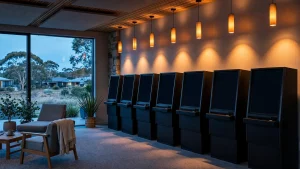
Lightning Link is a game series created by Aristocrat, the Australian developer whose name belongs to the long history of electronic gaming in venues. In Australia, the series is encountered on machines in physical venues, not as a real-money online pokie. The distinction is easy to blur in a country where the same word, “pokies,” covers familiar machines in clubs and pubs as well as the games people try to find on a screen. The setting, however, changes the product.
The word “online” can make a title seem portable: a game associated with a venue becomes, in imagination, an app or a browser window. Lightning Link does not make that journey for Australian players. Its Australian availability is tied to venue machines. Searches for Lightning Link online pokies in Australia may therefore point towards the name and its reputation, but they do not describe a real-money online version available in this market.
That is a distinction about where the series exists, not a judgement about what a player might find appealing in it. Aristocrat designed Lightning Link for land-based venues, and that origin is part of its identity. A machine sits within the social geography of a club, hotel or casino: among other machines, staff, posted rules and the ordinary traffic of people who are there for different reasons. The screen is only one part of the encounter. The room matters.
Australian venue culture gives pokies a particular public presence. They are not hidden in private rooms or known only through specialist language; they have become part of the architecture of certain leisure spaces. That familiarity can make a named series feel as though it ought to be available everywhere, especially when entertainment is expected to follow people from a physical place onto a phone. But familiarity is not the same as online availability. Lightning Link remains a venue-based series in Australia.
The name can also appear in searches for “Lightning Link slots,” “Lightning Link pokie” or “Lightning Link pokies.” These phrases point to the same Aristocrat series, even when they imply different formats. In Australian usage, “pokies” is the natural term for the machines found in venues; it does not, by itself, establish that a particular title has an online counterpart. Naming conventions travel more freely than products do.
That gap between a recognisable title and its actual setting is worth keeping clear. A player may know Lightning Link from a venue and expect to meet the same game on a website. Yet the Australian version of the story stays grounded: the series is played on venue machines, and it is not offered for real money online to Australian players. The title can circulate digitally as a topic of conversation without becoming a digital product available for wagering here.
There is a small irony in the way a game made by an Australian company can be easier to imagine online than to encounter online at home. The brand crosses borders in search terms and conversation; the game itself remains attached to a physical machine and the venues that house it. In that respect, “Australian” describes the developer’s origin, not an online service for Australian players.
The distinction also keeps the series from being confused with any game that merely borrows a familiar visual or mechanical idea. A similar title, symbol or feature elsewhere does not turn that product into Lightning Link. The name refers to Aristocrat’s series, whose Australian presence is on venue machines.
A venue, then—not a browser. That is the useful starting point for understanding Lightning Link in Australia: an Aristocrat series with a physical home, not an online real-money pokie available to the local market.
The Major and Grand jackpots belong to a network of linked Lightning Link machines, not merely to the cabinet in front of a player. As wagers are made across linked machines, the jackpot amounts rise over time. A specialist game review describes this growth as part of the linked-jackpot arrangement. The movement is collective: activity on connected machines contributes to the changing totals, while each cabinet remains a separate place to play.
That distinction matters. A jackpot displayed on one machine can reflect wagering elsewhere in the network, so its figure is not simply a record of what has happened on that particular cabinet. The screen makes a distant activity visible. In a venue, that can give the machine a public, almost theatrical quality: people seated at separate cabinets are connected by a number that keeps changing, though they may never meet.
The Major and Grand labels identify different jackpot levels, but the central point is their shared relationship to linked play. Their growth is tied to wagering across the connected machines, rather than to a single player steadily building a personal balance. It is a system designed to make the network legible through a pair of visible totals. The amounts move; the conditions governing who can qualify are a separate matter.
Attention: Eligibility for a jackpot may depend on wagering at the maximum bet, and a rising total does not guarantee an award.
A specialist game review notes that eligibility for a jackpot may depend on wagering at the maximum bet. That condition can change the practical meaning of a jackpot display. Seeing a rising total does not, by itself, establish that every wager on the machine qualifies for it; the relevant bet condition matters.
This is a feature of the machine’s rules, not a reliable way to predict an outcome. The maximum-bet requirement, where it applies, determines eligibility. It does not make a jackpot more likely to arrive on a particular spin, nor does the amount shown indicate when it will be awarded. A growing total can attract attention precisely because it looks like a promise waiting to be collected. It is not one.
The distinction between eligibility and probability is easy to blur in a room built around illuminated displays. A player may meet the qualifying condition and still not receive a jackpot. The linked total can continue rising as wagering carries on across the network. The rule says who may qualify; it cannot say when an award will happen.
For anyone comparing Lightning Link machines, the jackpot condition belongs alongside the machine’s displayed rules, rather than being inferred from the size of the Major or Grand amount. Venue machines can present the same series within different local settings, and the operative conditions are those attached to the machine being played. A title on the cabinet is not a substitute for its rules.
This also explains why descriptions of a Lightning Link jackpot should be read carefully. “Linked” refers to the relationship between machines and the growth of the totals; it does not mean that every wager automatically qualifies for every jackpot. The network and the eligibility rule answer different questions. One concerns how the amounts rise. The other concerns the bet condition a player must meet.
For a venue machine, then, the jackpot display is best understood as a running feature of linked play, not as a forecast. Major and Grand totals may rise as players wager across connected machines, while a maximum-bet condition may govern eligibility. The figures can be conspicuous. The conditions are quieter, but they matter just as much.
This page may contain affiliate links and sponsored recommendations. Real-money gambling content is intended only for adults aged 18 and over.
Lightning Link is not available for real-money online play to people in Australia. Its presence in the country is on venue machines, not through an online casino service. A website displaying the name, or an app that resembles the game, does not change that distinction: an online version would not become an Australian real-money offering simply because it can be reached on a screen.
That boundary matters because the question is not whether a page loads, or whether an offshore operator claims to accept Australian customers. The relevant point is what the Australian market provides lawfully. Under the Interactive Gambling Act 2001, operators cannot provide real-money online casino-style games to people in Australia. The prohibition covers pokies as well as other casino formats. Lightning Link, when played for money, therefore belongs to the venue setting here.
 Live Baccarat Online Casinos in Australia: What to KnowAustralia has no locally licensed online casinos. Learn how offshore live baccarat works, what the law distinguishes, and what to check at…
 Best RTP Slots in Australia: How to Read the FiguresLearn how RTP compares long-run expectations across slots, why a high figure needs a paytable check, and what the percentage cannot predict…
 Video Slots in Australia: How the Games WorkLearn how video slots display results across screens, why each RNG spin is independent, and what free play and RTP can show.
The difference between physical and online access is not a quirk of the game. It reflects a choice in the country’s rules about where gambling services may be offered. The same product name can appear in different contexts, but the setting changes its status: a machine in a venue is not an online casino service, and a digital imitation does not acquire permission by borrowing the original’s branding.
For anyone searching for real-money Lightning Link online, the practical answer is no Australian online version is offered. That answer should not be softened into a suggestion to look abroad. Offshore access is not the same as a lawful local market, and promoting a foreign site would obscure the very distinction that matters. The Australian market does not provide this game for online cash play.
Nor does the absence of an online version mean that the venue machines are merely a temporary substitute pending an app release. The distinction is structural, not a matter of waiting for a platform update. Lightning Link is played on venue machines in Australia; real-money online access is not part of its Australian availability.
The wording of a site can blur this line. A page may use the game’s name while describing a different product, or present a familiar theme as though it were the original. Naming alone proves little about what is being offered. In this market, the important distinction remains whether play is on a venue machine or through an online service for money.
This is a narrow answer, but a useful one. Searches for online cash play may produce pages that mix descriptions of the venue game with offers for unrelated services. That mixture does not make Lightning Link available online in Australia. The name travels more easily than the game’s lawful format.
Real-money gambling content is for adults aged 18 and over. This page is affiliate-linked and may contain sponsored recommendations elsewhere on the site; that disclosure does not alter the availability described here or endorse an online casino service. The distinction is plain, even when the surrounding pages are not.
An app carrying familiar symbols or a Hold and Spin feature is not necessarily Lightning Link. The series was made for land-based venues; an online game that borrows the mechanic belongs to a different product, even when the play feels recognisable. Specialist reviews describe online platforms offering comparable Hold and Spin games from Aristocrat and other developers. That is a resemblance, not a change of address.
The distinction matters when an app description uses Lightning Link’s name loosely. Happy Lantern is a named variant in the series, but seeing that title mentioned in an app listing does not establish that the venue game is available there. Nor does a similar bonus feature make another game an official Lightning Link release. Labels travel more easily than machines.
For Australian players, searches for a Lightning Link app should not be read as confirmation of real-money mobile access. The series remains associated with venue machines in Australia. Similar mechanics appearing online do not make the land-based game an Australian online product. A familiar animation can suggest continuity; the platform and product are still different.
Requests for Lightning Link tips face the same limit. Tips cannot turn a related game into the original, or establish a reliable method of winning. A Hold and Spin feature is a game mechanic, not a promise about what a particular spin will return. Instructions circulating for one title may not describe another title with a similar feature.
This distinction is especially important when an app is presented as a shortcut to the experience of a venue machine. A name, theme or bonus label alone says little about whether the product is the same game. The more useful question is what the app actually offers, and whether it is describing a similar mechanic rather than Lightning Link itself. Similarity is not identity.
This page is affiliate-linked and may contain sponsored recommendations. Real-money gambling content is for adults aged 18 and over.
Hold and Spin is a feature in which the screen divides into two kinds of positions: those occupied by special symbols and those still available to spin. When the feature begins, the special symbols stay fixed. The other positions spin independently, rather than moving as one unbroken field.
That separation gives the feature its name. “Hold” describes the symbols that remain in place; “Spin” describes the continuing activity around them. A new symbol may appear in a position that was turning, while the held positions preserve their place on the screen. The process makes the arrangement easy to follow: some elements are settled, others are still in motion.
A specialist review describes the feature in those terms: special-symbol positions lock, and the remaining positions spin independently. The distinction matters because the animation can suggest a single, continuous reel movement even when the screen is behaving in separate parts. The locked positions do not join the spin of the others.
There is no need to treat this as a method for controlling an outcome. The mechanic describes what the symbols do once the feature is active, not how to make it appear or what result a spin will produce. Searches for how to win on Lightning Link pokies often mix the feature’s visual rhythm with the idea of a reliable tactic. The two are not the same. A symbol staying put is a rule of the feature, not evidence that the next position will land in a particular way.
The appeal is partly theatrical. Motion continues in some places while other symbols sit still, making each new result legible against what has already been held. It is a small drama of interruption and return, built into the screen rather than supplied by a player’s judgement.
The feature’s logic is simple. Some positions lock; the rest spin on their own.
Lightning Link is encountered in Australian venues on physical machines, not as a real-money online game. That setting shapes the wager: the amount is selected at the machine, and the available minimum can differ between venues and versions of the game. A figure attached to one installation is not a reliable description of every machine bearing the same name.
A specialist review gives a minimum-bet range of $0.20 to $1.00 per spin, while noting that casino and variant affect the amount. That is a reported range, not a fixed national tariff. The machine in one venue may begin at a different level from another; the title alone does not settle the question.
The distinction matters because a minimum is the entry point for a spin, not a measure of what a session will cost. Repeated wagers accumulate, even when each individual amount looks modest. Venue machines make that arithmetic unusually visible: a player chooses a setting, sees the cost of a spin, and decides whether to continue. The surrounding room may be noisy; the arithmetic is not.
A specialist review reports a minimum-bet range of $0.20 to $1.00 per spin for venue machines, though the specific amount varies by casino and variant.
Online searches for a way to play Lightning Link on a phone or computer do not change its Australian status. The series is played on venue machines here, and the quoted range concerns those machines rather than an online version. Similar features elsewhere are separate games, not a digital doorway to the same Australian venue installation.
This is informational content with affiliate links and may include sponsored recommendations. Such links do not alter where Lightning Link is available. Real-money gambling content is for adults aged 18 and over; the venue setting does not make the minimum bet a promise of affordability or a prediction of results.
Small numbers can look harmless. They still add up.
A downloadable file may sound like a simple substitute for a venue machine, but it does not change where Lightning Link is available in Australia. The Aristocrat series is played on venue machines; it is not offered for real-money online play to Australian players. A file labelled as a download should not be mistaken for an authorised online version of the game.
The distinction matters because online platforms may present games with mechanics resembling Hold and Spin. A specialist review describes examples from Aristocrat and other developers, but those are similar games, not proof that Lightning Link itself has become a downloadable Australian pokie. The catalogue can change, and resemblance is not identity.
This leaves two different meanings behind requests for a Lightning Link download. One is a search for the named game as software that can be installed and played online; that is not how the series is made available to Australian players. The other is interest in the general style of play, which may appear in other titles on online platforms. Neither should blur the boundary between a venue machine and an online imitation.
A title’s presence in an app store or on a platform does not, by itself, establish that it is the original Lightning Link or that real-money access is available in Australia. The label can travel farther than the game.
This page contains affiliate links and may include sponsored recommendations. That disclosure does not alter the access limits described here. Real-money gambling content is for people aged 18 or over; this section does not direct Australians to online casino services or provide instructions for reaching them.
Lightning Link is a series rather than a single fixed set of symbols and payouts. Specialist game reviews identify Happy Lantern, Magic Pearl, Sahara Gold and High Stakes among its variants, while noting differences in paytables and bonus features. That is a useful distinction: a familiar title does not guarantee an identical play experience across machines.
The names suggest separate themes, but the meaningful comparison lies in each version’s own rules. Paytables determine how symbol combinations are valued; bonus features shape what can happen when a feature is triggered. Those details belong to the individual variant, not to the series as a whole. A general description of Lightning Link therefore cannot stand in for the rules displayed on a particular machine.
The named versions are not interchangeable labels. Happy Lantern and Magic Pearl, for instance, are separate releases, just as Sahara Gold and High Stakes are. The available review coverage groups them as examples of the series, rather than establishing a definitive catalogue or ranking. No universal “best” variant follows from their names.
That small difference matters. A series title can make a changing collection look like one stable product, while paytables and bonus rules are precisely where versions diverge. The name stays; the details move.
This material is affiliate-linked and may include sponsored recommendations. It is informational, not an invitation to seek online pokies: Lightning Link is not offered for real-money online play to Australian players. Real-money gambling content is restricted to adults aged 18 and over.
Minimum bets typically range from $0.20 to $1.00 per spin, depending on the game variant and casino.
Yes, you can play pokies-style social games using virtual currency, provided that currency cannot be converted into real-money winnings.
The Interactive Gambling Act prohibits operators from providing online casino-style gambling services to Australian residents. The law targets operators rather than players, and there are no known cases of Australian players being prosecuted for gambling on offshore sites.
No. Lightning Link is played on venue machines in Australia and is not offered online for real money to Australian players, though online games with similar Hold and Spin mechanics are available.