A guide to offshore baccarat platforms, live-dealer formats, table rules, payments and the legal distinction in Australia.
The phrase “Australian online casino” can suggest a local industry with domestic licences, consumer rules and a familiar regulator standing behind each table. For online casino games, that picture does not fit the law. The Interactive Gambling Act 2001 bars Australian-licensed operators from offering online casino games, and no locally licensed online casinos officially operate in Australia. Baccarat belongs on the prohibited side of that boundary when it is offered online for real money.
That is a distinction between a service and its customer. The law concerns operators providing prohibited gambling services to people physically in Australia; it does not turn an offshore platform into an Australian-licensed casino because its pages are accessible here, or because its interface displays Australian dollars. A local currency symbol is not a local licence. Neither is an Australian-facing welcome message.
Australians nevertheless play baccarat online through international casino platforms that accept Australian players. This is a fact about use, not evidence that those platforms are authorised under Australian law. Their location, corporate structure or foreign permissions do not create a domestic online-casino licence. In the language of the market, “live baccarat online casino Australia” may describe what someone is looking for, but it should not be mistaken for a category of locally regulated service.
The distinction is easy to blur because the screen makes distance look incidental. A table may appear in a browser or app, while the business operating it sits elsewhere. Yet a streamed game reaching a household in Australia does not become local merely by crossing a screen. The law is directed at operators providing the service to people in the country. The commercial appearance can be international; the prohibition on supplying online casino games to Australians remains the relevant local frame.
This is not the same arrangement as a locally licensed online betting service. Australia permits some forms of online wagering under separate rules, but online casino games are not simply another product within that domestic system. Baccarat, roulette, poker and slots fall within the online casino category at issue here. The familiar word “licensed” therefore needs a place attached to it: a foreign licence, where one exists, is not an Australian casino licence.
That gap says something about the country’s view of gambling as well as its legal structure. Australia has not built a domestic licensing framework for online casinos in the way some jurisdictions have. Instead, the law places the responsibility on operators not to provide these services to people in Australia. A polished table, a dealer’s voice and a well-organised lobby can make the service feel settled and ordinary. They do not alter its legal status.
The resulting market is less tidy than the interface. On one side is the Australian prohibition on supplying real-money online casino games; on the other is the continued presence of international platforms used by Australians. The two statements can both be true without making offshore services locally authorised. That tension is the context for any discussion of online baccarat in Australia, not a recommendation to use a particular platform or a suggestion that access amounts to approval.
For readers, the practical point is not to confuse availability with endorsement or protection under a domestic casino-licensing scheme. Nor should a platform’s own claims be taken as proof of Australian authorisation. The legal position concerns the supply of the game; the fact that people encounter or use a service does not turn it into a locally regulated one.
18+ only. Gambling can cause financial harm, and losses are possible. Fairgoslots-hubau.com is not liable for gambling losses.
Choosing a live baccarat casino in Australia calls for checking the available operator information before deciding where to play. This list offers a concise reference to the details provided for each option.
Roby Casino
Roby Casino is listed with a Curacao eGaming licence held by Roby Games Ltd.
DragonSlots Casino
DragonSlots Casino is listed with a Curacao Gaming Authority licence held by Jumpman Gaming Ltd.
Thor Casino
Thor Casino is listed with a Curacao licence issued through Antillephone N.V. to Versus Odds B.V. Its minimum deposit is EUR 20.
7Bit Casino
7Bit Casino is listed as operating under a Curacao licence, with Dama N.V. as its operator.
Golden Pokies
Golden Pokies is listed with a Curacao licence.
Rollero Casino
Rollero Casino is listed with a Curacao Gaming Control Board licence, OGL/2023/176/0095, held by Hollycorn N.V.
MrPacho
MrPacho lists a minimum deposit of A$30. Its stated payout times are 30–120 minutes for crypto and 24–72 hours for fiat.
Kingmaker
Kingmaker lists a minimum deposit of A$30. Its stated payout times are around 90 minutes for crypto and 1–5 days for fiat.
JustCasino
JustCasino is listed with a Curacao Gaming Control Board licence.
WinSpirit Casino
WinSpirit Casino is listed with a Curacao eGaming licence, OGL/2024/923/0383, issued through Antillephone N.V. Its minimum deposit is A$30.
“Best” sounds like a verdict. In practice, a comparison of baccarat platforms is more useful when it is treated as an examination of conditions: what a balance is worth after conversion, and what rules govern taking money out. Those details can change the meaning of a headline claim without changing the game on screen.
That distinction matters especially in Australia, where a comparison should not be mistaken for an endorsement or an invitation to use an offshore casino. The relevant question here is narrower: what financial terms would shape an evaluation, and why might they matter more than a polished lobby or a long menu of tables?
An account displayed in Australian dollars gives a clearer view of the balance than one held in US dollars or euros. When the wallet is denominated in AUD, it avoids the stated conversion margin of 2.5–4% that can apply to USD or EUR balances. That is not a small footnote in the arithmetic: it is a cost attached to moving between currencies, rather than to the baccarat hand itself.
Accounts denominated in AUD avoid the 2.5–4% conversion margin typically applied to balances held in USD or EUR.
A foreign-currency balance can make a deposit or withdrawal look different at different stages. The amount shown by a platform may not be the amount ultimately reflected in an Australian bank account or card statement, because conversion is part of the transaction. Exchange rates and payment-provider terms can add further variation; the precise result depends on the parties handling the transfer. A comparison that looks only at the displayed balance therefore sees only part of the picture.
AUD denomination does not make an offshore service local or regulated in Australia. It is simply a way of avoiding that particular currency-conversion margin. A familiar currency symbol should not be allowed to imply a familiar legal framework. The symbol is not a licence.
A withdrawal limit describes how much an account may be permitted to take out over a stated period. It is distinct from processing time, verification requirements and the method used to receive the money. A platform might describe one of these clearly while leaving another in separate terms. For a fair comparison, each condition needs to be read in its own category rather than gathered under the reassuringly broad label of “payouts.”
 Pokies & Games: Slots and Casino GamesExplore guides to reel counts, volatility, bonus buys, RTP, jackpots, and games including baccarat, blackjack, roulette, dice, crash, mines and plinko.
 Best RTP Slots in Australia: How to Read the FiguresLearn how RTP compares long-run expectations across slots, why a high figure needs a paytable check, and what the percentage cannot predict…
One specialist review reported weekly withdrawal caps of $5,000–$10,000 at offshore sites. That is a reported range, not a universal rule or a dependable description of every platform. Limits can be specific to an operator or account, and terms may change. The practical point is not that a particular ceiling can be assumed, but that a withdrawal cap can shape access to a balance even when the balance itself is visible.
The period attached to a limit matters as much as the amount. A weekly cap, for instance, is not interchangeable with a per-transaction limit or a daily restriction. Nor does a high stated ceiling establish that a withdrawal will be immediate. These are separate terms, and collapsing them into one score gives the comparison a false neatness.
A careful assessment can make costs and restrictions easier to see. It cannot turn those details into proof that a platform is safe, suitable or lawful for Australians. Nor does a ranking resolve the difference between an advertised condition and the conditions that apply to a particular account. The language of “best” often makes unlike things appear to be measured on one clean scale.
Currency denomination and withdrawal rules are therefore useful comparison points, but not a complete test. Their value lies in exposing friction: the conversion margin that may be applied to a foreign-currency balance, or the cap that may constrain access to funds. Neither tells the whole story about an online casino, and neither should be mistaken for an assurance.
There is no honest shortcut from a tidy table of figures to a trustworthy verdict. Terms have to be read as terms, not as decoration around a rating. That is less satisfying than a crown for a winner. It is also more precise.
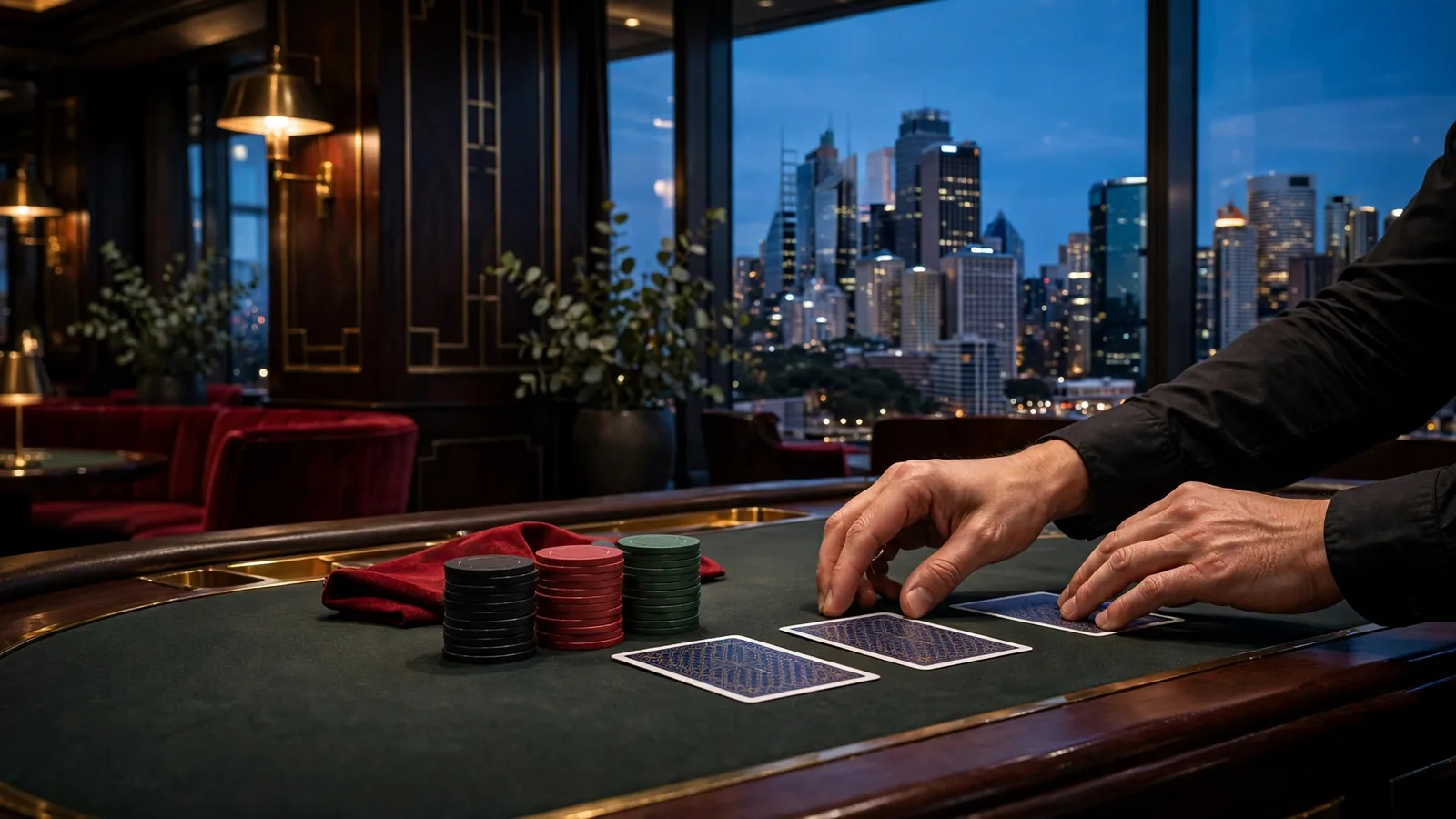
A live dealer baccarat table is a small performance transmitted from a casino studio. The dealer handles physical cards; a camera carries the scene to a virtual table, where players watch the deal and place bets in real time. The distinction is not merely decorative. The cards have a material presence, while the people around them are separated by screens and distance.
That arrangement gives online baccarat a curious double life. It is a card game happening somewhere tangible, and a digital service assembled for people who are not in the room. The dealer’s hands connect those two spaces. Each movement is part of the game and part of the broadcast: the cards are dealt in the studio, but the action is presented for remote viewers seated at a virtual table.
The camera makes the dealer visible, though not quite present. A professional dealer guides the table as the stream unfolds, giving the game a human point of focus that an automated interface cannot supply in the same way. There is a person on screen, attending to the cards and the rhythm of the table. Yet the exchange remains shaped by the frame: viewers see what the broadcast shows, not the whole studio.
 Live Blackjack in Australia: Online Casino RulesThe Interactive Gambling Act 2001 prohibits Australian-licensed operators from offering online casino games; the guide covers live tables, payments and play.
 Plinko Casino Australia: RTP, Payments and RulesUnderstand what RTP can establish, why a provider’s 94%–96% slot range does not verify every Plinko game, and how to assess payments…
That is the social texture of live dealer baccarat. It borrows the familiar scene of a casino table—the dealer, the cards, the gathering of players—and rebuilds it for people watching from elsewhere. The room is shared only through an image. Participation arrives through the table interface, while the dealer’s presence is carried by the stream.
Some tables may also offer chat with the dealer or other players. A specialist review describes this as a feature that can be available, rather than a guaranteed part of every table. When present, chat adds a thin layer of conversation to an activity otherwise conducted through cards, prompts and decisions on screen. It can make the table feel less solitary, without turning the remote players into a crowd physically gathered around the felt.
The exchange is necessarily uneven. The dealer is visible to the players; the players may communicate through a chat window, but they do not occupy the studio. The result is neither a private game against software nor a conventional gathering around a casino table. It is a broadcast with an audience that can act.
For some, that human presence is the point. The appeal lies not only in watching cards appear, but in seeing a dealer manage a live table as events happen. The stream gives the game a tempo and a face. It also preserves the distance that makes online play possible: a studio on one side, a virtual table on the other.
There is no need to mistake the image for intimacy. The dealer is working; the camera is transmitting; the players are connected through a service. Still, the format depends on a recognisable social ritual. Cards are dealt by hand, attention gathers around the table, and a person—not an animated avatar—presides over the scene.
Some tables offer chat functions with the dealer or other players, adding a layer of conversation to the game, though this is a feature that may be available rather than a guarantee for every table.
A live dealer baccarat table is therefore both a game space and a viewing space. Its physical cards anchor the action, while the camera turns a studio into a place that remote players can briefly share. The table is real. The gathering is at a distance.
18+ only. Gambling involves financial risk and can cause harm. Fairgoslots-hubau.com is not liable for gambling losses.
Baccarat can arrive on a screen by two quite different routes. International platforms offer live dealer baccarat, in which a person deals physical cards, and RNG baccarat, in which software determines the outcomes. The familiar name of the game links them; the source of each result does not.
In the live format, the camera shows a table and a dealer handling cards in a studio. The stream makes the game feel like a public event, even when each viewer is alone with a screen. Its pace is tied to a human procedure: cards are handled, results appear, and the next round follows. The technology carries the table into the room, but it does not turn the table into an algorithm. The dealer remains part of what is being watched.
RNG baccarat removes that visible table. Algorithm-based software generates outcomes rather than dealing real cards. There is no dealer’s movement for the camera to follow, and no physical card handling at the centre of the scene. The format may resemble baccarat in its presentation, but its defining feature is how the result is produced.
 Lightning Link Online Pokies in Australia: Legal LimitsLearn how the Interactive Gambling Act 2001 draws the boundary for online casino-style games, and why Lightning Link is discussed as a…
 3-Reel Slots in Australia: Bonuses, Odds and RulesLearn how bonus features differ from reel layouts, why return figures are not predictions, and what the article says about offshore play.…
That difference matters more than the screen design. A digital table can borrow the colours and layout associated with a casino game baccarat, yet appearance alone cannot establish whether cards are physically dealt or outcomes come from software. In live dealer baccarat, the stream shows a real dealer and cards; in RNG baccarat, the software is the mechanism. Two versions of one named game, with different sources of action.
There is a small social history in the contrast. The live table preserves the older spectacle of watching another person make a procedure visible. The digital version belongs to a different habit: the result can be generated without staging the dealer at all. Neither format changes the basic identity of baccarat, but they offer different relationships to it. One puts human performance in view; the other makes the underlying calculation the unseen actor. The screen is not neutral.
A separate variation concerns the Banker bet. In standard baccarat, a winning Banker bet carries a 5% commission. No Commission Baccarat removes that charge, but the change does not necessarily leave every payout untouched: some versions may alter payouts for particular Banker totals instead. The label describes the removal of a commission, not a guarantee that every other term is identical.
A specialist review describes this kind of table variation, but the exact treatment depends on the version being offered. The practical distinction is structural: one format takes commission from winning Banker bets, while a No Commission version may compensate through a changed payout in specified circumstances. The table’s rules, rather than its title alone, determine how that adjustment works.
A streamed game where a professional dealer handles physical cards in a studio.
An algorithm-based game where software determines the outcomes without physical cards.
A version where the standard 5% Banker commission is removed, often altering payouts for specific totals.
This is why “live” and “No Commission” describe different things. The first identifies the way the game is presented and how outcomes are produced; the second identifies a payment variation within a baccarat format. A live table may have its own commission arrangement, while a no-commission label says nothing by itself about whether a dealer or RNG software determines outcomes.
The distinction is easy to blur on a crowded digital lobby, where formats and table labels sit beside one another. Yet a camera, an algorithm and a payout condition are not interchangeable details. They are separate parts of the game’s design—and separate things to understand before any real-money play. 18+ only. Gambling carries financial risk. Fairgoslots-hubau.com is not liable for gambling losses.
Payment options can make an online table look close at hand. PayID, bank transfers, e-wallets and cryptocurrency appear in Australian payment-method roundups; card brands are mentioned there too. Such lists describe what international platforms may display, not an invitation or assurance that a payment route is lawful or available. Australian law prohibits operators from providing real-money online casino games to people in Australia. Familiar banking tools do not alter that distinction.
The same caution applies to a search for a PayID baccarat casino. PayID is a payment rail, not a licence, and its presence in a payment menu says nothing about the legal status of the gambling service. Nor does the appearance of Visa or Mastercard settle whether a transaction is permitted. Online gambling services must not accept credit-card payments. A payment logo is a small piece of interface; the legal framework is rather larger.
 Progressive Jackpot Slots: How Shared Pots WorkLearn how progressive pots build, why casinos are not necessarily the jackpot bank, and how contribution-rate estimates vary from about 1–3% to…
 Five-Reel Slots in Australia: Features and RTPExplore how five-reel slots handle free spins, tumbling wins and RTP, including a reported Sweet Bonanza trigger of four or more scatters…
The mechanics of playing on a phone are less mysterious than the setting in which the game is offered. Live dealer baccarat can be accessed on Android and iOS devices, bringing the streamed table to a mobile screen. A compact display changes the view, not the underlying service: the dealer, cards and betting interface are still presented as part of an online casino game. Convenience is not a separate category of law.
Trial play presents a different limitation. A specialist review describes live dealer games as often being available only for real-money play, which means a player needs a real-money balance rather than a free practice mode. That condition distinguishes a streamed table from some forms of digital trial play, but it does not make the transaction safe or lawful in Australia. It is a threshold, not a recommendation.
There is also a practical difference between watching a table and taking part in it. A stream may be visible on a mobile device, while the betting functions remain tied to an account and funds. A trial option, where offered, may not reproduce that full experience. The screen can make the distance between spectator and participant seem negligible. The money is not.
Questions about how to play baccarat at a casino often begin with the interface: where the options sit, when betting is open, and whether the screen fits a phone. Those details belong to the table itself, not to the payment method. Here, the more consequential distinction is between a mobile device as a viewing tool and a real-money account as a route into play. Neither should be mistaken for evidence that an online casino is locally authorised.
Legal Prohibition
The Interactive Gambling Act 2001 prohibits operators from providing real-money online casino games to people physically located in Australia.
18+ only. Gambling can cause financial harm. Fairgoslots-hubau.com is not liable for gambling losses. In Australia, real-money online casino games are prohibited services when offered to people in the country.
A live baccarat lobby is arranged around time as much as around tables. A listing can show a table as open, full or scheduled, while its pace determines how quickly one hand gives way to the next. This is a description of the format, not an invitation to use offshore gambling services: Australian law does not permit operators to provide real-money online casino games to people in Australia, and no locally licensed online casinos operate here.
The distinction between standard and Speed tables is chiefly a distinction in tempo. A specialist review describes standard tables as dealing around 40–50 hands an hour, while Speed tables exceed 80. Those figures are estimates from that kind of review, not a guarantee of what any particular table will deliver. A quicker stream compresses the pauses between decisions; a slower one leaves more room to watch the table’s rhythm. Neither changes the basic game, but pace can shape how long a session feels.
The lobby’s clock also has a calendar behind it. Live-table schedules can impose time restrictions, so the published timetable matters to availability. A table shown in a catalogue is not necessarily running at every hour, and the distinction between a game being listed and a game being open is a practical one. A specialist review advises checking the relevant schedule; the timetable, rather than the title in the lobby, is the useful detail.
 Pokie Machines in Australia: Games, Odds and RulesLearn how Australian law treats offshore real-money pokies, alongside game features, odds, bonuses and mobile play; the Interactive Gambling Act places the…
 7-Reel Slots in Australia: How to Assess ThemLearn how reel count, paytables, bonus terms and legal context shape slot choices. A specialist review reports 10 free spins for four…
Seats add another limit. Trial play may be available, but a live table has a finite number of places, occupied by people rather than generated on demand. A specialist review notes that this can restrict trial access. The constraint belongs to the format itself: a stream can reach many screens, while participation at the table still depends on space. Not every seat is a vacant seat.
These details explain why a lobby is more than a menu. Its schedule governs when a table appears, its pace shapes the interval between hands, and its seats determine whether trial access is possible. None of that alters the Australian legal position. The Interactive Gambling Act 2001 prohibits operators from supplying real-money online casino games to people physically in Australia; an international platform’s presence on a screen does not make it locally licensed.
18+ only. Gambling carries a financial risk and can cause harm. Fairgoslots-hubau.com is not liable for gambling losses.
Baccarat’s three familiar wagers do not carry the same mathematical cost. The house edge is 1.06% on Banker and 1.24% on Player, while Tie carries a markedly higher edge of 14.36%. These figures describe the game’s long-run advantage to the house, not a forecast of what will happen in a particular hand. Short runs can depart sharply from the arithmetic.
House Edges
The house edge is 1.06% on Banker and 1.24% on Player, while the Tie wager carries a significantly higher edge of 14.36%.
The small gap between Banker and Player is easy to overlook; the distance to Tie is not. A Tie wager may look like a neat shortcut to a larger return, but its higher house edge makes it the costlier proposition over repeated play. The table’s least frequent outcome is not necessarily its most generous one. Mathematics has little regard for drama.
That distinction matters when baccarat appears alongside a casino bonus. A headline offer may give the impression that every game moves its wagering requirement forward at the same rate. It may not. Live baccarat’s contribution can be limited, and the terms attached to a particular offer determine how much eligible play counts. A specialist review reported a contribution range of 5–15%; that is a reported figure, not a universal or permanent rule. Terms can vary, and the percentage alone does not establish whether an offer is worthwhile.
There is a practical tension here: the game’s measured house edges can be relatively low on Banker and Player, yet bonus conditions may give live play only a small role in clearing requirements. A baccarat casino bonus therefore cannot be assessed from its headline value alone. The contribution rate and the applicable conditions matter, while the underlying wager still carries its own house edge. One calculation does not cancel the other.
This is information about risk, not an invitation to gamble. Online casino games are prohibited for operators to provide to people in Australia under the Interactive Gambling Act 2001. Gambling can cause financial loss; Fairgoslots-hubau.com is not liable for losses arising from gambling. 18+ only. If gambling is causing harm, support is available through appropriate local services.
A baccarat scoreboard is a record of what has already happened at the table. Its marks can look like a private shorthand, but the arithmetic beneath them is deliberately spare: cards are reduced to a hand total, and the left-hand digit disappears when that total passes ten. The display is not a forecast. It is a ledger with a graphic habit.
The cards do not all carry the value suggested by their faces. Picture cards count as zero. When the combined total is greater than ten, only the right-hand digit remains: the left-hand digit is dropped. That small adjustment is the hinge between the cards on the felt and the result represented on the screen. A total that looks larger in ordinary arithmetic is not necessarily a stronger baccarat total.
This is why a casino baccarat scoreboard should be read as a summary, not as a second set of rules. It condenses completed hands into visible outcomes, allowing a table’s recent history to sit beside the current deal. The symbols may differ between casinos, and a coloured mark can make a pattern appear more eloquent than it is. Underneath, the same modest operation remains: the cards are counted, the total is reduced, and the hand is recorded.
There is a familiar human impulse to treat a sequence of marks as a message. Repeated colours, alternations and apparent runs invite interpretation; the eye is good at finding shape, even where the record offers no promise about what comes next. A baccarat scoreboard can make the past unusually legible. It cannot make the future obedient.
Attention Baccarat scoreboards record past outcomes and patterns, but they cannot be used to predict future results or explain why a specific hand occurred.
The distinction matters because the display is often more visually assertive than the arithmetic. Rows and trails give outcomes a sense of momentum, while the cards themselves are governed by the simple treatment of values and the dropped digit. Reading the board means knowing what it records, not asking it to explain why a hand occurred or to predict another.
The cards are the evidence; the scoreboard is the filing system. And the filing system has no foresight.
The price of a seat at a baccarat table is not the same as the price of a hand of cards in a physical casino. In online listings, the minimum stake sets the smallest permitted wager for each hand; it does not describe the whole table or make a game suitable for every budget. The distinction matters because a low entry figure can make a table look modest even when the surrounding game is built for much larger wagers.
A specialist review reports live baccarat minimums of $5–$10 per hand, while $1 tables are uncommon. That is a snapshot from a particular kind of source, not a fixed rule across platforms or a promise that a table will remain available at those stakes. Limits can vary by table, and the displayed minimum is only one end of the range. Small figures have their own theatre: they make access appear ordinary, even where the wider setting is anything but.
At the other end, a specialist review reports that some VIP baccarat tables may permit wagers as high as A$20,000 per bet. This is a ceiling associated with some games, not a typical stake and not a measure of what most players wager. VIP labels describe a tier of access and limits; they do not change the basic arithmetic of the game. The gulf between a modest minimum and a high ceiling is part of how online table lobbies divide audiences, from cautious spectators to players prepared to risk sums that would be conspicuous in any room.
The term mini baccarat can add confusion. It refers to a version of the table game, not a guarantee of a miniature stake. A table’s name alone cannot establish its minimum: the relevant figure is the limit shown for that specific game. In Australia, these figures describe offerings discussed by international platforms, not locally licensed online casino services.
18+ only. Gambling can cause financial harm. Fairgoslots-hubau.com is not liable for losses.
A baccarat hand begins with a choice of outcome, not a choice of card. The wager can be placed on the Banker hand, the Player hand or a Tie. These are labels for the two sides of the deal and the possibility that they finish level; they do not give the person betting control over either hand.
Once the bets are closed, cards are dealt to the Banker and Player sides. The aim is to finish nearer to nine. The side whose total is closest to that target wins, while a tie wager succeeds only if the two sides end on the same total. The structure is spare by design: a decision, a deal, then a comparison.
The casino baccarat rules also determine whether a hand receives another card. Under the basic rule relevant here, a further card is dealt when a hand’s total is below five. That instruction belongs to the dealing procedure, not to a player’s discretion; the wager does not let anyone request a card or stand. The hand proceeds according to the table’s rules, and the outcome follows from the final totals.
The Banker and Player names can suggest a contest between people. They describe betting positions instead. Baccarat’s small ceremony rests on that distinction: the table offers a few possible outcomes, while the cards settle which one occurred.
18+ only. Gambling can cause financial harm. Fairgoslots-hubau.com accepts no liability for gambling losses.
Australians can access international platforms that offer live baccarat, but no online casinos are locally licensed to operate in Australia. Australian-licensed operators cannot offer online casino games.
Yes. Live baccarat is streamed from a casino studio, where a real dealer deals physical cards at a virtual table.
Australians regularly play baccarat online through international platforms that accept Australian players.
Sometimes, but trial play at live tables is typically limited because seats are limited. Live dealer games are often offered only for real money.
It is baccarat played at a virtual table with a real dealer dealing physical cards, streamed from a casino studio. Players bet on the Banker, Player or a tie; the hand closest to nine wins.